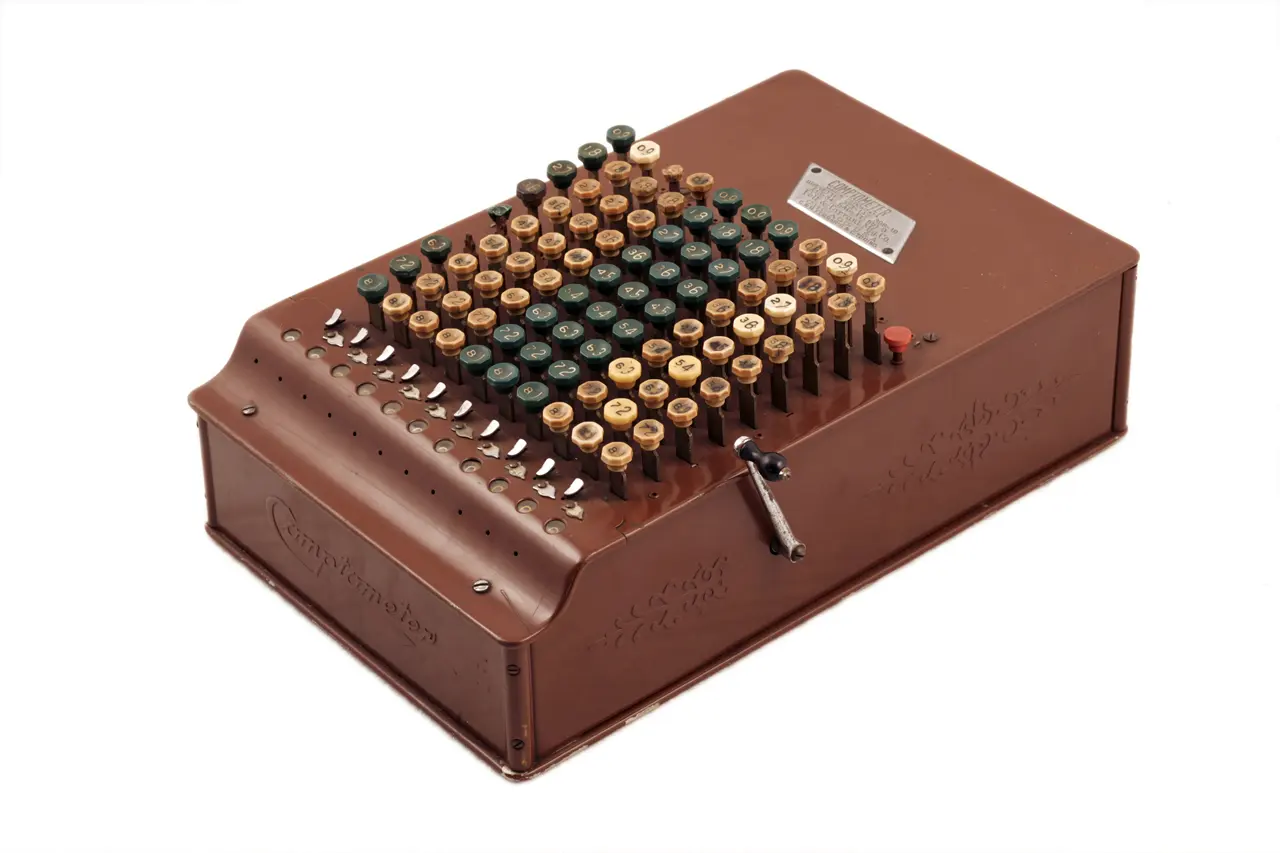
Patented by Dorr E. Felt in 1887, the Comptometer changed the physical act of calculating. Instead of entering a figure and turning a crank, the operator pressed keys, and the value was added immediately to the machine’s accumulator. It became the first commercially successful key-driven mechanical calculator. Its design made finger speed—and the skill of the person using it—central to office arithmetic.
One key for each decimal place
The keyboard was arranged in columns, each representing a decimal place and containing numbered keys. Pressing a key added its value to the accumulator. Because the columns worked independently, a skilled operator could press keys in several columns at once, entering the digits of a number in a single action.
Simultaneous entry made the machine fast, but it did not automate every part of the work. The operator had to understand the procedure and use the keyboard accurately. The Comptometer added directly; subtraction used the nines-complement method, while multiplication was carried out through repeated addition. The machine provided an immediate mechanism, but the method still depended on its user.
This skill was taught systematically. According to the Computer History Museum, Comptometer schools were established in the early twentieth century to teach efficient keyboard operation. The machine was therefore more than a mechanical object: it belonged to a working practice that could be learned and improved.
From patent to accounting work
Felt received the U.S. patent for the Comptometer on October 11, 1887. That same year, he entered into partnership with Robert Tarrant; the company they formed manufactured different versions of the machine. Its commercial importance is best understood through the work it served: frequent calculations and office record-keeping, where a fast operation might be repeated many times.
One example in The Henry Ford’s collection has a specific working history. Made in 1951, it was used in the accounting department of an eyewear company from that year until 1967, when its operator retired. The case shows how a mechanical calculator could remain part of a professional routine decades after Felt’s patent.
The Comptometer was not a home computer, nor could it solve every arithmetic problem on its own. Its historical significance lies in a more specific combination: a keyboard that acted directly on an accumulator, calculation methods the user had to know, and a skill developed through practice. It helped shape everyday number work in the office before electronic calculators and computers took over its role.
- Decade
- Before 1950
- Region
- North America
- Level
- Introduction
- Entities
- Museum
Sources and references 5
- Mechanical Arithmeticdoi.org · 2026-11-15
- Comptometeren.wikipedia.org · 2026-11-15
- October 11: Comptometer Inventor Receives Patentwww.computerhistory.org · 2026-11-15
- Dorr E. Felt patents the comptometer - Eventwww.computinghistory.org.uk · 2026-11-15
- Artifact - Felt & Tarrant Comptometer, 1951www.thehenryford.org · 2026-11-15