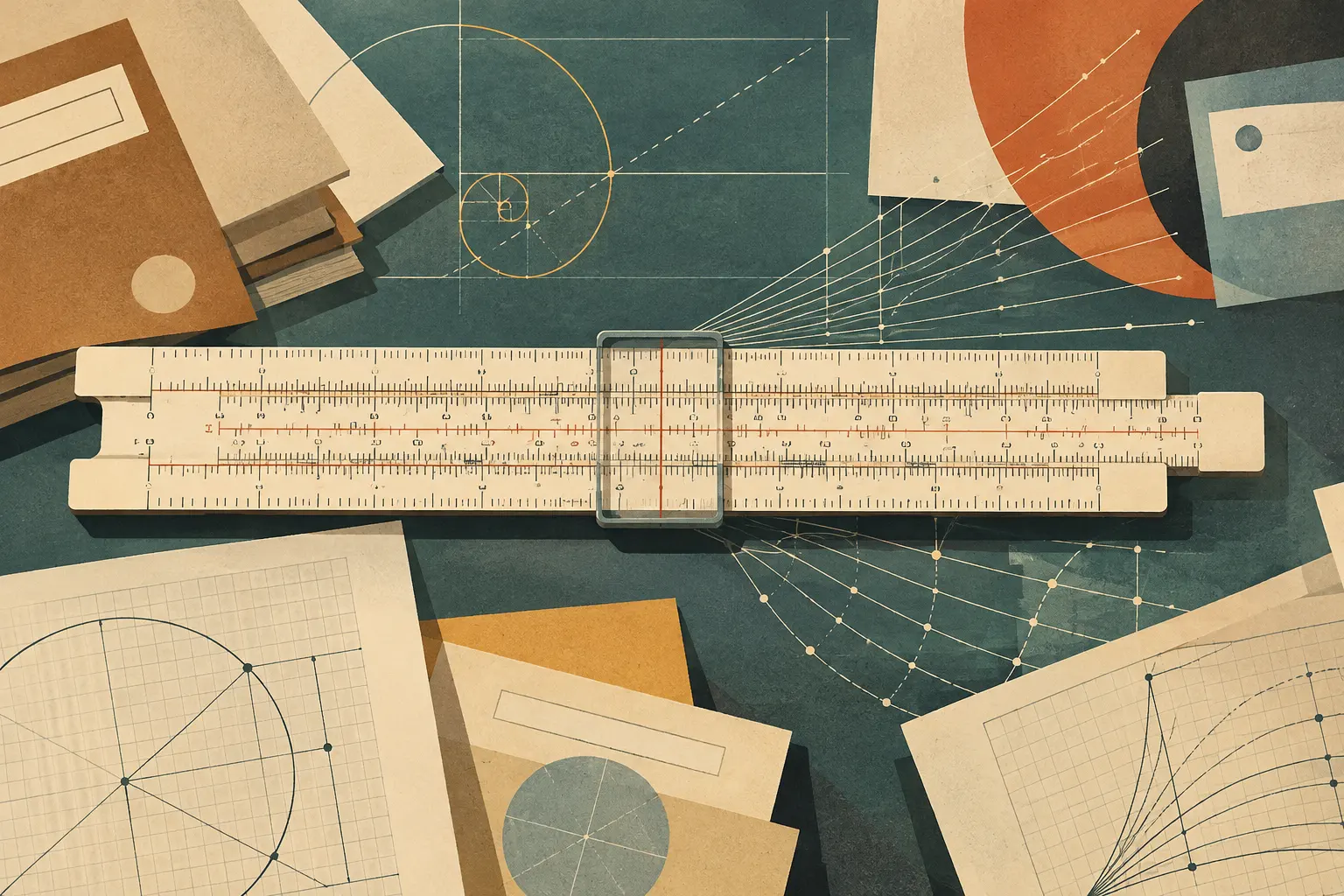
An analogue computer in the shape of a ruler
A slide rule turns difficult operations into distances that are easy to compare. In a typical linear model, a movable slide runs inside a fixed body. Its logarithmic scales make adding distances equivalent to multiplying values, and subtracting them equivalent to dividing. A transparent cursor, with one or more reference lines, helps align marks that are not adjacent and transfer readings between scales.
The instrument does not show where the decimal point belongs: users estimate the order of magnitude and check whether the answer is plausible. A standard linear rule usually yields only a few significant figures, not the precision of a digital calculator. Despite its appearance, it is not a measuring ruler.
Scale labels offer clues to the operations a rule can perform. On many models, C and D are used for multiplication and division; A and B for squares and square roots; and K for cubes and cube roots. S and T commonly serve trigonometric functions, while LL scales support powers and exponentials. Not every model includes the same scales or arranges them in the same way.
Forms, systems and applications
The linear rule is the most familiar design. Single-sided models are often called simplex; duplex rules carry scales on both faces and usually support a wider range of operations. Circular and cylindrical rules are also common forms. On a cylindrical model, a long scale winds around a cylinder, packing considerable scale length into a compact instrument. Circular rules range from general-purpose models to specialized tools such as the E6-B flight computer.
Scale layouts may follow recognizable systems, including Mannheim, Rietz and Darmstadt. These are useful conventions for describing a rule, but the system name should be supported by the visible layout rather than a general impression. Specialized instruments were also made for navigation, surveying, electrical work and other fields; their scales reflect the calculations used in each occupation.
What a brand can—and cannot—tell you
A trade name does not always identify the manufacturer. Distributors sold instruments made by other firms under their own names, while manufacturers produced OEM models for third parties. A familiar name—Faber-Castell, Aristo or Keuffel & Esser, for example—is therefore a starting point for research, not necessarily a definitive attribution.
To test a possible identification, gather several clues: model number, scale types and order, materials, manufacturing marks, cursor, case and associated documents. Resemblance to another instrument can guide a search, but does not by itself prove that both came from the same maker. The International Slide Rule Museum’s reference galleries and documented examples are useful for comparing models and terminology.
A record that lets others revisit the identification
Start with clear photographs of the front, back, ends, cursor, case, labels and every inscription. Transcribe brands, numbers, codes and units exactly. A patent date is not necessarily a manufacturing date, and an isolated code is not conclusive. Dating can be difficult: some serial numbers were reused, and parts may have been stored before assembly.
Next, record the scales on each face in the order they appear. Note whether the cursor has multiple hairlines, and name a scale system only when the layout supports it. Include measurements, observable materials and general condition. Distinguish what can be seen on the instrument from what is known through testimony or documents.
Provenance—the known history of an object’s ownership, custody or location—deserves the same care. Former owners, the place where a rule was found and papers that accompanied it may all be valuable, but record the source of each claim and keep verifiable information separate from hypotheses. A strong collection record does not erase uncertainty; it makes clear what evidence might change the attribution.
Preserving the instrument and its context
Slide rules may combine wood, laminates, metal, plastic and cursors made of glass or other transparent materials. That variety is a reason not to default to universal cleaners or unnecessary disassembly: surfaces, finishes and inks can respond differently. The International Slide Rule Museum’s guidance favors cautious methods for routine cleaning; for fragile or valuable objects, consult a conservator before treatment. Keep the instrument with its case and associated papers, and document any intervention.
Manuals are part of a rule’s history of use. They explain reading conventions and sometimes the scales specific to a model; they may also offer clues about the period or market for which it was intended. Reglas de Cálculo maintains an index of manuals in several languages for makers including Faber-Castell, Aristo and Pickett. If the original is missing, a digital copy can help, provided its bibliographic details are kept with the instrument’s record.
Reference collections and communities
The International Slide Rule Museum brings together manufacturer galleries, a glossary, manuals and dating resources. The Oughtred Society and the United Kingdom Slide Rule Circle encourage study and exchange among collectors. The Spanish-language ARC forum links to manuals and other documents and gives collectors a place to share information about their instruments.
These communities can help locate references, compare examples and test an identification. An attribution should still rest on features of the object and relevant documentation. To place a rule within the broader history of calculating instruments, researchers can also consult the MIT Museum’s collection, which includes slide rules, nomograms and mechanical calculators.
A well-organized record brings together images, physical description, scales, markings, manuals, provenance and references consulted. The rule is then more than a brand name or a probable date: its documentation also preserves clues to how it may have been used and how its identification was reached.
- Decade
- 1960s
- Region
- Global
- Level
- Collector
- Entities
- Museum
Sources and references 5
- Términos, Glosario y Enciclopedia de las Reglas de Cálculosliderulemuseum.com · 2026-11-19
- Regla de cálculotranslate.google.com · 2026-11-19
- Manuales de Instrucciones Instruction Manuals Reglas ...www.reglasdecalculo.com · 2026-11-19
- slide rule, rechenschieberwww.calculatinginstruments.com · 2026-11-19
- Faber Castell artilleria militar WWII - ARCarc.reglasdecalculo.org · 2026-11-19