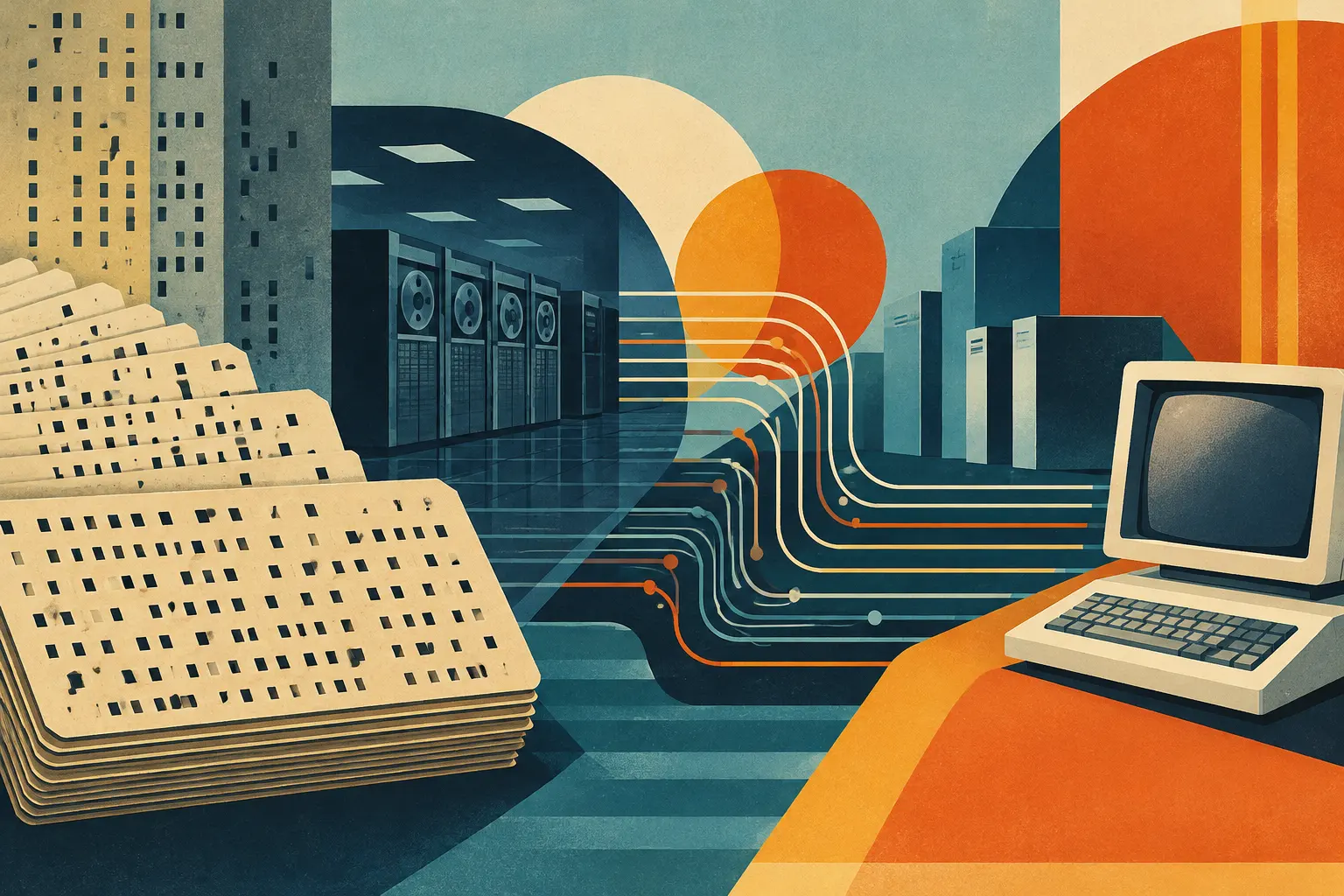
Between 1911 and 1981, IBM grew from a combination of businesses making recording and tabulating equipment into a seller of computers for scientific, commercial and personal use. This was not a simple handoff from one technology to another. Different kinds of machines coexisted, and each major shift involved new choices about the problems to solve, how to sell systems, and how equipment and programs would relate to one another.
IBM’s corporate history is useful for establishing dates and products, but it also presents events from the company’s perspective. Read with that in mind, the sequence highlights five milestones: punched-card tabulation, the IBM 701, the IBM 650, System/360 and the IBM PC 5150. They do not form one architecture or an uninterrupted line of compatibility.
From C-T-R to IBM
The Computing-Tabulating-Recording Company (C-T-R) was incorporated on June 16, 1911, as a holding company to control three separate businesses, including the Hollerith Tabulating Machine Company. Its activities included tabulators, time-recording devices and scales. This was the founding date of C-T-R, not the date when it immediately adopted the IBM name.
One of its most promising technologies was the tabulator associated with Herman Hollerith. Perforated paper cards encoded data for machine tabulation; Hollerith’s design was put to the test calculating data for the 1890 US census. In the decades that followed, tabulation also found commercial uses. It was mechanized data processing with cards, not an electronic stored-program computer.
Thomas J. Watson joined C-T-R as general manager in 1914. Under his leadership, the company gave greater weight to tabulation and expanded internationally. In 1924, it adopted the name International Business Machines, or IBM. The new name signaled broader business ambitions, but the company still worked with mechanical products and lines of business that were not reducible to electronic computers.
Two different computers for different needs
The IBM 701, known as the Defense Calculator during development, was announced in April 1952. IBM designed it for scientific and engineering calculations, including work connected with defense projects. It was a general-purpose electronic machine, distinct from earlier mechanical and electromechanical tabulators. Its announcement should not be confused with the worldwide birth of the electronic computer: other electronic systems already existed.
On July 14, 1953, IBM announced development of the 650, a machine that used magnetic-drum memory. John Hancock Mutual Life Insurance Company took delivery of the first IBM 650 in December 1954. The 650 served both business tasks, such as payroll and sales control, and scientific and educational uses. Its presence in organizations and universities helped more people and institutions work with computers, though claims of worldwide primacy found in corporate accounts are not needed to explain its importance.
The 701 and 650 show that computing did not expand along a single path. The 701 was aimed at scientific calculation, while the 650, initially geared toward scientific and engineering clients, evolved over time into a general-purpose system; both coexisted with IBM’s tabulating equipment. In both cases, the computer had to fit into an organization’s work: processing data was only part of the task; procedures, staff and ways of preparing work mattered too.
System/360: compatibility within a family
On April 7, 1964, IBM announced System/360, a new family of computers intended to cover a range of commercial and scientific applications. Its central proposition was a common architecture across several models. Compatibility among members of the family meant customers could move between models without treating each one as an entirely unrelated product.
That does not mean System/360 was a compatible upgrade to every earlier IBM machine. It was a new family and architecture, designed to replace all five of IBM’s existing computer product lines. Its historical significance lies, among other things, in the effort to combine compatibility across models with a scalable offering. Buying a system could therefore be more than an isolated decision about a machine: it could also be a commitment to a platform and the work built around it.
Compatibility had organizational and commercial consequences. It could reduce the need to rewrite programs when moving among compatible models, and give customers a reason to plan for future expansion. It also connected decisions about hardware, software, peripherals, maintenance and investment more closely. This was not automatic technical continuity from punched cards to electronic computers, but a design choice within a particular family.
The PC 5150 and an expanding ecosystem
On August 12, 1981, IBM introduced the Personal Computer 5150. Personal computers already existed; the 5150’s historical interest does not depend on assigning it worldwide primacy. Its design departed from IBM’s traditional practice of making or controlling most components in-house: the project used off-the-shelf parts and products from other companies for key hardware and software elements.
IBM also published technical documentation that helped software developers and peripheral makers build for the system. The result was an ecosystem extending beyond the machine IBM sold, including a market for PC-compatible computers. This openness did not mean the hardware or software was in the public domain; it describes specific decisions about components, documentation and opportunities for expansion.
The contrast with System/360 is revealing, but it does not establish a direct lineage between the two architectures. In System/360, compatibility was built into the design of a centrally produced family of systems. In the PC, third-party components and documentation helped other manufacturers and developers expand a personal-computer market. In both cases, choices about compatibility and openness affected who could build, program and sell around a platform.
The PC did not make mainframes disappear. For IBM, personal computing added another market and scale of use; large-scale business systems remained part of computing. The history from 1911 to 1981 does not lead to a final machine that replaces all its predecessors, but to a wider range of equipment and ways of organizing its use.
Five milestones, five roles
| Milestone | Main change | What it helps explain |
|---|---|---|
| C-T-R, 1911; IBM name, 1924 | A combination of tabulating businesses, followed by the adoption of the IBM name | Mechanized data processing preceded electronic computers. |
| IBM 701, announced in 1952 | General-purpose electronic computer aimed at scientific calculation | Electronic computing opened new possibilities for scientific and engineering problems. |
| IBM 650, development announced in 1953; first delivery in 1954 | Magnetic-drum system used for business, scientific and educational work | Computers reached more kinds of organizations and applications. |
| System/360, announced in 1964 | A family of models sharing a common architecture | Compatibility across models could support the growth of systems and programs within a family. |
| IBM PC 5150, introduced in 1981 | Personal computer using third-party components and accompanied by technical documentation | The participation of other manufacturers and developers helped expand the compatible-computer market. |
The comparison shows a twofold transformation. The equipment and media changed, from punched cards to electronic systems and personal computers, but so did the conditions of use: who could access machines, what work they could handle, and how responsibility was shared among the manufacturer, customers and other market participants. IBM’s trajectory is a useful thread through these changes, but it is not, by itself, the whole history of computing.
- Decade
- 1960s
- Region
- North America
- Level
- Introduction
- Entities
- IBM PC 5150, IBM PC, Ordenadores personales, IBM 650
Sources and references 5
- The origins of IBMwww.ibm.com · 2026-11-17
- The IBM700 Serieswww.ibm.com · 2026-11-17
- The IBM650www.ibm.com · 2026-11-17
- The IBM System/360www.ibm.com · 2026-11-17
- The IBM PCwww.ibm.com · 2026-11-17