Between 1951 and 1969, Argentine television changed from a technical curiosity into part of everyday life and a way of sharing events across distance. The shift was about more than the spread of sets and programmes: it reshaped schedules, gathering places and the sense of what a dispersed national audience could experience at the same time.
Historian Mirta Varela examines this process in La televisión criolla, looking both at broadcasts and at the material and social conditions of reception. Drawing on press coverage, surviving programmes and images, and testimony, she distinguishes an early television that was scarce and intermittent from a later medium that, with longer schedules and wider reach, developed recognisable genres, routines and a place in the home.
Watching together before owning a set
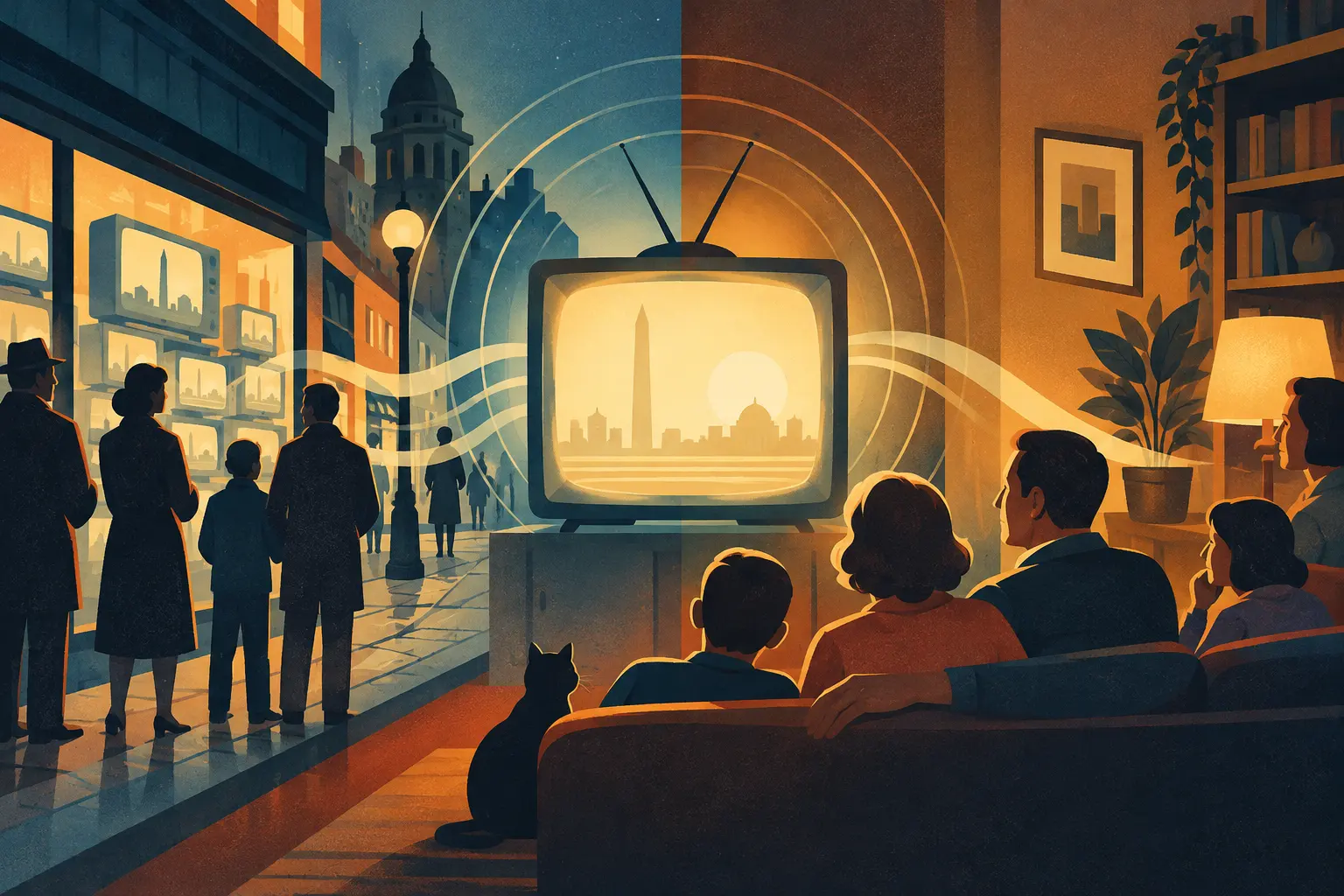
Canal 7 began public broadcasts in Buenos Aires in 1951. At first, receivers were scarce and programming filled only part of the day. Watching television was therefore not necessarily a private household activity. Recollections gathered by Varela place viewers in front of screens in shop windows, bars, clubs, political neighbourhood centres and neighbours’ homes. Football matches could draw groups to commercial or community spaces; the screen added a shared image to existing forms of sociability.
The contrast with the promotional image of a family sitting comfortably in front of a set is telling. Buying a television required considerable expense and could also signal social status. Watching collectively was not simply an incomplete stage on the way to domestic consumption. It was a concrete way the medium entered social life, shaped by scarce sets, irregular schedules and curiosity about a new technology.
Limited programming gave each broadcast the feel of an event. Viewers had to organise themselves around a still-restricted schedule: they went to watch television, waited for a programme or gathered to follow a transmission. The broadcast time was also an appointment and an invitation to meet. Television did not yet fill domestic time continuously.
From occasional broadcasts to routine viewing
During the 1960s, broadcast hours expanded, time slots and genres became established, and competition among channels helped distinguish their styles. Schedules included soap operas, comedies, music and comedy programmes, quizzes, news, films, series and cartoons. Certain kinds of programmes became associated with familiar times and expectations.
Repetition mattered as much as novelty. Recognisable formats and characters helped viewers know what to expect and organise their time around the screen. Long-running programmes sustained habits; advertising and regular scheduling increasingly made the television set a familiar focus of domestic life.
Varela stresses that live broadcasts, reruns and recordings are distinct phenomena. In Argentina, the spread of videotape during these years accompanied changes in the production and circulation of content. But the social meaning of watching also depended on when something aired, whether a set was available and where viewers gathered. A surviving schedule can document titles and times; it cannot, by itself, show who had access to the screen or how viewing was organised.
Images of modernity and contemporary life
Television did more than transmit stories: it proposed images of contemporary life. Family fiction, music programmes and variety shows combined urban models, references to consumption, local traditions and imported ideas of modernity. Television was not a neutral mirror of society. It selected and arranged images, languages and characters that could then circulate in everyday conversation.
That circulation does not mean audiences received every message in the same way. Varela distinguishes the intentions of producers and advertisers, the forms of programmes and viewers’ experiences. The testimony she discusses records enthusiasm, disappointment, conversation and criticism: a broadcast could bring people together without erasing differences of interpretation.
1969: from local conflict to a global screen
The Cordobazo and the Moon landing, both in 1969, reveal different dimensions of television’s reach. Images of the Cordobazo brought scenes of conflict in Córdoba to viewers in other cities. Live coverage and expanding signals gave screen presence to events people could not witness in person and made them part of a national conversation.
The Moon landing operated on a different scale. People in different places could follow an international event at the same time, although technical conditions and reception quality were not equal everywhere. In Argentina, access depended on satellite links and infrastructure whose establishment brought its own difficulties. Simultaneity was real but unequal; it was not a perfect, universal connection.
Varela treats these moments as more than technological milestones: they show how television could alter the perception of distance. In one case, it made a political conflict within the country visible; in the other, it turned a space mission into an event watched in many places. The contrast also matters: unexpected coverage interrupted routine, while the Moon landing was announced and prepared as an exceptional transmission.
Archives, broadcasts and memory
Reconstructing television history requires combining different kinds of documents. Schedules and listings track titles, times, genres and changes in programming; the press records announcements, premieres and debates; surviving recordings show what some broadcasts looked and sounded like. Testimony helps recover viewing practices, although memory reconstructs the past from the present and cannot replace contemporary records.
Surviving archives do not necessarily represent all programming or every channel. Live television could disappear without leaving a complete recording, so a history of schedules is not a comprehensive history of what people watched. It is also useful to distinguish preserving a programme, choosing to repeat it and the experience of watching at its scheduled time. The evidence allows us to trace the growth of programming and changes in viewing practices without assuming that every household experienced them uniformly.
The journey from shop window to living room shows how television took shape at once as a medium, a schedule and a shared conversation. Its history lies in the programmes, but also in the gatherings they organised, the routines they changed and the connection between local broadcasts and events seen from afar.
- Decade
- 1960s
- Region
- Latin America
- Level
- Enthusiast
- Entities
- Televisión, Buenos Aires, Argentina
Sources and references 5
- Full text of "Mirta Varela - La televisión criolla - Desde sus inicios hasta la llegada del hombre a la luna (2005)"archive.org · 2026-11-22
- Corporativo: Línea de tiempo TVN | TVNwww.tvn.cl · 2026-11-22
- Cómo hemos cambiado: así eran las caras de Cuatro hace 10 añoswww.eldiario.es · 2026-11-22
- Corporativo | Home | TVNwww.tvn.cl · 2026-11-22
- 57 años de Televisión Nacional de Chile: 10 hitos históricos del canal público que marcaron a un paíswww.tvn.cl · 2026-11-22