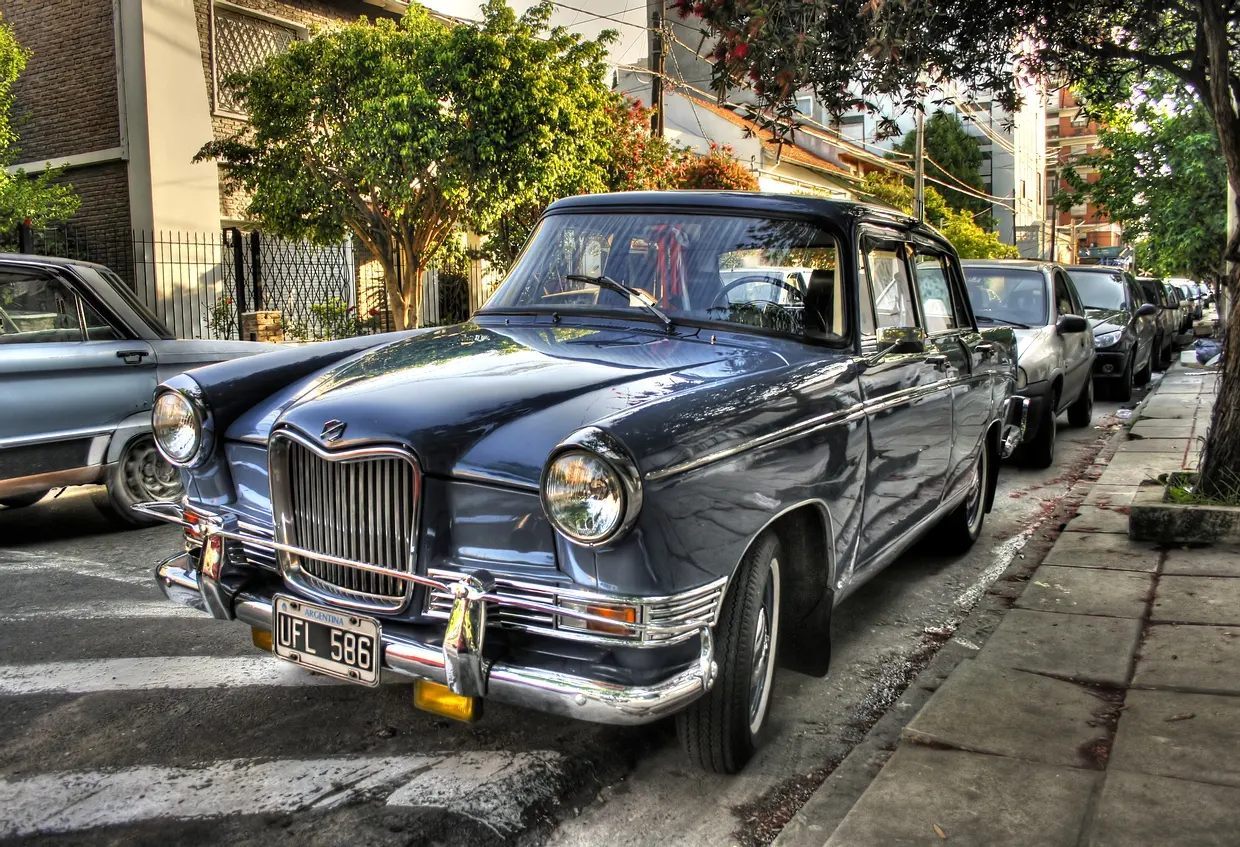
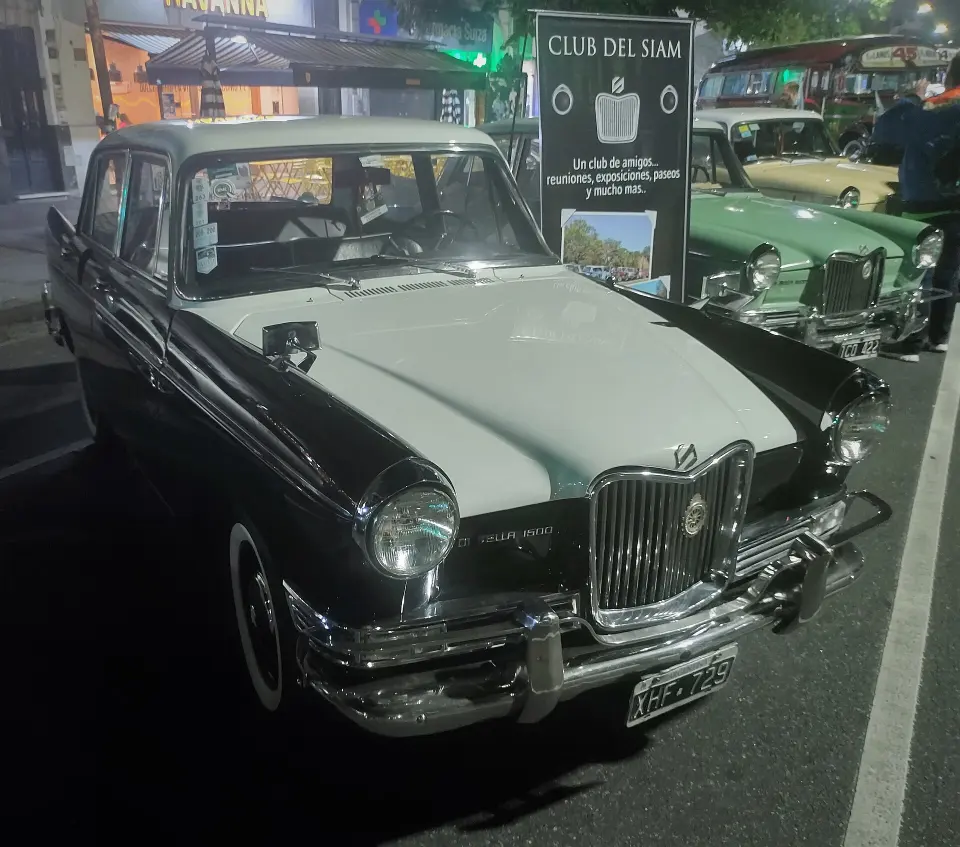
The SIAM Di Tella 1500 was one of the most visible signs of Argentine metalworking’s move into car production in the 1960s. It was neither a design created from scratch in Argentina nor an imported car with a different badge: SIAM built it under licence from the British Motor Corporation (BMC), adapting a British-origin platform for local production. Its history brings together three stories: an everyday saloon, an industrial company’s attempt to enter a demanding sector, and a period of expansion in Argentina’s automotive industry.
From metalworking to car production
Founded in 1911, SIAM grew by making machinery for bakeries, followed by industrial equipment, household appliances, and scooters. Decades later, the expansion of car manufacturing offered a new opportunity: to put its factory experience and infrastructure to work producing an established model rather than designing an entirely new car.
The Di Tella belonged to BMC’s family of medium-sized saloons. Accounts differ over its closest British relative: some link it to the Riley 4/68, while others identify the Austin A55 Cambridge Mk II. That disagreement makes it prudent to place the car within the BMC range without presenting one lineage as definitive. Specialist documentation also credits Pininfarina with the body design.
The decision to build under licence formed part of a wider shift. Under President Arturo Frondizi, developmentalist policies encouraged industrial investment, including in car manufacturing, and the participation of foreign capital. The aim was to expand domestic production and reduce dependence on imported cars. SIAM entered this environment alongside manufacturers with greater scale and resources—a difference that would weigh on the project’s future.
A saloon for families and taxi service
The 1500 was a four-door saloon with a longitudinal front engine, a four-speed manual gearbox, and rear-wheel drive. Its unitary construction integrated the body with the load-bearing structure. Technical sources cite a 1,489 cc BMC B-Series engine and a stated output of 55 SAE hp for the Argentine version. In a road test published by Parabrisas in July 1962, the car reached 116.9 km/h.
Comparisons with British versions require care. Accounts of the model say that suspension components were modified and the engine’s compression ratio reduced compared with some UK variants. This adaptation was associated with a lower stated output than that of certain British versions. A licence, in other words, did not mean that cars built in the two countries were mechanically identical.
The Di Tella served both as a family car and as a taxi. A reconstruction based on specialist statistics states that 3,870 of the first 14,500 units went into taxi service. The figure helps explain the car’s visibility in cities, but it applies to that initial group and should not be confused with total production or the output of related models.
Rapid growth, fragile financial foundations
Production began at the Monte Chingolo plant. The first car left the line on 2 April 1960. Figures reported by specialist sources put output at 4,102 vehicles that year and more than 14,000 in 1961. The range expanded to include the 1500 Special, the Traveller estate, the Argenta pickup, and the Magnette. Although they shared part of the industrial and mechanical basis, these were distinct models; their production figures should not simply be added to the total for the 1500 saloon.
Rapid commercial growth did not, by itself, meet the needs of a car factory. Sustaining and renewing the range required investment; financing for buyers and a broader local supply network for components also mattered. Educational material from the Directorate General of Culture and Education of Buenos Aires Province identifies SIAM’s financial capacity as a key constraint, both for maintaining consumer credit and for renewing its models. Growth across the sector and an individual company’s ability to keep pace were not the same thing.
In 1965 SIAM Di Tella Automotores agreed on industrial cooperation with Industrias Kaiser Argentina (IKA). That year, IKA acquired 65 percent of the carmaker’s shares. Financial difficulties deepened, and in 1966 the company became Compañía Industrial de Automotores S.A. (CIDASA). The vehicles were renamed as well: the Di Tella 1500 continued as the Riley 1500, while other variants adopted names associated with Morris, Riley, or MG. Production continued for a time; the last vehicles of this phase are recorded in March 1967.
Popularity did not ensure continuity
The SIAM Di Tella 1500’s story fits neither a straightforward tale of success nor one of failure. The car became a familiar presence in urban life and served families as well as taxi fleets. At the same time, its British origins, local manufacture, and eventual change of corporate control show that making a car involved more than building a successful design: it also required sustained investment, financing, and product renewal.
Its technical figures therefore tell only part of the story. A period road test describes a particular version under specific conditions; taxi use speaks to the car’s social presence; the licence explains its relationship with BMC; and SIAM’s corporate trajectory reveals the financial limits of the venture. Taken together, these elements show how an expanding industry tried to turn metalworking expertise and international technology into a car made in Argentina.
Documentary gallery
- Decade
- 1960s
- Region
- Latin America
- Level
- Enthusiast
- Entities
- Cuatro, Buenos Aires, Argentina, SIAM Di Tella, SIAM Di Tella 1500
Sources and references
- SIAM Di Tella 1500: historia, motor y ficha técnica del…maquinasconhistoria.com.ar · 2026-11-11
- Sumario de abril de 2017 - Archivo de autos - WordPress.comarchivodeautos.wordpress.com · 2026-11-11
- 5. La segunda etapa de la industrialización por sustitución ...continuemosestudiando.abc.gob.ar · 2026-11-11
- Historia de la industria en la Argentinaes.wikipedia.org · 2026-11-11
- Historia de la Argentina entre 1943 y 1963es.wikipedia.org · 2026-11-11