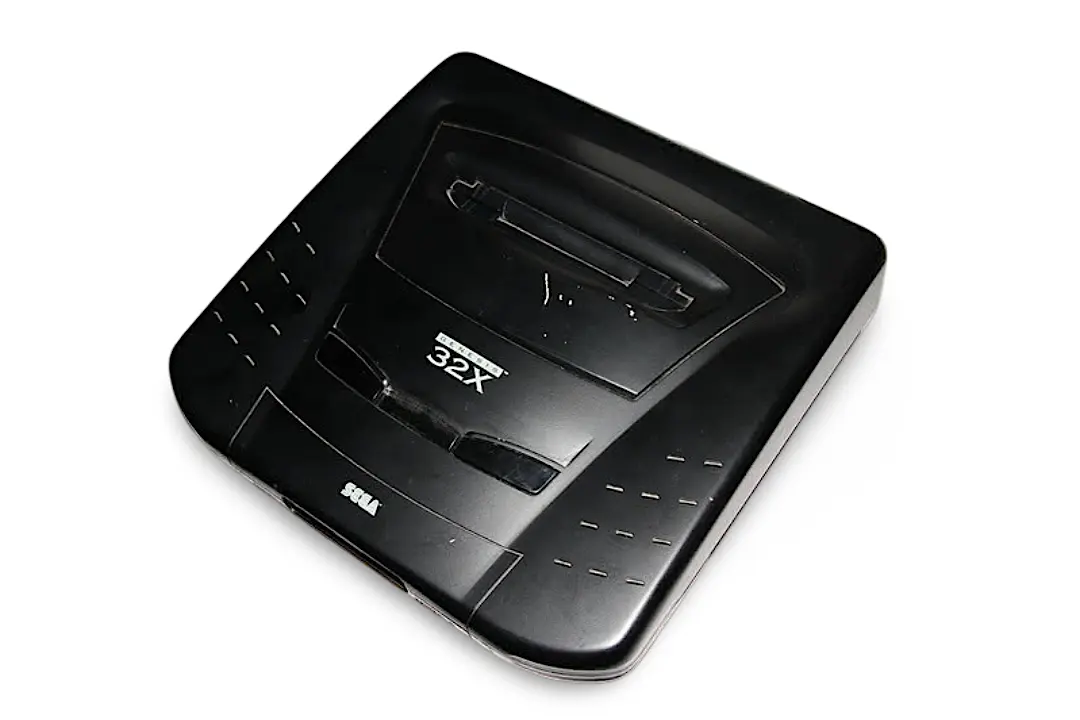
The Sega 32X grew out of an appealing but difficult idea: give Mega Drive owners access to some of the possibilities of 32-bit systems without requiring them to replace their console. The add-on kept the existing machine as its base, while adding processors, connections and power requirements of its own. Its brief history was shaped by that tension—and by a release schedule in which the next generation was already coming into view.
An expanded console
The 32X connected to the Mega Drive and used its controllers and cartridges, but added hardware to process specific games. It was neither a standalone console nor a simple software upgrade: it occupied an intermediate position, relying on the machine users already owned while offering capabilities that the Mega Drive could not provide on its own.
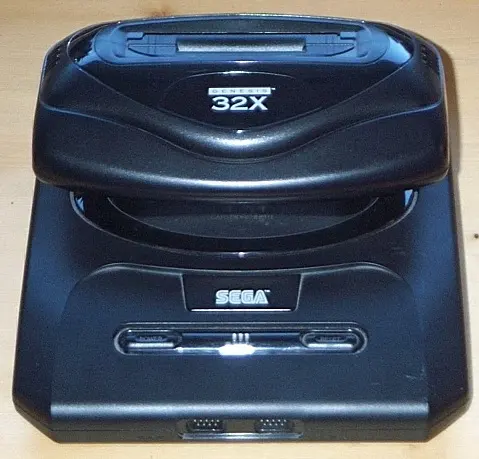
That integration came with practical costs. The add-on needed its own connections and power supply, so increased capability also meant more cables and more steps in setting up the system. Combined with the Mega-CD, it could form the stacked configuration known as the “Tower of Power”. The arrangement captured Sega’s modular ambition, but also made clear that each upgrade could complicate the home setup.
The 32X appeared under different names in different markets: Genesis 32X in North America, Super 32X in Japan, and Mega Drive 32X in Europe and Australia. Its two Hitachi SH-2 32-bit processors gave the add-on a different hardware foundation from the original console. They enabled more colours and certain three-dimensional environments, although the “32-bit” label did not, by itself, make the add-on equivalent to the systems ushering in the next generation.
Games as demonstrations
The catalogue revealed both what the add-on could do and where its limits lay. Star Wars Arcade brought a polygon-based space-combat experience to the home console. Knuckles’ Chaotix took the Sonic series in an unusual direction: two characters were linked by an elastic ring, whose tension became part of the platforming mechanics. Kolibri, a shooter starring a hummingbird, stood out for its visual approach and its departure from the genre’s more conventional heroes.
Other releases offered a more incremental change, adapting or enhancing familiar games. Mortal Kombat II and Pitfall: The Mayan Adventure, for instance, were based on titles already available on 16-bit systems. The catalogue was not uniform: some games clearly demonstrated the 32X’s capabilities, while others raised the question of how much the add-on improved on a version the player might already own.
The gap between a technical demonstration and a compelling reason to buy a system mattered. The 32X needed an appealing library to persuade users, and it needed a user base large enough to justify developers’ support. During a generational transition, confidence depends not only on what hardware can do but also on how long it seems likely to receive backing.
The timing problem
When the 32X reached the market, Sega was also developing and promoting the Saturn. The add-on was presented as a less radical alternative to buying another console, but its arrival close to a new system could make the choice confusing: invest in a module tied to the Mega Drive or wait for the next platform?
The add-on’s history therefore belongs to a moment when two strategies overlapped. One aimed to extend the life of a platform already installed in many homes; the other required a new system with its own identity. That coexistence could be difficult to explain to buyers and developers, particularly when the future roles of the two machines were unclear. Vida Extra describes the initiative as confusing amid the arrival of the Saturn and PlayStation.
Retrospective accounts also describe the 32X’s catalogue as small and its commercial life as short. Its trajectory need not be attributed to a single flaw: the installation demands, partial continuity with the Mega Drive ecosystem and proximity of a new generation reinforced one another. The product could expand the console’s capabilities, but it could not remove uncertainty about whether continued investment in the older platform made sense.
The physical shape of a transition
The 32X is revealing because it turned a strategic choice into a tangible object. The Mega Drive remained the starting point, but it was no longer enough on its own; a module sat on top of it, promising to bring the older console closer to a new generation. Continuity and change occupied the same setup: the familiar machine was preserved, while its original limits became visible.
The add-on’s historical interest does not depend on classifying it simply as a success or a failure. It shows both the appeal of protecting an earlier investment and the risk of multiplying dependencies while a manufacturer prepares a successor. Rather than becoming a lasting bridge, the 32X remained an intermediate solution whose future was constrained from the outset by the Saturn’s arrival: an expansion for the Mega Drive, not its replacement or an equivalent version of the next generation.
Documentary gallery
- Decade
- Contemporary
- Region
- Global
- Level
- Enthusiast
- Entities
- PlayStation, Sega 32X, Sega, Star Wars, 32X
Sources and references
- MEGA DRIVE 32X, LA HISTORIA DE UN FRACASO ...thevideogamesmuseum.blogspot.com · 2026-11-04
- La revolución del 32X en Mega Drive, cuando SEGA ...www.vidaextra.com · 2026-11-04
- Videoconsolaes.wikipedia.org · 2026-11-04
- Crash Bandicoot (videojuego)es.wikipedia.org · 2026-11-04
- Sonic the Hedgehog (serie)es.wikipedia.org · 2026-11-04