An industrial project in a country with few cars
SEAT emerged in the post-war period as part of an industrial ambition: to build passenger cars in Spain on a scale the country’s market and manufacturing capacity could not yet support. Founded on 9 May 1950 as Sociedad Española de Automóviles de Turismo, the company brought together the National Institute of Industry (INI), with 51% of the capital; six Spanish banks, with 42%; and Fiat, its technical partner, with 7%.
The arrangement combined state capital, bank financing and foreign industrial expertise. Fiat supplied models and manufacturing knowledge; SEAT was expected to build facilities, train workers and develop suppliers in Spain. The plant was established in Barcelona’s Zona Franca, close to the port and within a city with a substantial manufacturing tradition. Its location connected production to transport networks and existing industrial capabilities.
Zona Franca and the growth of a supplier industry
Production began in 1953 with the SEAT 1400. The factory could not expand in isolation: it needed companies able to supply parts, tools and services. SEAT’s own account says that 93% of components were already made in Spain by 1954. That figure points to rapid localisation of production, but not to technological independence: at this stage, the models and much of the technical foundation remained tied to Fiat.
Introduced in 1957, the SEAT 600 gave the project a more visible social dimension. For many families it became a route to private mobility and an enduring image of Spain’s motorisation. Its cultural significance, however, should not be mistaken for universal access: price, income and manufacturing capacity continued to determine who could buy one, and when.
As production expanded, SEAT also became a place of industrial training and a major customer for suppliers. Mass manufacturing required the coordinated provision of components, tooling, transport and skilled labour. The company’s influence thus extended beyond the plant and helped consolidate a supplier industry around carmaking.
Fiat: technology, growth and dependence
During its first decades, SEAT mainly built models derived from Fiat’s range. The partnership made it possible to start production with established designs and processes, and helped expand Spain’s car market. But the arrangement also limited SEAT’s autonomy over products and exports.
Agreements negotiated in the 1960s gradually widened SEAT’s ability to export and adapt models. At the same time, the company developed its own technical centre. The transition was not an abrupt move from licensing to independence, but a gradual negotiation over how much technical knowledge, design and commercial decision-making the Spanish company could take on.
The relationship ended in 1981, when Fiat withdrew from the shareholding after negotiations over new investment failed. The break did not erase the capabilities already built or the company’s reliance on inherited technical infrastructure; it did require SEAT to establish its own product strategy and commercial identity.
The Ronda, introduced in 1982, brought that challenge into focus. Fiat disputed whether the car differed sufficiently from its Italian counterpart. An international arbitration panel ruled in SEAT’s favour. The dispute showed that industrial autonomy was not simply a question of share ownership: it also meant being able to change designs, sell them under an independent brand and seek markets abroad.
From Volkswagen cooperation to Martorell
Cooperation with Volkswagen began before the group acquired SEAT. An industrial agreement allowed Volkswagen models to be built at Spanish facilities and opened a new phase of collaboration. In 1986, Volkswagen initially acquired a majority stake; in 1990, it took full ownership. SEAT ceased to be independent, while retaining its brand and an industrial presence in Spain.
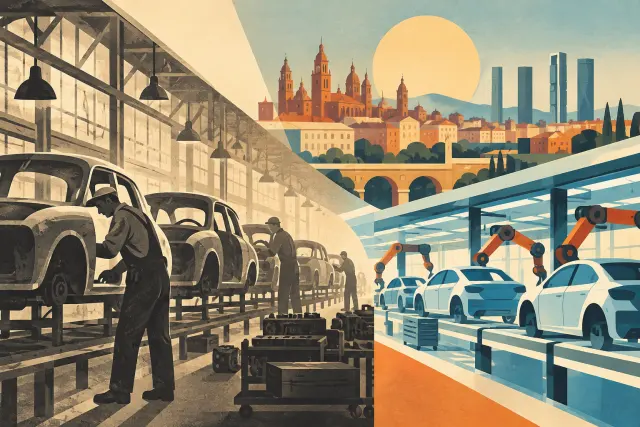
The shift was also geographical. Martorell opened in 1993 and gradually assumed the role of the main production centre. Zona Franca ceased to be the principal car-assembly plant and continued to manufacture components. This was more than a move between sites: the new complex embodied production organised on a larger scale and integrated into European networks.
The Ibiza bridged the two periods. Launched in 1984 as SEAT sought to establish itself after the break with Fiat, it was developed with outside technical partners and work from the company’s own technical centre. Its second generation was among the first models built at Martorell. The 1991 Toledo, meanwhile, was the first model developed entirely under Volkswagen ownership, signalling changes in partnerships and development methods.
One brand, different forms of industrialisation
SEAT’s trajectory makes it possible to trace the transformation of Spanish industry through three related but distinct dimensions: company ownership, the origin of technology and the location of production. In 1950, the state controlled most of the capital while Fiat supplied essential expertise. Local capabilities grew over time, but autonomy remained gradual and negotiated. Integration into Volkswagen changed the company’s ownership and organisation without eliminating the industrial base built in Spain.
The cultural memory of the cars should also be distinguished from the conditions that made them possible. The 600 acquired a symbolic power beyond its role as transport, but that image alone cannot explain the factories, jobs and supplier network behind each car. Similarly, Martorell’s arrival did not erase Zona Franca’s history; it changed the role of each plant within a wider industrial system.
SEAT shows how a company can change partners, owners and production scale while remaining connected to the places where its workers and suppliers developed their skills. Its move from Zona Franca to Martorell is not only a corporate story: it is also a story of how Spain built the capacity to manufacture cars in series and later incorporated that capacity into a multinational structure.
- Decade
- 1950s
- Region
- Spain
- Level
- Enthusiast
- Entities
- SEAT, SEAT 600
Sources and references 5
- ASIENTOtranslate.google.com · 2026-11-13
- Todo sobre los 70 años de historia de SEATwww.seat.es · 2026-11-13
- SEAT - Wikipedia, la enciclopedia librees.wikipedia.org · 2026-11-13
- Historia del SEAT Ibiza: 30 años de éxito en las carreterasnoticias.coches.com · 2026-11-13
- Empresa públicaes.wikipedia.org · 2026-11-13