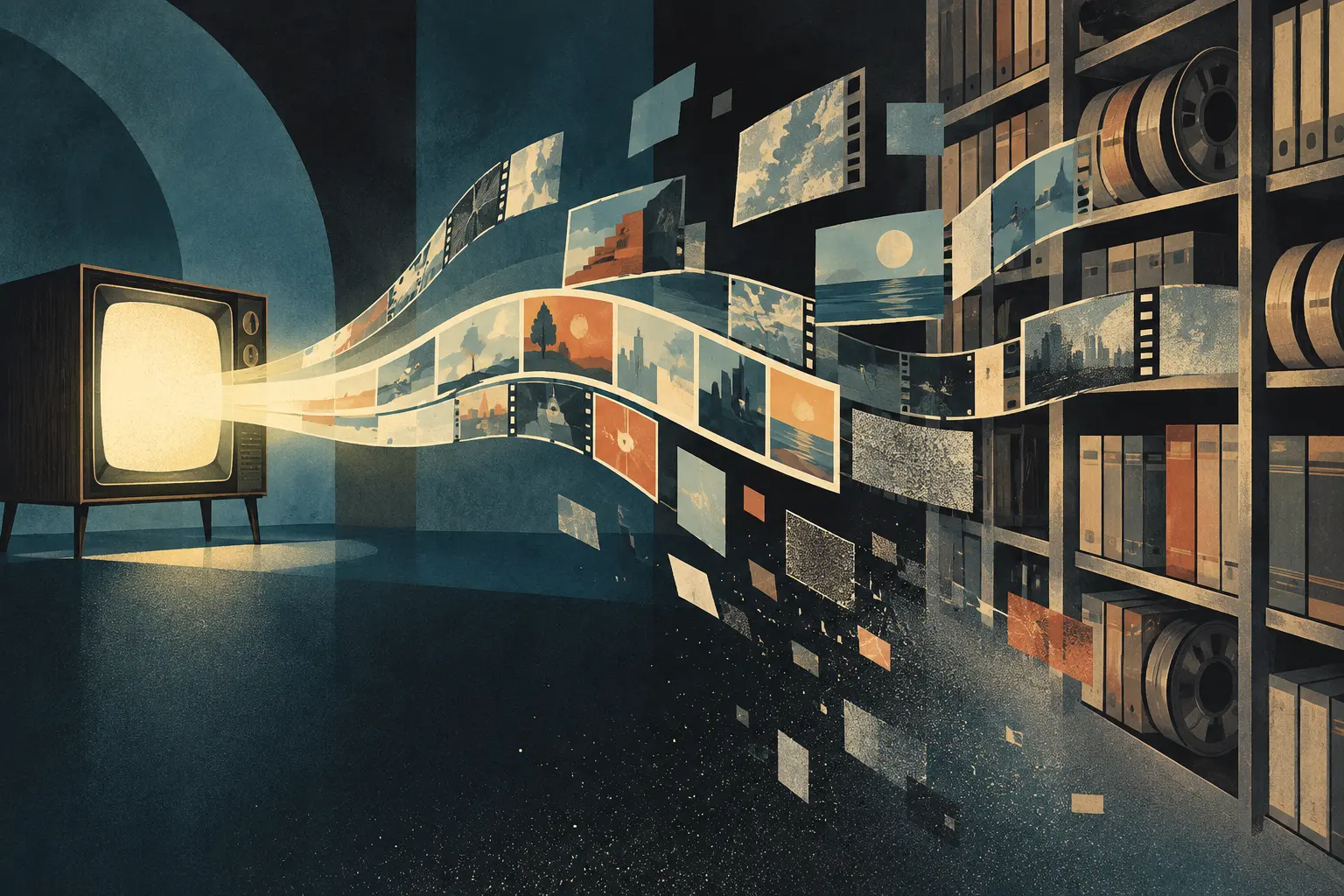
Television takes the form of a flow: programmes, advertisements, trailers and transitions follow one another, gaining meaning from their order. Yet much of what reaches an archive consists of separated pieces. The distance between continuous broadcasting and the surviving fragment shapes what can be reconstructed about television’s past—and what remains beyond reach.
The flow and its fragments
In her study of Argentina’s Radio and Television Historical Archive (RTA), researcher Elina Adduci Spina examines a central tension in television preservation: archives tend to separate units from a medium whose characteristic form is continuity. A programme may survive without its commercial breaks; a news item may be detached from the broadcast in which it appeared; an advertisement may be catalogued as an independent object. Such records allow specific content to be studied, but they do not, by themselves, amount to a complete broadcast experience.
The practice has technical and institutional roots. In television’s early years, when many transmissions were live, an audiovisual record might not exist. Videotape expanded the ability to record and reuse material, but it also made erasing and recording over tapes possible. According to Adduci Spina, Argentina’s first official television broadcast, on 17 October 1951, went out live and left no audiovisual record. Material from other periods survives as film footage, broadcaster recordings and recordings made by viewers.
It is also important to distinguish a schedule from an actual transmission. A preserved schedule documents what was planned; on its own, it cannot prove what went to air. Recordings, production documents, advertisements and press coverage can be brought together to compare the two. Each offers a perspective, but none necessarily contains the complete sequence.
The equipment tells a story too
Colombia’s RTVC museum approaches public television through cameras, mobile units, telecine equipment and recording formats. Señal Memoria’s article reports that the Colombian government acquired a Dumont Telecruiser mobile unit in 1954. It was used to transmit President Rojas Pinilla’s speech from the Palacio de San Carlos on 13 June that year. The museum also presents an RCA TK-30 camera, designed for live transmission without built-in recording capability.
These machines help explain why so many early broadcasts were ephemeral. A live camera made it possible to produce images in the moment, but could not preserve them by itself. Telecine equipment, by contrast, converted 16 mm or 35 mm film into a television signal, connecting cinema with broadcasting. Later formats such as two-inch videotape, U-matic and Betacam shaped how material was recorded, stored and recovered.
A television archive is more than a collection of titles. It includes carriers, equipment, production and circulation decisions, metadata and preservation conditions. A tape remaining in storage does not guarantee that its contents can still be played. RTA’s study of the series Los gringos describes preserved tapes whose deterioration prevented access to a substantial part of the work. Physical preservation, cataloguing and access are related but distinct tasks.
Selection and changing meanings
Preserved collections do not represent everything that was broadcast equally. Broadcasters’ archives served production and reuse needs; home recordings depended on what each person chose to capture. Selection influences which voices, genres and moments become visible over time. A surviving state advertisement or interview cannot, by itself, offer a complete portrait of television in its era.
The later life of the material also changes how it can be read. Adduci Spina examines promotions produced by ATC during Argentina’s 1976–1983 dictatorship. Originally conceived as propaganda, they can now also be studied as records of production practices and as objects of critical analysis. Their cataloguing, presentation and historical explanation all affect how audiences interpret them.
Another example is Gente, an interview programme broadcast in Argentina from 1960. Partial audio recordings made by its presenter survive, but not the programmes’ television images. The recordings allow aspects of the show to be studied and preserve testimony, though they cannot replace its audiovisual experience. The absence of images is part of what the archive preserves and should remain in view when the audio is interpreted.
Reconstructing without mistaking traces for the whole
Schedules, recordings, advertisements, news items, continuity segments, production documents and press accounts can be brought together to approach a historical broadcast. They help distinguish what was planned from what was transmitted and illuminate how a programme was assembled. Even so, relating these pieces does not mean recovering the original flow in full.
Home recordings add a perspective on reception and everyday life: they show that some broadcasts were captured to be watched again or kept. But recording transforms the event. It turns it into an object that can be repeated, excerpted and circulated in a different context; that second life is not the same as the original reception. The cases examined do not establish a general measure of how audience habits changed as home recording spread.
Television history is made not only of images and sounds, but also of the technical and institutional conditions that enabled them to be transmitted, recorded, selected and recovered. Archives preserve valuable traces, not a neutral copy of the entire television experience. Relating carriers, documents and recordings brings us closer to broadcasting as both a medium and a social practice, without mistaking the surviving fragment for everything viewers saw.
- Decade
- 1950s
- Region
- Global
- Level
- Enthusiast
- Entities
- Museum, Televisión, Sounds, Elina Adduci Spina, Argentina, Archivo Histórico de Radio y Televisión Argentina
Sources and references
- Memorias de archivosopenalex.org · 2026-11-11
- Preservación del patrimonio audiovisual de televisión El archivo de Televisión Española (TVE): de los orígenes a la digitalizaciónopenalex.org · 2026-11-11
- Paradojas y desafíos del patrimonio audiovisual televisivo. ...www.scielo.org.ar · 2026-11-11
- Recuerdos en movimiento: Archivo Audiovisual de CMEFMwww.casamuseoeduardofrei.cl · 2026-11-11
- Tecnologías de la memoria: el museo y el archivo de RTVCwww.senalmemoria.co · 2026-11-11