A past that can also feel new
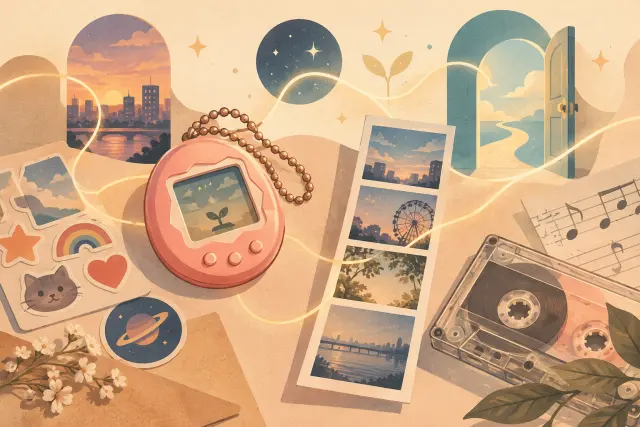
Interest in Heisei retro culture brings together two different experiences: remembering objects that were part of everyday life between 1989 and 2019, and encountering them for the first time today. A Tamagotchi, a sheet of stickers or a purikura photo booth can prompt nostalgia in one person and curiosity in another. The object may be the same; the memory is not necessarily shared.
“Heisei retro” covers varied references: toys and stationery from the 1990s, sticker photography, music and fashion, as well as products from the 2000s. It helps to specify which period and practice are in view. Y2K is commonly associated with fashion and design around the year 2000; Heisei joji with children’s toys, stickers and character goods. The categories overlap, but neither explains an entire era on its own.
A reissue is not a replay
The original Tamagotchi went on sale in Japan on 23 November 1996. Its compact form, small screen and three buttons belonged to a portable experience: caring for a virtual creature throughout the day. Contemporary versions retain the recognisable idea of nurturing, but do not necessarily reproduce the device or its rules unchanged. Tamagotchi Paradise, released in July 2025, adds a dial for changing the area being observed. It is a new product in conversation with the series, not a reproduction of the 1996 experience.
Tamamori stickers show another kind of continuity. The experience was not simply looking at illustrations: it involved combining accessories, customising characters, peeling and reapplying stickers, and sharing them. The Oshi Lab cites an official announcement dating their original sale to 2011 and noting a reissue of stickers and albums in January 2026. The act of personalising remains, but now sits alongside everyday practices such as decorating fan goods and sharing images. The resemblance makes comparison possible; it does not prove that current practices descend directly from the product.
Music calls for similar care with dates. TRF’s “BOY MEETS GIRL” is a 1994 song, but a digital edition or video available today may belong to a later compilation or have a different distribution date. The original release, a compilation edition and a platform upload are separate facts. Keeping them distinct prevents a new route to a song from being mistaken for a release from its original period.
Purikura: photographs, shared differently
Print Club, launched in 1995 and the source of the term purikura, combined taking photographs with printing a sheet of stickers. The experience was tied to a place and a group: meeting up, choosing a frame, posing, then sharing or keeping the images. Cutting out a sticker for a friend was not the same as posting a digital photograph for a broad audience.
Today’s machines have changed their capture and retouching features, along with the ways people can keep digital files. Taking a photo in a booth now does not simply recreate the practice of 1995. The continuity lies in meeting up and playing with one’s image; the differences lie in technology, circulation and reach. The social context has changed too: handing someone a sticker and posting pictures of other people online involve different expectations and permissions.
Older works, new audiences
Discovering an older work no longer depends solely on having lived through its original circulation. A song may be found through an official channel, a series on a streaming service, and a reissue may introduce someone to a franchise. The work’s chronology and the audience member’s biography do not always coincide: a 1990s object can feel like a new discovery rather than a memory.
That distinction also helps separate projects often grouped under the idea of a “comeback.” A reissue may restore a form, feel or mechanic; a collaboration may put older illustrations to a new use; an exhibition may present the history and offer another way in. These are not interchangeable versions of the same thing. Explaining what is reproduced and what is updated—materials, functions, content, edition or access—clarifies what each proposal preserves.
Heisei retro culture is not reducible to nostalgia or a single aesthetic. Its objects bring together personal memory, cultural archives and the novelty of encountering them now. Comparing these layers reveals connections between eras without erasing their differences: a design can quote the past, a reissue can restore a gesture, and a new generation can make both its own.
- Decade
- Contemporary
- Region
- Japan
- Level
- Introduction
- Entities
- Internet, Fotografía digital, Tamagotchi Paradise, Tamagotchi
Sources and references
- Modelo multidimensional de los factores que afectan la interacción entre marketing y ventas en el lanzamiento de nuevos productos en Latino Américadoi.org · 2026-11-10
- Por qué el estilo retro Heisei renació como actividad fan en ...oshifuturelab.com · 2026-11-10
- Marketing de nostalgia: ejemplos, claves y cómo aplicarlowww.ceupe.com · 2026-11-10
- Nintendoes.wikipedia.org · 2026-11-10
- Ponges.wikipedia.org · 2026-11-10