Three decades, many pasts
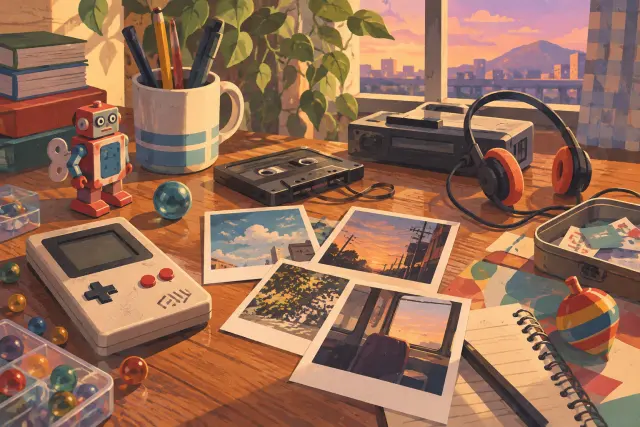
Japan’s Heisei era ran from 1989 to 2019. Its retro culture has no single look: it may call to mind toys and photo booths from the 1990s, or stickers, mobile phones and visual styles from the 2000s. Y2K overlaps with part of this landscape, but does not encompass it all. There is also a more specific interest in toys and stationery associated with childhood, sometimes called Heisei joji. Distinguishing these strands helps prevent three decades from becoming a uniform backdrop.
The trend does not require having lived through those years. An object can be a memory for one person and a discovery for another. The order in which someone encounters a song, series or toy need not match its release date. Retro culture therefore works as both memory and point of entry: it lets people share an interest without assuming they have the same biography.
Objects matter for what they let people do
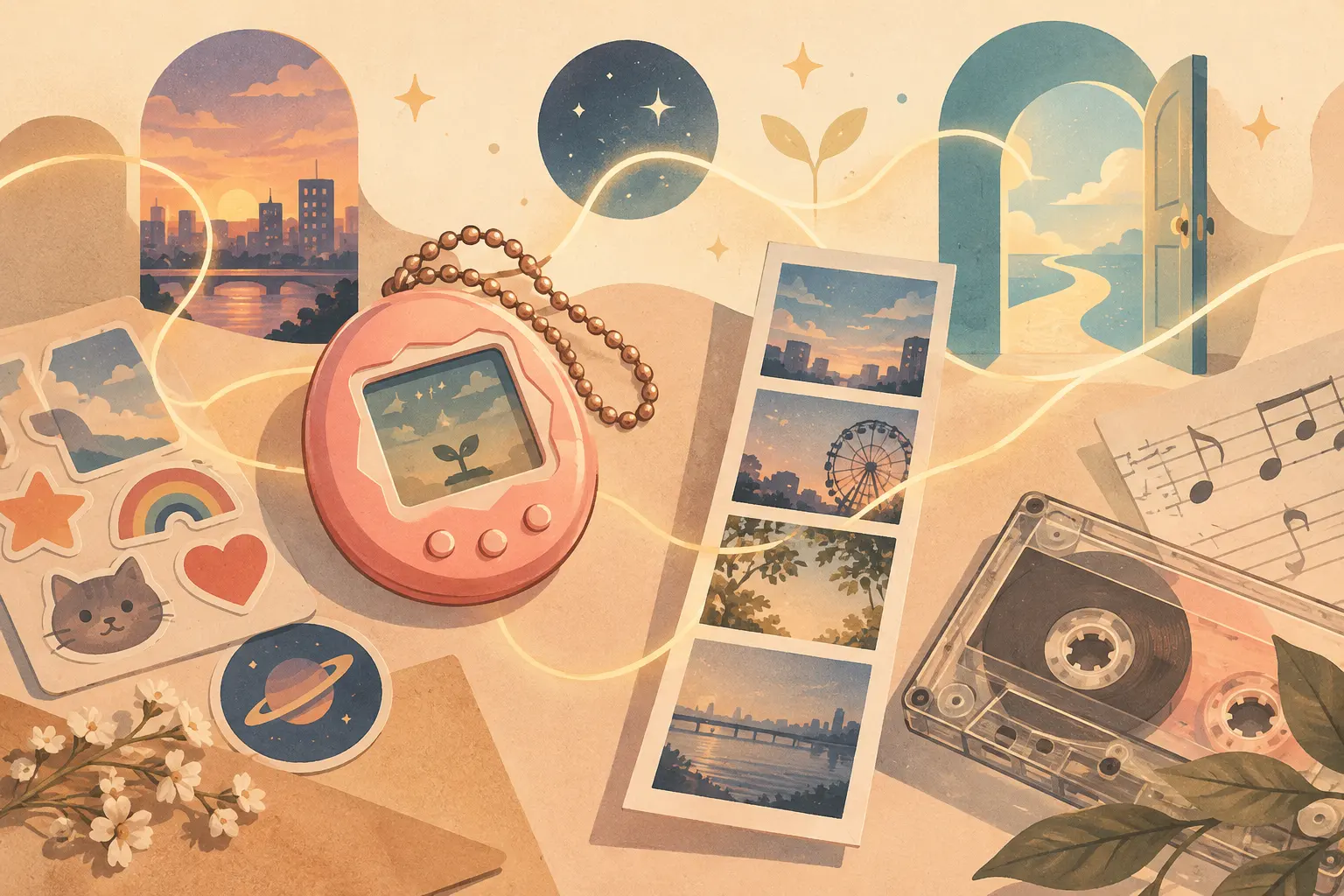
The original Tamagotchi, launched by Bandai on 23 November 1996, brought a screen and three buttons together in a small portable shell. Its appeal was not simply watching the screen: players had to feed and care for a virtual creature over time. Its hangable design allowed the game to accompany everyday life. Later models may retain a familiar appearance while changing the mechanics and the way people interact with them.
That distinction matters when describing a reissue. It is not enough to say that an object is back: it helps to specify what has been retained—its appearance, mechanics or everyday use—and what has changed. A recognizable silhouette can coexist with new features and a different experience.
Tamamori stickers offer another example. Their appeal lies both in the illustrations and in combining accessories to customize characters. The line first went on sale in 2011; in January 2026, Bandai announced a reissue together with collecting albums. Here, the ability to stick and peel the stickers revives a hands-on activity, not just an image. That participation distinguishes the stickers from a new product that merely reuses an old design.
Purikura: from shared sticker sheets to digital files
Print Club, the origin of the term purikura, was launched in 1995 by Atlus and Sega. The booth combined photography with sticker printing. Choosing a frame, waiting for the sheet and dividing it among friends were part of the experience, not merely steps on the way to getting a picture.
Today’s machines have evolved in their capture and retouching features, as well as in how they deliver digital files. Taking pictures now therefore does not exactly reproduce the 1995 process. The circulation of the result has changed too: a sticker passed among friends and a photograph posted on a social network travel in different ways. Remembering purikura’s social dimension does not mean privacy and distribution work the same way across both media.
One work, different generations of access
Long-running franchises show how memories can be reinterpreted. The Sailor Moon television anime, based on Naoko Takeuchi’s manga, began in March 1992. The colours, costumes and objects associated with its characters can remain recognizable in current products. But references to the series are more precise when they specify whether they point to the manga, the classic anime or a later production. Visual resemblance alone does not make a product officially licensed.
Music also reaches new listeners through channels that did not exist when songs were released. TRF’s “BOY MEETS GIRL” came out in 1994; a recording available on the artist’s official channel may be presented as part of a greatest-hits album released later. The song’s release year, the compilation’s year and the digital upload’s year are different dates. Current distribution opens new ways to listen, but should not be confused with the original edition.
A return is not necessarily an unchanged return
A reissue can revive a design, a mechanic, a hands-on activity, a physical format or a way of sharing. A product may preserve an object’s silhouette while changing how it works; an exhibition can explain a practice without reenacting it; a digital release can bring an older song within reach without being its original edition. The useful question is not whether something “came back exactly as it was,” but what remains and what changes.
Heisei retro brings those who remember into conversation with those who are discovering. Concrete objects make it possible to share an interest without turning a personal experience into a universal memory. Comparing period, version and present-day use makes reinterpretation visible: the past supplies recognizable references, while today’s ways of playing, photographing, collecting and listening give them new meanings.
- Decade
- Contemporary
- Region
- Japan
- Level
- Enthusiast
- Entities
- Anime, Sega, Tamagotchi
Sources and references
- Modelo multidimensional de los factores que afectan la interacción entre marketing y ventas en el lanzamiento de nuevos productos en Latino Américadoi.org · 2026-11-09
- Por qué el estilo retro Heisei renació como actividad fan ...oshifuturelab.com · 2026-11-09
- Marketing de nostalgia: ejemplos, claves y cómo aplicarlowww.ceupe.com · 2026-11-09
- Nintendoes.wikipedia.org · 2026-11-09
- Ponges.wikipedia.org · 2026-11-09