An evocation is not an original
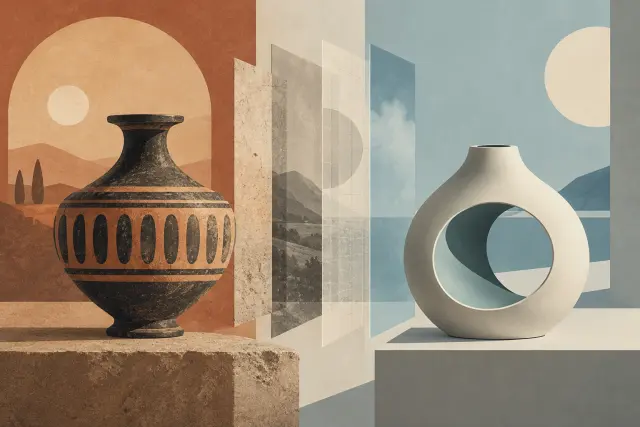
The word “retro” describes a visual or cultural relationship with the past, but it does not establish an object’s history. A contemporary creation may revive a silhouette, colour palette, interface, or way of using something. That does not make it a historical example or prove material or technical continuity. A rigorous account distinguishes the date and provenance of the present-day object from the historical reference it evokes.
This avoids two shortcuts: presenting a recent creation as if it had survived from another era, or reducing it to a copy without considering the choices that make it contemporary. A useful comparison asks what is quoted and what is transformed: materials, scale, manufacturing, function, distribution, or the relationship with an audience.
Context changes meaning
The meaning of a form lies in more than its appearance. Historical design emerged under specific technical, social, and commercial conditions. A reinterpretation can borrow that visual language and place it in another setting. Even when the resemblance is deliberate, the circumstances of production and reception have changed. The same reference can function as homage, a design resource, a consumer object, or a marker of cultural belonging; those possible readings do not, by themselves, prove a particular intention.
The history of Costa Rica’s Museum of Contemporary Art and Design offers an example of why design must also be understood through institutions and debate. Daniel Soto Morúa examines the MADC, founded in 1994, as a hybrid institution bringing art and design together through curatorial strategies connected to regional context and cultural policy. His study describes disciplinary tensions and shifts in circulation: categories such as “art,” “design,” and “heritage” are not neutral labels, but part of an institutional history.
Conservation adds another dimension. Leire Escudero and Cristina Bausero document work at Montevideo’s Juan Manuel Blanes Museum to organize and conserve three-dimensional modern and contemporary works in a historic house. The project involved assessing the collection’s needs, creating a dedicated storage area, and reorganizing the works using the RE-ORG method. Although the study is not about retro products, it is a reminder that an object’s visible appearance does not tell its whole physical history. Its materials, condition, storage, and conservation environment matter too.
Comparing without erasing differences
A catalogue entry, exhibition, or article can make a comparison clearer by asking specific questions: which feature refers to the past? What documentation identifies the reference? Which materials and processes were used? What was the earlier object’s function, and what is the reinterpretation’s function now? If authorship or manufacturer is known, it should be placed in its own period and the information supported. Visual similarities can be described; claims of influence or intention need specific evidence.
The context in which an object circulates again matters as well. The FutureMuseum project gathers museum professionals’ reflections on participation, access, collections, research, and relationships with communities. Its contributions offer no single formula, but they bring out a useful point: objects acquire meaning through the stories, knowledge, and perspectives brought into relation with them. Applied to contemporary retro, this means showing both the historical reference and the present-day circumstances of its renewed circulation.
A strong interpretation neither turns the past into a decorative label nor requires every reuse to be a faithful replica. It makes differences visible and explains the cultural operation: which features remain, which are changed, and what new readings become possible. Nostalgia can then be understood as a relationship with history, not as proof that a present-day object belongs to it.
- Decade
- Contemporary
- Region
- Global
- Level
- Enthusiast
- Entities
- Museum, Museo de Arte y Diseño Contemporáneo
Sources and references
- Conservación del patrimonio y sostenibilidad en museosdoi.org · 2026-11-10
- Museo de Arte y Diseño Contemporáneo: orígenes, desarrollo institucional y contexto de un museo en movimientodoi.org · 2026-11-10
- De casa quinta a Museo. Plan de conservación preventiva para una colección de arte moderno y contemporáneo en el Museo Blanesdoi.org · 2026-11-10
- El arte es un juego: El desplazamiento cultural de los videojuegos de artefactos cotidianos a objetos de arte contemporáneo legitimadosopenalex.org · 2026-11-10
- El proyecto FutureMuseum: ¡Aporta tu voz al futuro de los ...translate.google.com · 2026-11-10