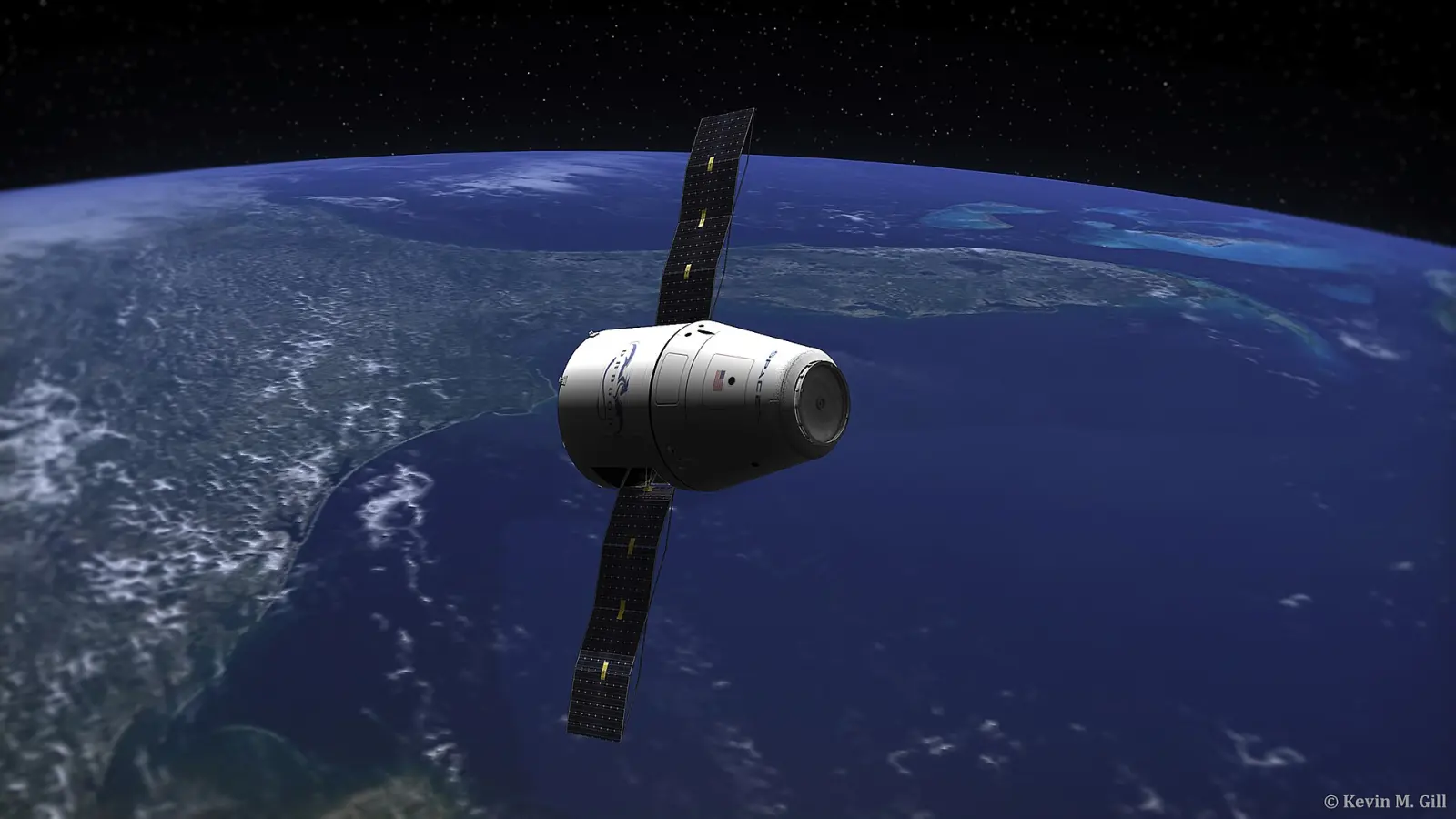
SpaceX's Red Dragon project was not a vehicle that was built and launched, but an idea that emerged in 2011 to redefine how the company approached orbital logistics. Its historical relevance does not lie in having flown, but in serving as a conceptual laboratory for the reuse technologies that would define the following decade. This article examines the technical roots of this concept and its impact on SpaceX's trajectory, based on available documentation and the context of the aerospace industry at the time.
A concept born from engineering
Red Dragon emerged when SpaceX engineers identified that the Super-Draco engines, originally designed for the Dragon capsule's braking and attitude control system, generated enough delta-V to perform significant orbital maneuvers. This technical observation transformed a safety component into a propulsion tool. The idea was to use these engines to allow the capsule to adjust its orbit, perform precise docking, or even return to Earth without relying exclusively on main propulsion systems.
The 2011 public presentation
In 2011, SpaceX presented this concept to the public, describing it as an orbital cargo vehicle capable of operating with greater autonomy. The presentation was not just a product announcement, but a statement of intent regarding the versatility of the Falcon architecture. By showing that a cargo capsule could have its own maneuvering capabilities, SpaceX proposed a new standard for orbital flexibility. This moment marked an inflection point in the perception of the company, transitioning from being a launch provider to a developer of integrated space systems.
The role of Super-Draco engines
The Super-Draco engines were the technical heart of the Red Dragon proposal. Although their primary function was the safety of the crew and cargo, their ability to generate thrust in a vacuum made them ideal for orbital operations. The integration of these engines into the Red Dragon concept demonstrated SpaceX's philosophy of reusing proven components for new applications. This modular approach reduced development risks and accelerated the innovation cycle, a principle that would become central to the design of the Falcon Heavy and other subsequent missions.
Competitive and financial context
In 2011, the space launch industry was in transition. Companies such as Orbital Sciences and Sierra Nevada Corporation were developing their own spacecraft, creating a competitive environment. However, SpaceX faced financial challenges typical of an expanding private company. The lack of specific public funding for the development of Red Dragon as an independent vehicle limited its progress. Despite this, the company continued to invest in the underlying technology, knowing that the Super-Draco engines would be crucial for future crewed missions.
Influence on Falcon Heavy design
Although Red Dragon as an independent orbital vehicle was not realized, its technical lessons directly influenced the design of the Falcon Heavy. Experience with Super-Draco engines and delta-V management in orbit contributed to the architecture of the Falcon Heavy's thrusters and control systems. Furthermore, the idea of a modular and reusable vehicle became a pillar of SpaceX's strategy. The Falcon Heavy, launched for the first time in 2018, incorporated many of the efficiency and reuse principles that had been explored in the Red Dragon concept.
SpaceX's reuse strategy
Red Dragon was a key step in the evolution of SpaceX's reuse strategy. By demonstrating that safety engines could be used for orbital propulsion, the company laid the groundwork for a broader vision of reuse. This strategy was not only applied to first and second stage boosters, but also to capsules and other components. The ability to reuse proven technology reduced costs and increased reliability, two critical factors for the economic viability of space launches.
Limitations of historical evidence
It is important to note that information about the Red Dragon project comes primarily from secondary sources and public statements by SpaceX. There are no detailed internal documents describing the design and decision-making process. Therefore, some of the motivations and specific decisions may not be fully documented. Additionally, the exact timeline of the transition from Red Dragon to other initiatives is not clearly defined in available sources. This lack of detailed documentation limits the ability to make definitive statements about certain aspects of the project.
Conclusion
SpaceX's Red Dragon was a concept that, although it never flew, had a significant impact on the history of private launches. Its focus on component reuse and orbital flexibility laid the groundwork for the company's subsequent innovations. By examining this project, we can appreciate how conceptual ideas can influence the technological and strategic development of a company, even when they are not realized as final products. Red Dragon represents an important chapter in the evolution of SpaceX and the aerospace industry as a whole.
- Decade
- 2000s
- Region
- Global
- Level
- Introduction
- Entities
- Red Dragon
Sources and references
- EL DERECHO COMERCIAL INTERNACIONAL:doi.org · 2026-10-20
- Sobre Teresa Eleazar Serrano Espinosa y Ricardo Jarillo Hernández (coords.), Cofradías de indios y negros: origen, evolución y continuidadesdoi.org · 2026-10-20
- La resurrección del Dragón Rojo de 1966translate.google.com · 2026-10-20
- Adiós a la Red Dragon de SpaceX - Eureka - Naukasdanielmarin.naukas.com · 2026-10-20
- The Silence of the Lambs (novela)es.wikipedia.org · 2026-10-20