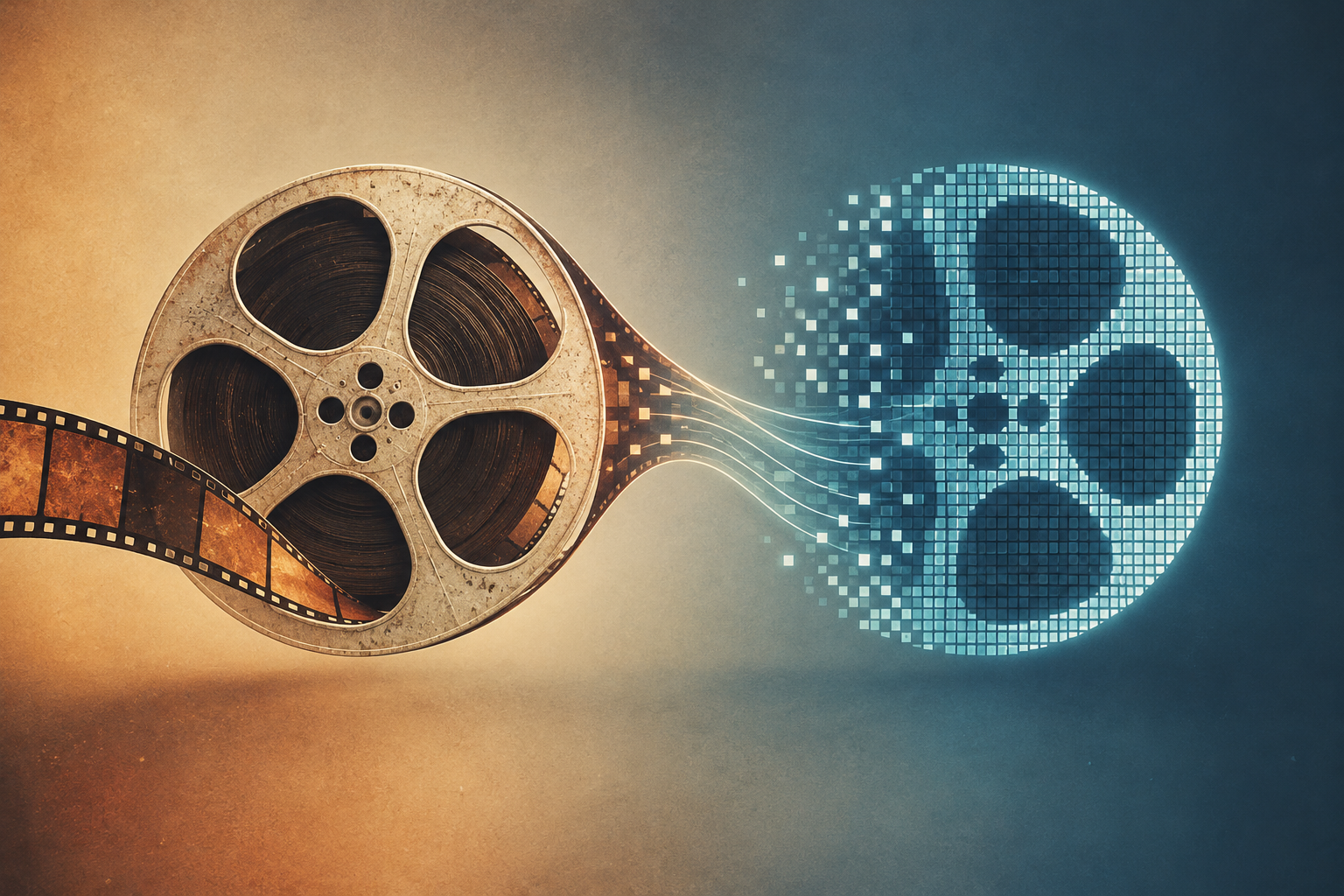
Film preservation has ceased to be an exclusively technical task to become a cultural debate about the nature of memory. For decades, the priority was clear: keep the physical support intact. Today, that priority coexists with an inescapable reality: digital access has altered how new generations perceive audiovisual heritage. It is not a linear substitution, but a complex coexistence where the material object and its virtual replica fulfill distinct but interdependent functions.
The fragility of physical support
Celluloid is a chemically unstable material. Its conservation requires strict environmental conditions, temperature and humidity control, and minimal handling to prevent degradation. This vulnerability has been the historical driver of preservation policies. Institutions like the Spanish Film Library have focused their efforts on restoration and dissemination as pillars of cinema's survival. Evidence suggests that without these physical interventions, much of the film archive would have disappeared. Film is not just an archive; it is a material artifact susceptible to time.
The rise of the digital archive
Simultaneously, a second front of conservation has emerged: the digital one. Recent studies indicate that online access to digital film archives positively influences the perception that cultural heritage remains alive. In a society increasingly mediated by the digital, online availability is not a luxury but a condition for cultural relevance. The digital archive allows for mass dissemination that physical support, due to its fragile and limited nature, cannot offer. This accessibility transforms the passive viewer into an active user of heritage.
Tension between authenticity and access
Here lies the central complexity. There is an inherent tension between the material authenticity of celluloid and the versatility of the digital archive. The original possesses an aesthetic and historical quality that the digital copy, no matter how high its resolution, cannot fully replicate. However, the digital offers a layer of interpretation and dissemination that amplifies the work's reach. Institutions face the challenge of balancing the preventive conservation of originals with the creation of high-quality digital copies. This balance is not trivial; it involves ethical and technical decisions about what is preserved, how, and for whom.
The redefined role of the museum
The museum and film archive are redefining their function. They are no longer just custodians of objects, but managers of cultural contexts. Technology is not merely a copying medium, but a new environment where the work acquires new meanings. MOMI, for example, encompasses overlapping chronologies that reflect the evolution of cinema in its social context. This integral perspective allows understanding cinema not only as a product but as a cultural phenomenon. The digital museum thus becomes a space of mediation between past and present.
Challenges in unequal contexts
This transition is not uniform. In Latin America, film preservation policies operate in contexts of coexistence and inequality. Resources for digitization and physical conservation are limited, forcing prioritization. The preservation of film memory in these regions faces specific challenges that require strategies adapted to local reality. The globalization of digital access does not eliminate the economic and technical barriers that persist in many institutions.
Memory as active construction
Digitization has transformed film memory from a static archive to an active construction. Online access allows heritage to be constantly reinterpreted by new audiences. This does not mean the original loses value, but that its meaning expands. Technology acts as a catalyst that keeps the cultural relevance of cinema alive. The perception of accessibility is key for heritage not to become a relic, but a living part of contemporary culture.
Towards hybrid conservation
The future of film preservation seems to be hybrid. Neither celluloid nor pixel is sufficient on its own. The most effective strategy combines rigorous physical conservation with accessible digitization. Institutions must invest in both fronts, recognizing that each has a distinct value. The ultimate goal is not to choose one over the other, but to manage the duality to ensure that cinema remains a living, accessible, and meaningful heritage for future generations.
- Decade
- 2000s
- Region
- Global
- Level
- Advanced restoration
- Entities
- Museum
Sources and references
- Cine en el museoopenalex.org · 2026-10-20
- Museos del cine latinoamericanos Políticas de preservación fílmica en contextos conviviales y desigualesopenalex.org · 2026-10-20
- Museos y archivos del cineunesdoc.unesco.org · 2026-10-20
- El valor del archivo digital de la historia del cine: disposición a ...translate.google.com · 2026-10-20
- (PDF) El cine como patrimonio cultural: el caso de la ...www.researchgate.net · 2026-10-20
- Preservación de la memoria cinematográfica - RiuNet - UPVriunet.upv.es · 2026-10-20