How an album turns loose pieces into a series
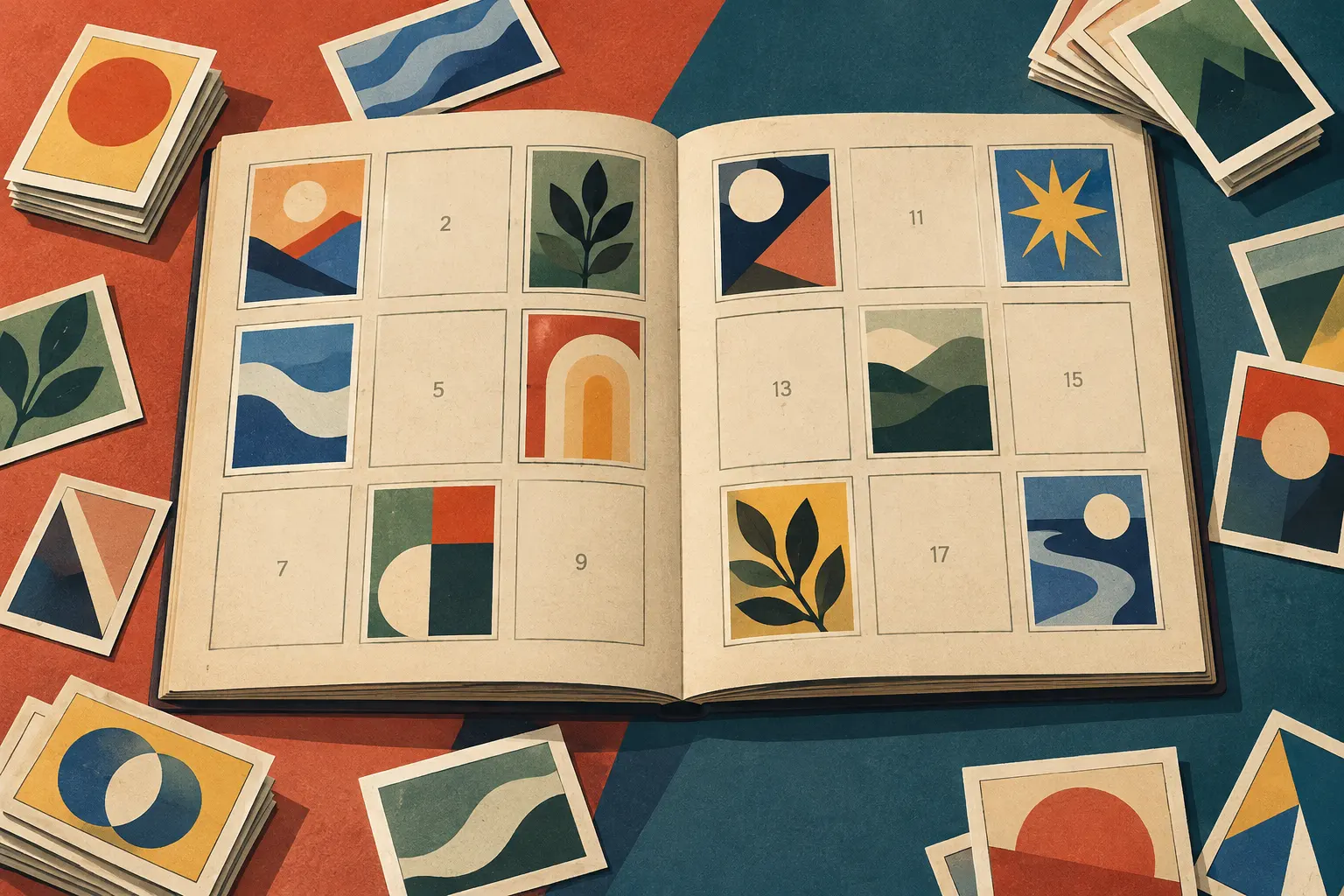
A sticker album does more than store images: it gives them an order. Numbered spaces indicate which pieces belong to the series and where they go. By gathering them on its pages, the album offers a visual reference for recognizing the set and tracking what is missing. In this sense, it works as a physical catalogue, although it may not record every publishing variant or change between print runs.
That order can also suggest a way of reading. The educational collection Mérida, Patrimonio de la Humanidad, listed by the National Museum of Roman Art among its educational resources, covers the city’s history from the pre-Roman period to the contemporary era. In a format like this, the succession of images can link periods and themes, giving a shared framework to pieces that might otherwise circulate separately.
The album therefore does more than make classification easier: it turns a selection into a route. The choice of subjects and their placement direct the reader’s attention and shape a collectible narrative. In a historical collection, that route reflects how the past was chosen for presentation; numbered pages alone do not make it a complete or neutral account of history.
Duplicates and the social life of a collection
When stickers are acquired without knowing in advance which image each contains, a collector may receive pieces they already own. A duplicate may seem surplus to one person’s album, yet prove useful to someone else. The individual aim of filling empty spaces can thus lead naturally to a shared activity: comparing lists, offering duplicates and agreeing on swaps.
A collection exists beyond its covers. It also extends into stickers that change hands and conversations about missing or repeated numbers. The album provides a visual and numerical guide; swapping broadens the chances of finding the missing pieces. These are distinct but connected dimensions of the same collecting practice.
This circulation adds a history of use to the object. Empty spaces indicate that the series is not yet complete for its owner; loose stickers and exchanges suggest that pieces have moved between people. They cannot, by themselves, reconstruct every transaction or identify those involved, but they help show that collecting can be both an individual and a shared activity.
Documenting a collection without confusing culture with price
To identify a series, it is useful to record the album title, the publisher if named, the visible numbering or sequence, and features that distinguish individual pieces. A catalogue description can compare copies and record variants when the objects themselves or publishing documentation support them. Differences in printing, condition or presumed rarity do not establish historical or monetary value without specific evidence.
An album’s cultural significance does not depend on being complete or on its market price. Its arrangement preserves how a subject was organized; signs of use, empty spaces and swapped stickers can offer clues about how the collection was assembled. In historical albums, selection and sequence also reveal which episodes or motifs were chosen to shape a narrative for collectors and readers.
Understanding the album as both object and system makes it possible to consider these layers together: its pages classify, its images communicate, and duplicates help sustain exchanges. Attending to the collection and the practices around it offers a fuller account than measuring it only by filled spaces or an attributed price.
- Decade
- 2000s
- Region
- Global
- Level
- Collector
- Entities
- Museum, Mérida, Patrimonio de la Humanidad
Sources and references
- Desarrollo y conservación del patrimonio cultural-natural en el contexto neoliberal y nuevas tecnologíasdoi.org · 2026-11-08
- Plan museológico, herramienta de planificación y gestión para el patrimonio cultural mueble : museo de Artes Gráficas, Imprenta nacional de Colombiaopenalex.org · 2026-11-08
- Rare Vintage Print Media Archivetherecord.institute · 2026-11-08
- Didáctica-Difusión-Museología-Museografíawww.cultura.gob.es · 2026-11-08
- Coleccioneswww.museosoumaya.org · 2026-11-08