A studio credit is not the whole story
When an episode ends, the animation studio is often the most recognizable name in the credits. But producing the animation does not necessarily mean that the studio conceived the project, financed its development, managed its rights, or took on the commercial risk. A series may also involve publishers, distributors, music companies, and other partners.
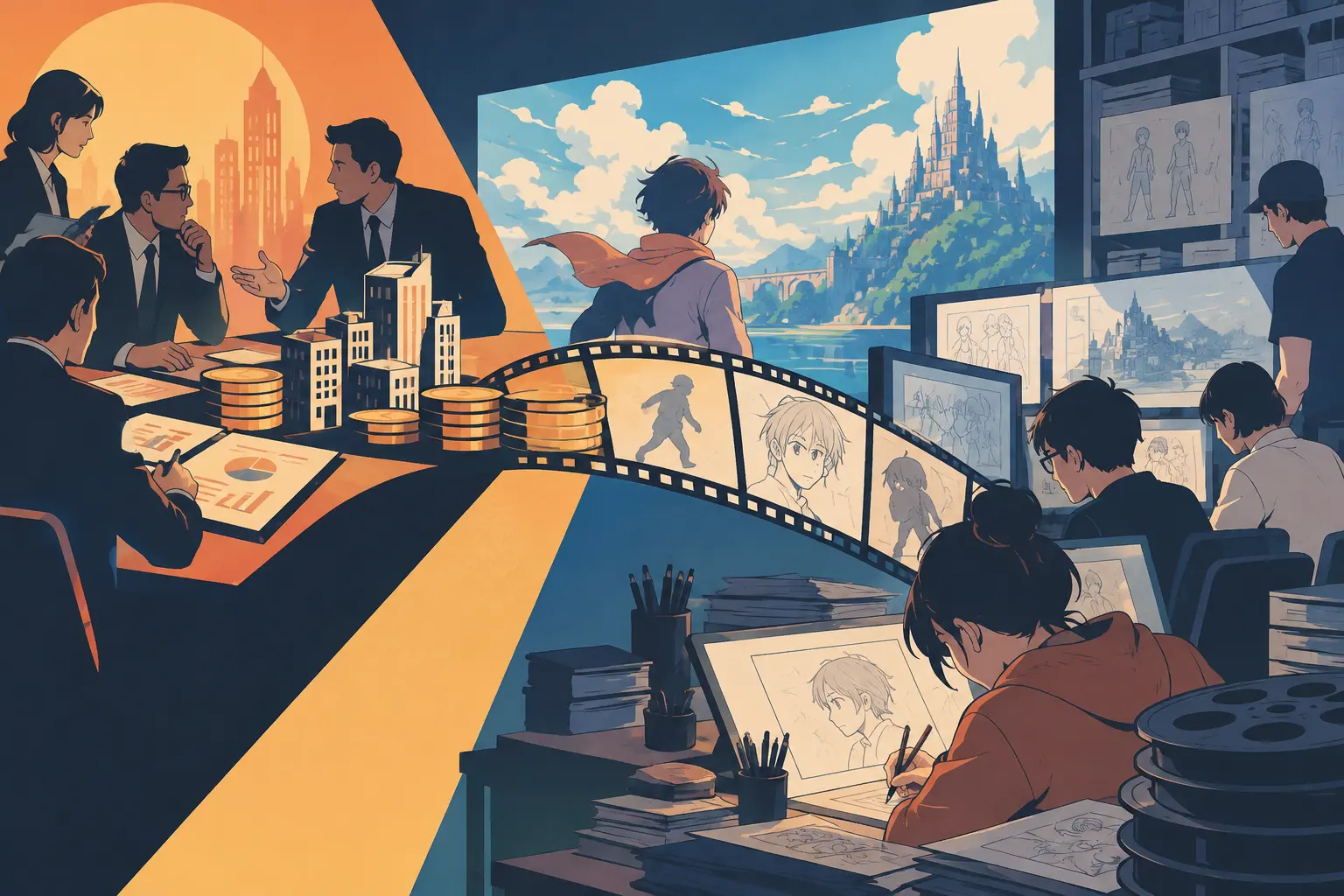
One common way to organize this collaboration in Japan is the production committee: several companies join around a work and contribute resources, financing, or services. The arrangement spreads some of a project’s risk among its members and brings together different areas of expertise. A publisher may handle publication; another company may take responsibility for music, promotion, distribution, or merchandise. Members do not necessarily contribute equally or receive equal shares of revenue.
The distinction matters because the word “studio” can suggest a broader corporate authorship than the credits establish. A studio may be responsible for producing the animation without belonging to the committee. Conversely, committee membership does not mean that a company animates the series or decides every staging choice.
What the credits show—and what they do not
Committees often take the work’s name followed by terms such as “Project” or “Partners,” though conventions vary. Some include just two companies; others have more than ten. Sakuga Blog’s explanation notes that the order of companies can offer a clue to their relative financing contributions: appearing earlier may generally point to a larger financial stake. It is not, however, a public accounting of contracts or an automatic measure of artistic influence.
The committee’s membership offers a useful indication of the business relationships supporting a production. The presence of a publisher, music company, or distributor can prompt questions about which areas of exploitation matter to each partner. But credits alone do not necessarily identify who holds each right, how much each company contributed, or how revenue is divided. Those details depend on specific agreements that are not visible in a list of names.
It is also important to distinguish corporate participation from creative authority. Committee members may have input on matters connected to their interests, but the director’s and creative team’s latitude depends on the project and its agreements. Attributing a particular decision requires evidence tied to that work, such as interviews, detailed credits, or production documents. The list helps frame the questions; it does not answer all of them.
MAPPA and the Chainsaw Man contrast
MAPPA shows why it is unwise to treat every studio as if it followed a single financing model. Founded in 2011 by Masao Maruyama, a former producer and founder of Madhouse, the studio began with the aim of bringing Kono Sekai no Katasumi ni, directed by Sunao Katabuchi, to completion. The account of MAPPA’s history says the project struggled to secure funding and that its release once seemed uncertain. The case shows how the organization of a film can be closely connected to the creation of a new production structure.
The studio’s later work has included different forms of collaboration, in-house teams, and assignments to outside creators or studios. According to the description of its practices, MAPPA often participates in production committees, but the 2022 television series Chainsaw Man was an exception: the studio produced it with its own investment rather than pooling funds from several companies through the usual committee model. The contrast illustrates two possible arrangements; it does not establish that every MAPPA project is financed in the same way.
The organization of the work is not just a question of who supplies the money. MAPPA has developed in-house departments for digital work and CGI, as well as locations with distinct functions. Its Sendai studio, for instance, has been associated with in-between animation and finishing, alongside training and local employment goals. At the same time, the studio works with freelancers and outsources tasks. Production capacity therefore depends on the combination of financing, staff, departments, and collaborators—not just the brand on screen.
A guide to reading production credits
When researching how an anime was made, it helps to keep three questions separate: who produced the animation, which companies joined the committee, and which working processes are documented. Credits can help with the first two, but they do not by themselves explain how each shot was made or who proposed a visual decision. Reconstructing those details requires specific materials—such as storyboards, layouts, or technical documentation—reliably connected to the title.
This approach avoids two shortcuts: assuming the animation studio is also the owner or main financier, and assuming the committee automatically determines every artistic detail. Credits map some of the responsibilities and partnerships involved. Understanding a particular title means reading that map carefully and distinguishing documented facts from inferences it merely suggests.
- Decade
- 2000s
- Region
- Japan
- Level
- Enthusiast
- Entities
- Televisión, Anime, Mappa
Sources and references
- Anime Complejo. La ambigüedad narrativa en la animación japonesadoi.org · 2026-10-31
- ¿Qué es un comité de producción de anime? - Blog de Sakugatranslate.google.com · 2026-10-31
- Animees.wikipedia.org · 2026-10-31
- Ánima Estudioses.wikipedia.org · 2026-10-31
- Mappa (estudio de animación)es.wikipedia.org · 2026-10-31