An archive of music and context
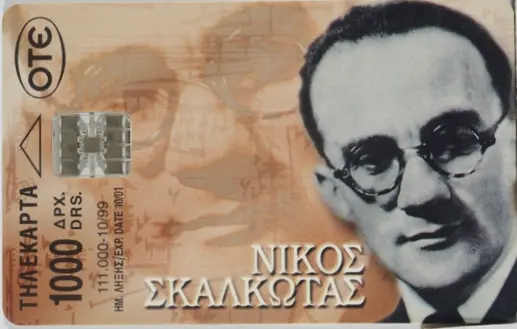
The Nikos Skalkottas archive at Greece’s Lilian Voudouri Music Library contains manuscript and printed scores, posters, programmes, correspondence, photographs, texts and audiovisual materials. Taken together, these records make it possible to study not only the compositions but also the circumstances of their creation and circulation: how the music related to its period and to the people and institutions around the composer.
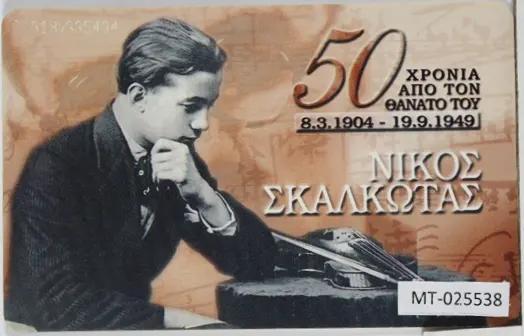
Skalkottas (1904–1949) was a Greek composer of twentieth-century classical music. His work encompassed different techniques and styles, including twelve-tone composition and pieces inspired by Greek musical tradition. The study that used the archive as a research case contrasted two works: the tonal dance Kleftikos, which some participants recognised from its use as opening music for radio and television programmes, and the less familiar atonal Octet. Participants’ associations differed between the pieces. Familiarity, personal memories and the way a work is presented are part of listening, not incidental to it.
From document to sound
The project began with a challenge specific to music archives: their records are tangible objects, but the music they refer to is experienced as sound and cannot be reduced to notation. A manuscript score can offer evidence about a composition and its history; mediation can help visitors without specialist training connect that evidence to what they hear.
People consulted during the study expressed interest in Skalkottas’s life, his historical context and the relationship between music and society, as well as in musical matters themselves. In response, the team developed two complementary proposals. One was a mobile digital story that imagined a journalistic journey through places associated with the composer’s life, combining episodes with group discussion activities. The other let visitors listen to compositions in virtual reality and record impressions using words placed on a two-dimensional emotion model. Manuscript scores appeared in the visual environment alongside the music being heard.
Emotional annotation was intended to express personal associations, not to provide a definitive interpretation of the music. Nor was it meant to show that a piece produces the same emotion in everyone. The study distinguishes emotions perceived in music from those experienced by listeners, and notes that the two do not necessarily coincide.
The medium shapes the act of listening
Hearing a work in an archive, in an exhibition or through an immersive device is not quite the same experience. A score allows close attention to notation and visual detail; a recording presents a particular performance; an interface directs attention through images, controls and actions. Each medium makes certain approaches possible while also imposing limits or drawing attention elsewhere.
In the virtual-reality prototype, the aim was to reduce distractions from the physical surroundings and encourage more focused listening. The team also identified the opposite risk: if the visual environment, controls or tasks demand too much attention, the music may recede into the background. Design sessions led to a simple, bounded environment and fewer annotation options, so interaction would not repeatedly interrupt listening. Immersion alone does not guarantee attention; what matters is how sound, image and action are balanced.
Telling the past without blurring fiction and evidence
The digital story proposed approaching Skalkottas from several perspectives and placing his life in its historical setting, rather than separating the music from the social and personal conditions of its creation. Its narrative combined fictional characters with references to real people. This approach can invite participation, provided that imagined elements remain distinguishable from documented facts.
The published work describes a formative design phase, not a conclusive evaluation of the experiences’ effects on learning or musical appreciation. Its design drew on a user study with 198 participants and sessions with specialists. The article discusses audience interests and practical design questions, including how to balance interaction with listening; formal evaluation of the experiences was envisaged for a later stage.
The proposal points to a broader idea about preserving music. Safeguarding a work means more than keeping its score: recordings, documents and historical context provide different kinds of knowledge. Bringing them together can make an archive useful both to specialists and to a wider public, inviting attentive listening and personal interpretation while keeping those responses distinct from documented history.
Documentary gallery
- Decade
- 2000s
- Region
- Europe
- Level
- Enthusiast
- Entities
- Televisión
Sources and references
- Desarrollo y conservación del patrimonio cultural-natural en el contexto neoliberal y nuevas tecnologíasdoi.org · 2026-10-30
- Conservación y Restauración del Patrimonio Cultural en soporte Papel - Museo Jesuítico Nacional de Jesús Maríadoi.org · 2026-10-30
- Archivo del Museo de Música de Mariana, siglos XVIII-XIXwww.unesco.org · 2026-10-30
- Diseño de una experiencia aumentada para un archivo ...translate.google.com · 2026-10-30
- Patrimonio culturales.wikipedia.org · 2026-10-30