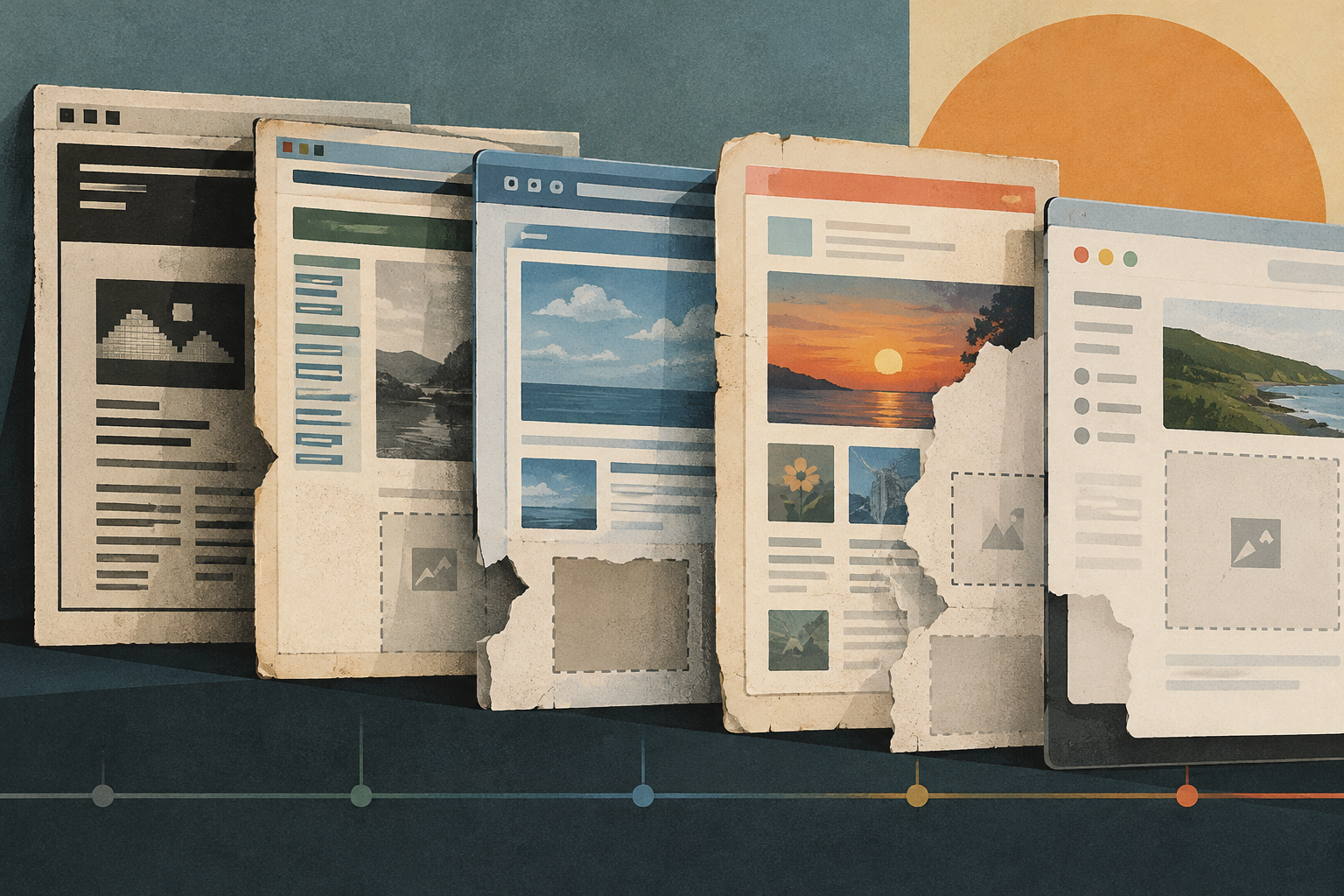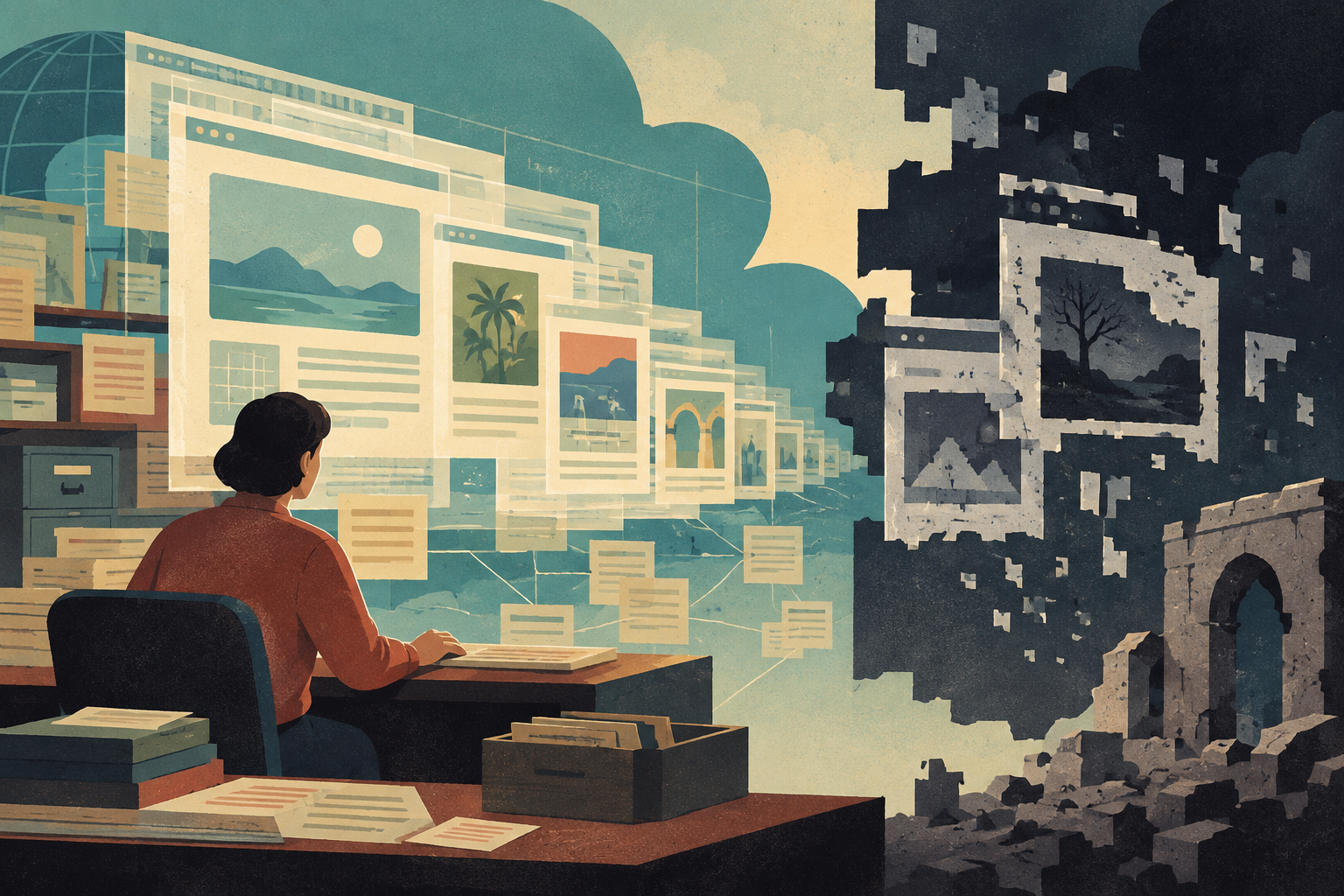
A saved page can look like a window onto the past, but it is a partial window. It may show content that was captured; on its own, it cannot prove how people reached it, which features were available in a particular session, or what people did with the service. This distinction matters when researching the internet before today’s interfaces: a memory of an experience is not the same as the date of a page, and a capture is not the complete history of a service.
An archive as a trace, not a substitute
The National Library of Spain describes its Spanish Web Archive as a collection intended to preserve websites and document internet history, the creation of websites, customs and ideas. This clearly states the collection’s documentary value: it can support research into both websites and cultural change. But the description does not claim that every page was captured in every version, or that every interactive feature can be reproduced. Begin with what the source actually says; do not turn a preservation aim into a guarantee of completeness.
From general history to a specific question
Overviews from Telefónica, the Universitat Politècnica de Catalunya and the ACTA article provide broad frameworks for the history and development of the internet. The work hosted by the Polytechnic University of Madrid focuses on the beginnings of the internet in Spain. These sources can help frame questions and place the network in historical context; the supplied excerpts, however, do not describe a particular vanished service or provide a detailed chronology of its archived pages.
Research into a specific service should therefore avoid treating a general history as direct proof of a particular feature. A document that describes the development of the internet in broad terms does not, by itself, establish when a given page appeared, whom it could reach, or how a form behaved. Such claims require traces directly related to the service and to the date being asserted.
What a capture can support
A capture can support bounded claims: that an archived representation of a page exists, that certain content appears in it, or that visible differences exist between preserved records. To make a case about a service, a researcher should record what is being observed, what date the archive assigns to the capture, and which aspects are absent. The material supplied here contains no specific captures, archived addresses or examples of changes to a page; it therefore cannot establish a particular interface or feature for any service.
The same caution applies to absences. A feature not appearing in a capture does not necessarily prove that the service never had it; it supports only the statement that the feature is not visible in that record. Nor can a complete user experience be inferred from a page in isolation. Editorially, it is more accurate to describe the document’s limits than to fill its gaps with a plausible scene.
Comparing kinds of documentation
The question “Which archives can help reconstruct vanished services?” has no single answer in the supplied sources. The BNE establishes the value of its Spanish Web Archive for preserving websites and studying them as records. The historical overviews and the work on Spain help provide context. Taken together, they suggest a cautious method: distinguish general context from direct evidence, identify which document supports each claim, and state what remains unverified.
If other materials are brought into a future investigation, their provenance and dates should be checked before linking them to a capture. The evidence supplied here does not list other collections, formats or holdings, so it would be irresponsible to present them as confirmed resources or to claim that they resolve the limitations of an archived page.
What remains unverified
The supplied sources support the importance of preserving the Web and studying its history; they are not enough to reconstruct the everyday operation of a particular vanished service. They identify no users, sessions, launch or closure dates, or interactions with specific pages. Nor do they provide an attributable interview or transcript that could present memories as direct testimony. This boundary does not diminish the archive: it clarifies which questions the consulted material can answer and which require further evidence.
Reading an archived page therefore means distinguishing the object from the experience. The preserved record is a source for studying the Web, not an automatic replica of everything that happened around it. The most reliable reconstruction begins when each claim is kept within the reach of its evidence and gaps remain visible instead of being turned into assumed memories.
- Decade
- 2000s
- Region
- Spain
- Level
- Enthusiast
- Entities
- Archivo de la Web Española, Internet
Sources and references
- Historia de internet - Arpanetwww.fib.upc.edu · 2026-10-12
- Historia de Internet: ¿cómo nació y cuál ha sido su evolución? -www.telefonica.com · 2026-10-12
- Historia de Internet - Wikipedia, la enciclopedia librees.wikipedia.org · 2026-10-12
- Historia de Internet y de sus inicios en Españaoa.upm.es · 2026-10-12
- Historia y evolución de Internetwww.acta.es · 2026-10-12
- Archivo de la Web Española | Biblioteca Nacional de Españawww.bne.es · 2026-10-12