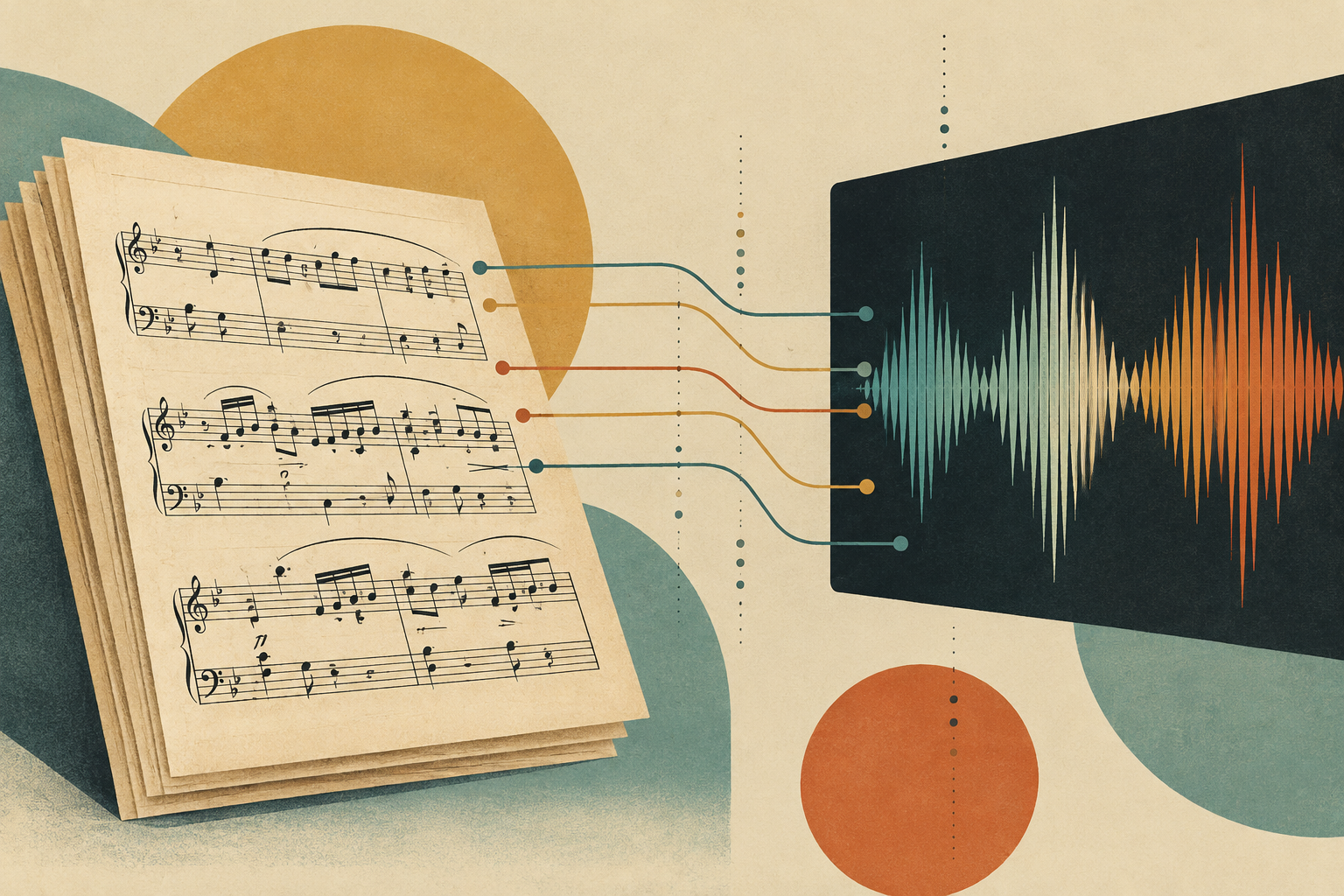
An archive is not a song
A history of music can begin with a simple question: what has survived of the music we want to study? The answer need not be a record. It may be sheet music, archival documents, bibliographic references or studies that examine music in context. Each trace makes something visible while leaving other things out of view. Identifying the kind of source in front of us is therefore a first step, not a cataloguing formality.
The materials available here illustrate that variety. The Museo Nacional de Artes Escénicas says that most of its musical heritage comes from the Museo-Archivo del Teatro Real, created by its director, Luis París, in 1919. El Museo Canario, meanwhile, describes musical holdings in its archive and a visit focused on written music and scores. These are references to particular institutions and collections; they do not justify assuming that all music archives hold the same materials or that preserved objects tell a complete story.
A score documents one form of music
A score makes it possible to study written music as a document. It may support questions about notation, composition or the transmission of a work, but it is not by itself equivalent to a sound performance. The written page does not automatically reproduce the choices of a player or singer, nor does it establish how a particular performance sounded. This distinction matters even when a score is associated with a familiar work: the work and the document are not the same thing.
El Museo Canario’s description is useful precisely because it sets a limit. The visit takes written music and preserved scores as its reference point. That description invites questions about what such a collection can contribute, but it does not justify attributing recordings, playback equipment or testimonies to the collection when the source does not mention them. Caution does not diminish an archive’s value; it helps specify what is being read and what questions it can support.
An archive also structures research
A collection does not speak without mediation. Its institutional history, preservation criteria and the way its holdings are described affect what researchers can find. The Museo Nacional de Artes Escénicas page gives provenance information: much of its musical heritage comes from the Museo-Archivo del Teatro Real, established in 1919. That helps locate a history of preservation, though it cannot replace a detailed inventory or establish how every documentary group was formed.
Historical research on music operates at another scale. A 2004 academic work among the results is titled “La música como elemento de análisis histórico: la historia…” (“Music as an element of historical analysis: history…”), and its abstract characterizes contemporary music as an expression of social relations. The available excerpt does not allow its full argument to be reconstructed. It does, however, indicate that academic work can treat music as an object of historical and social analysis—a different task from describing a score or establishing a collection’s provenance.
Work, edition and medium are not synonyms
It is useful to separate three levels. A work is what research identifies as a musical creation; an edition is a particular publication of that work; and a medium is the object or format through which it is preserved, distributed or heard. The sources consulted do not document a specific case in which all three levels can be compared side by side. Here, the distinction serves as an editorial tool for avoiding claims that go beyond what a source shows.
In practice, a reference to written music tells us about a kind of document, while a reference to an archive or historical study points to other contexts of interpretation. None of those mentions is enough to establish how a medium shaped listening in a particular case. That would require evidence about the medium, its use, and the related work or edition. Without it, it is better to ask the question than invent an answer: what listening experience can this object document, and what lies beyond its reach?
Chile as an example of historical scale
The results include references to Historia Social de la Música Popular en Chile, 1950-1970, a work by Juan Pablo González, Oscar Ohlsen and Claudio Rolle: a review published in the journal Historia and another bibliographic reference in Resonancias. Their titles and details identify research focused on Chilean popular music and a defined period. The available excerpts do not provide enough information to summarize specific findings about genres, artists, recordings or listening practices.
The presence of more than one bibliographic reference illustrates a useful distinction: a work can be a subject of study and also a publication with its own history of reviews and citations. That history should not be confused with the music the book examines. These records allow us to identify a publication and part of its bibliographic reception; they do not replace consulting the book or justify attributing conclusions to it that are absent from the supplied evidence.
What can be said, and what remains open
The sources support a limited conclusion: music history can draw on archives, scores and academic work, but those materials are not interchangeable. Institutional provenance helps contextualize a collection; a description of scores defines the kind of holdings being discussed; and academic titles or abstracts indicate research questions and scale. These are complementary clues, not a complete account of musical experience.
The central question about medium and listening remains open. Answering it precisely would require sources identifying specific formats or devices, editions, relevant dates, and testimony or documentation of use. This selection does not provide that evidence for a particular case. Distinguishing what is known from what is undocumented is not a shortcoming to hide; it is what makes a more precise history possible, one in which a score is not passed off as a recording and a bibliographic reference is not turned into an invented memory.
- Decade
- 2000s
- Region
- Global
- Level
- Introduction
- Entities
- Museo Nacional de Artes Escénicas, El Museo Canario, Luis París
Sources and references
- (Reseña) Juan Pablo González, Oscar Ohlsen y Claudio Rolle, "Historia social de la música popular en Chile, 1950-1970"doi.org · 2026-10-11
- Juan Pablo González, Oscar Ohlsen y Claudio Rolle. 2009. Historia Social de la Música Popular en Chile, 1950-1970. Santiago: Ediciones Universidad Católica de Chile.doi.org · 2026-10-11
- Archivo Musical - Museo Nacional de Artes Escénicasmuseodeartesescenicas.inaem.gob.es · 2026-10-11
- Recuperando la música del archivo de El Museo Canarioblogarchivoelmuseocanario.wordpress.com · 2026-10-11
- la música como elemento de análisis histórico: la historia ...bibrepo.uca.es · 2026-10-11
- “Los Sonidos del Archivo”, una visita para conocer el ...www.elmuseocanario.com · 2026-10-11