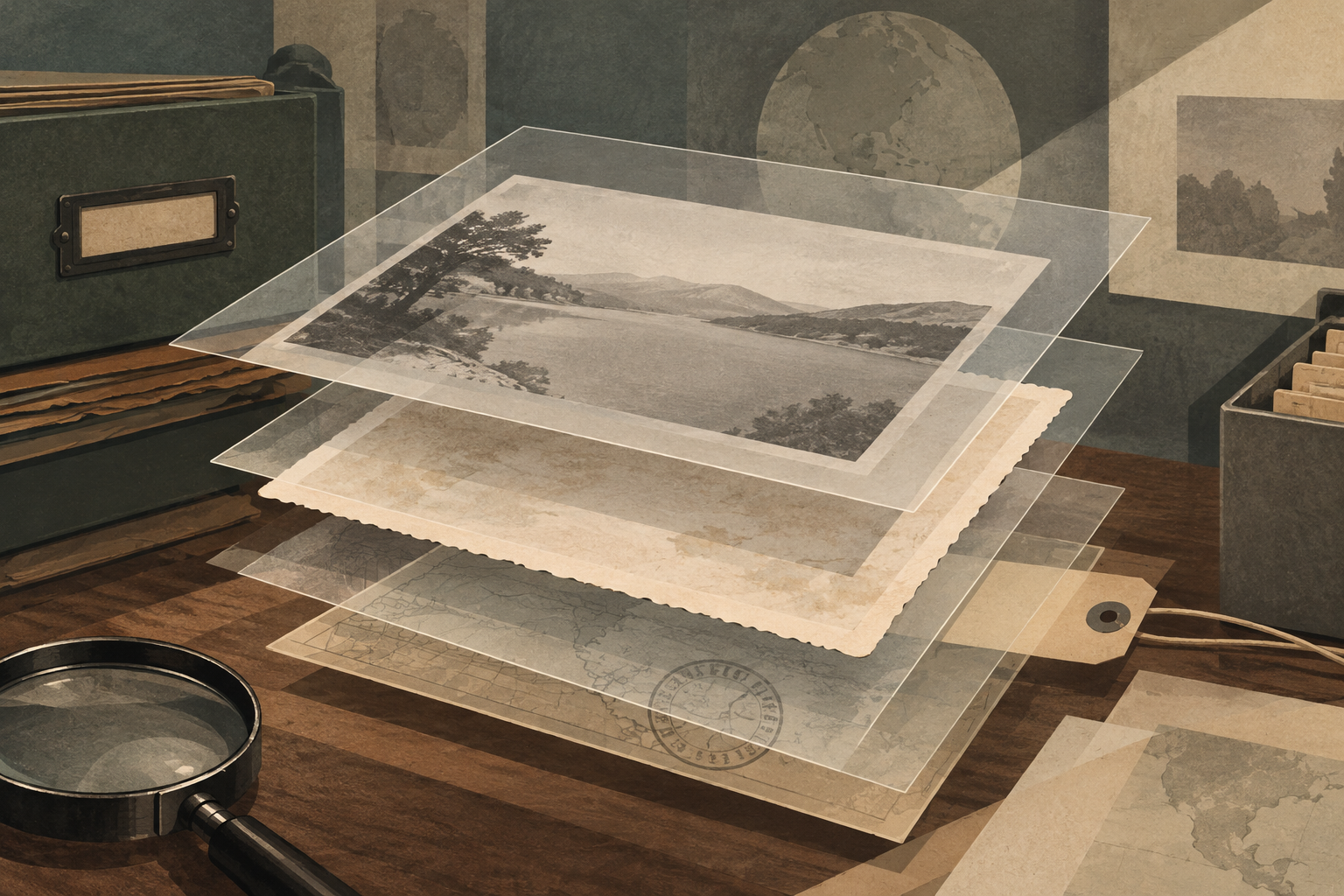
An archival photograph can be an image, a material object and an item within a documentary collection at the same time. Each aspect invites different questions, but not every answer is contained in the image itself. Research on photography and archives, together with studies of collections related to visual culture and art history, offers a way to distinguish what can be observed from what requires external records. That distinction is also a matter of rigor: context matters, but gaps should not be turned into certainty.
The image is not the whole document
A photograph can be described through visible elements: figures, spaces, framing and relationships within the composition. Such description does not automatically identify who appears, when the image was made or how it was used. Those claims may depend on information outside the image, such as catalogues, annotations or provenance records. The evidence available here does not detail any such documentation for a particular collection.
Isabel Argerich’s scholarly article “Photography and Archive” provides a bibliographic starting point for considering this relationship. Its citation identifies its subject and publication, but does not support attributing particular findings that are not included in the available information. The methodological question remains useful: what can be observed directly, and what is known through records accompanying the object?
The support is part of the interpretation
A photograph does not circulate only as a reproduced image. Its support and production process are part of its material nature and may be relevant to its description and study. Without examining a specific object, however, it is impossible to determine its technique, condition or conservation needs. Caution does not weaken analysis; it prevents a general possibility from being presented as a diagnosis of an individual photograph.
This distinction matters in archival work. A visual description may be useful, but it cannot replace a substantiated material identification. Nor does naming a photographic process establish the object’s complete history: making, preservation, reproduction and cataloguing are related, but separate, questions.
From visual culture to institutional collections
A study by Alicia Parras Parras and Julia Rodríguez Cela examines underground photography and the fanzine Rockocó through the Archivo Miguel Trillo at the Museo Nacional Centro de Arte Reina Sofía. The title and citation place the research at the intersection of photographs, visual culture and circulation through print. On their own, they do not reconstruct the archive’s specific contents or establish the article’s conclusions.
The case raises a broader cultural question without answering it automatically: photographs can acquire different meanings according to the collections in which they are preserved and the routes through which they circulated. An institutional archive is not merely a sum of images; its organization and documentation shape the conditions under which it can be studied. Claims about how a particular collection was formed or who used it require specific evidence.
Photographs as evidence for art and collections
V. David Almazán Tomás’s study of historical photographic holdings related to Aragonese art at the Biblioteca Nacional, the Museo del Prado and the Archivo Histórico Nacional points to another documentary role: photographs can be used in research on artworks and collections. The citation establishes that subject area, but does not justify general claims about what each photograph revealed or which methods the study used.
Read alongside the work on the Archivo Miguel Trillo, it suggests two possible fields of interpretation: the circulation of images in visual culture and the use of photographs as documents for researching art. These roles are neither identical nor mutually exclusive. In either case, a photograph gains meaning through links to other materials and to the history of its preservation, though those links must be demonstrated individually.
Provenance and context without filling the gaps
Provenance prompts questions about where a photograph came from and how it entered a collection. Context can place it within documented practices, institutions or uses. But both terms become empty labels if they are not supported by identifiable records. A biographical attribution, date or historical interpretation is not confirmed merely because it seems plausible when looking at the image.
A sound approach keeps different levels of certainty visible: what the photograph shows; what its material features indicate; what the records document; and what remains a hypothesis. This separation does not prevent interpretation. It makes clear what evidence supports each reading and what further information would be needed to reassess it.
What the available sources cannot establish
The references supplied support the existence of research on photography and archives, the Archivo Miguel Trillo and Rockocó, and historical photographic holdings related to Aragonese art. They do not include the full texts of those studies or the examination of a specific photograph. They therefore cannot identify a particular technique, date an image, reconstruct its history or support a universal conservation protocol.
The conclusion is straightforward: an archival photograph should be read as both image and object, while claims about its history require proportionate documentary support. Separating observation, materiality, provenance and context makes interpretation more useful and verifiable. Where evidence is missing, acknowledging the limit is part of historical work, not a refusal to understand.
- Decade
- Contemporary
- Region
- Global
- Level
- Enthusiast
- Entities
- Museo Nacional Centro de Arte Reina Sofía, Archivo Histórico Nacional, Rockocó
Sources and references
- Fotografía y archivodoi.org · 2026-10-17
- Fondos de fotografía antigua sobre el arte aragonés en la Biblioteca Nacional y unas notas sobre el Museo del Prado y el Archivo Histórico Nacionaldoi.org · 2026-10-17
- Una mirada documental de la fotografía underground a través del fanzine Rockocó. Análisis del Archivo Miguel Trillo en el Museo Nacional Centro de Arte Reina Sofía (MNCARS)doi.org · 2026-10-17
- 📸✨ Un nuevo fondo digital llega al Museo de los ...www.facebook.com · 2026-10-17
- La conservación del patrimonio también puede comenzar ...www.facebook.com · 2026-10-17