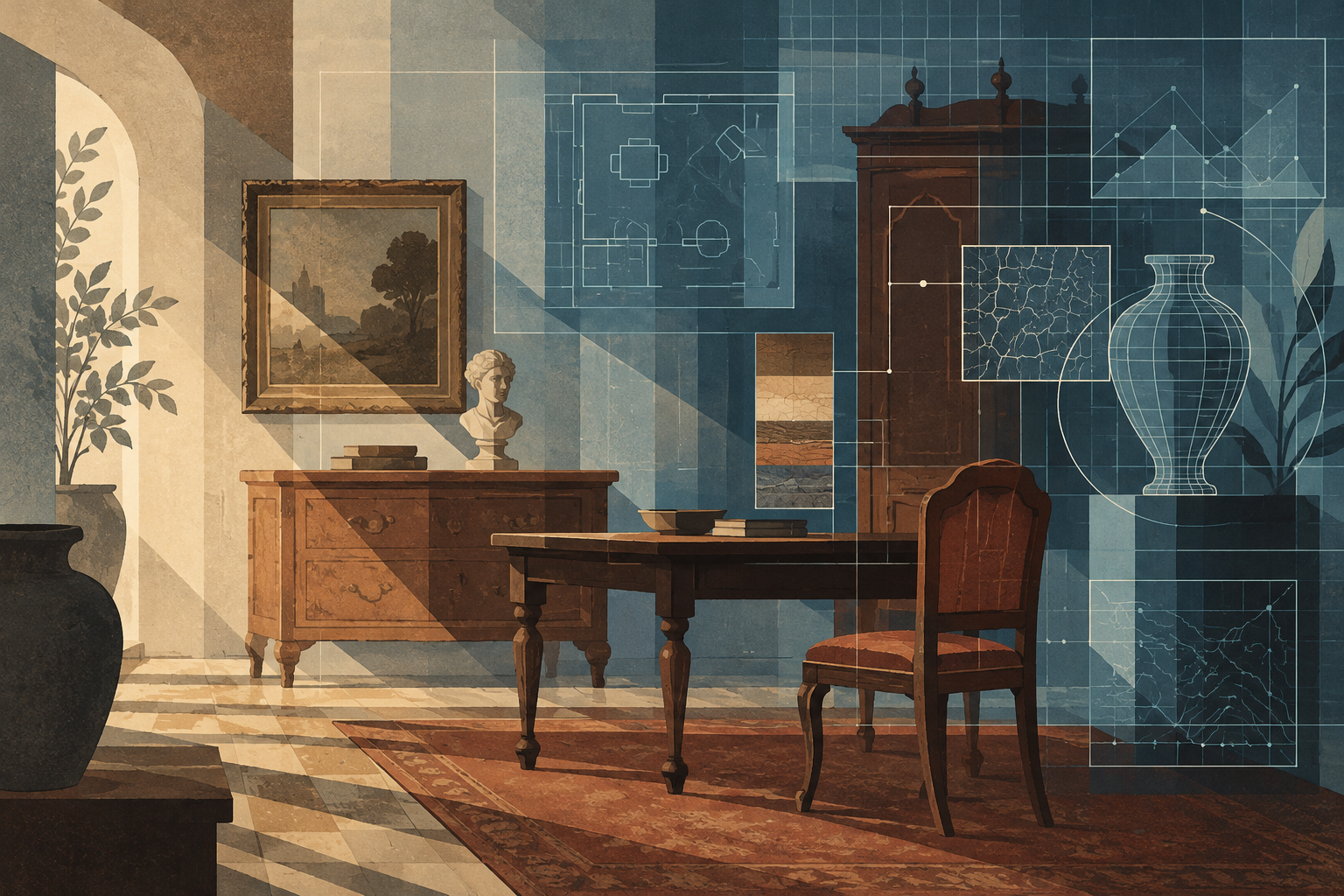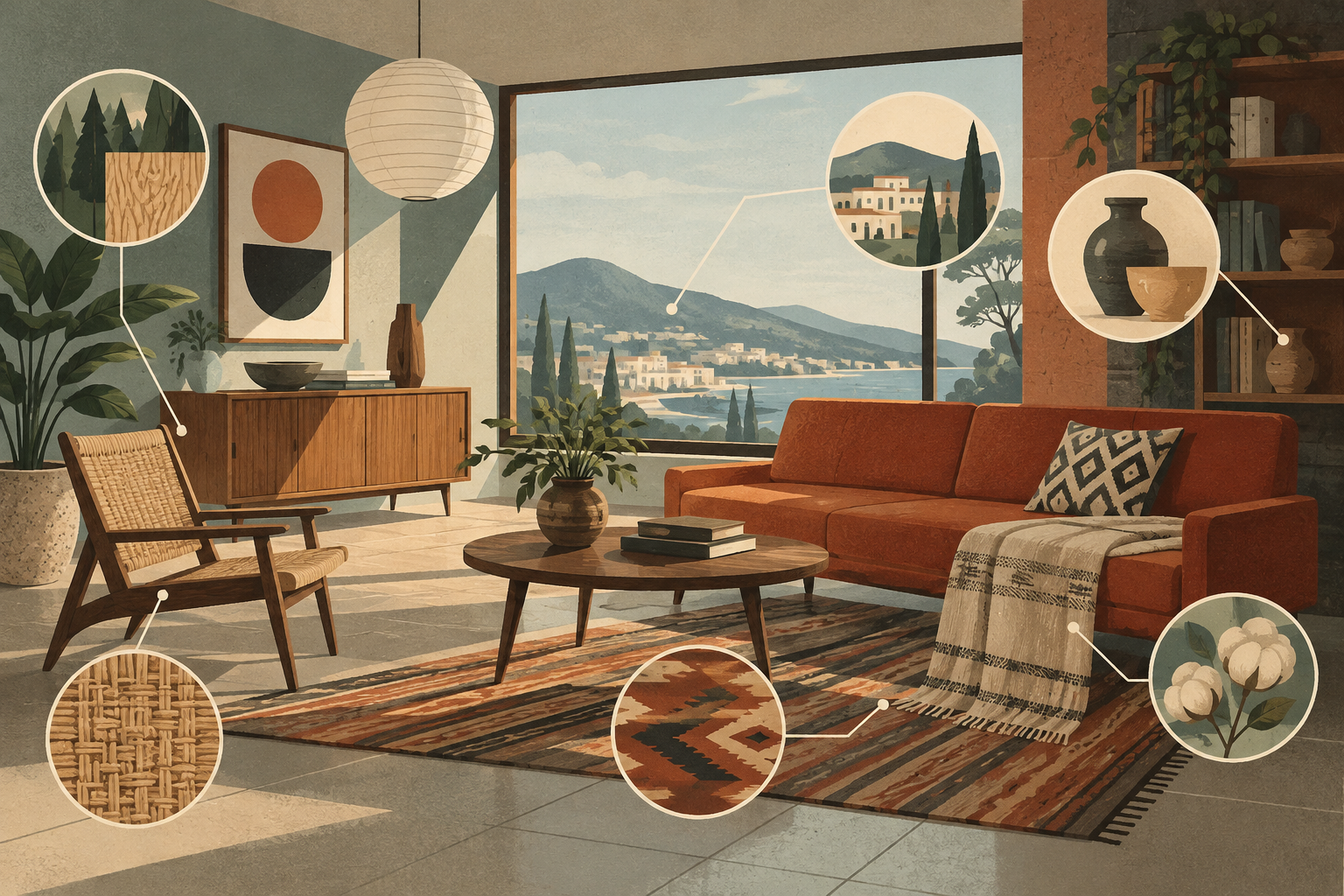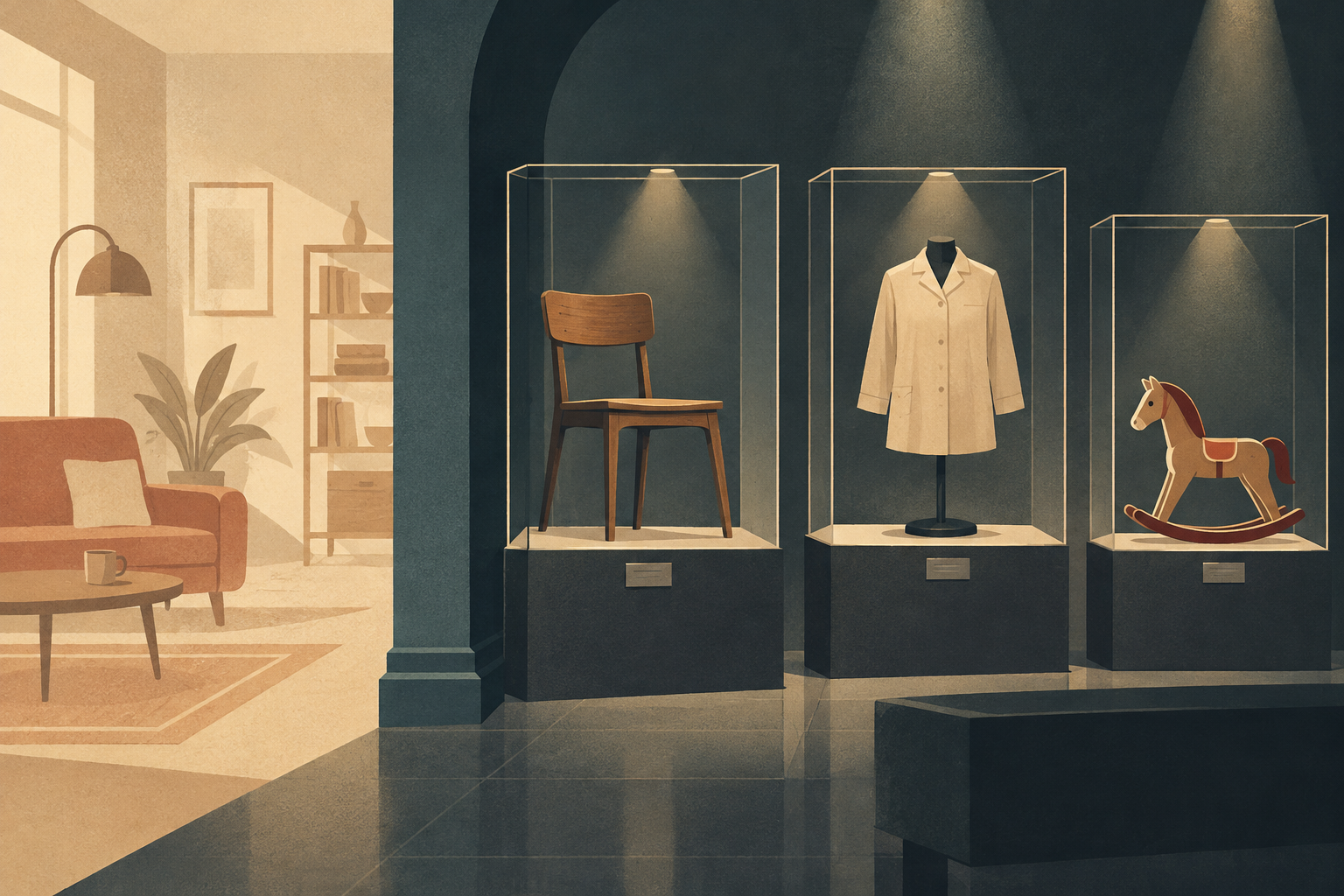
A piece of furniture, a garment or a toy may seem ordinary at home and become significant when it enters a collection. That change is not simply a matter of preserving an old thing: it turns an object detached from use into possible evidence of practices, relationships and ways of life. The central contribution of musealizing everyday life is also its difficulty: it makes the ordinary visible, while needing to explain the context that a display case can no longer provide by itself.
Ordinary things leave traces
Everyday life is often documented through modest objects, not only exceptional ones. A source describing the Regional Museum of Puebla lists furniture, clothing, toys, medicines and school supplies. The range matters: it suggests that an account of an era can encompass the home as well as dress, care, play and education. This list does not, on its own, establish how any household was organized or who used each object. It does show the potential of bringing different categories together to discuss ordinary practices.
The collection of the National Museum of American History offers another example of thematic breadth. The available description mentions ceramics and glass, textiles, domestic life and costume, alongside collections concerning ethnicity, education and religion. It says that the collections represent the everyday lives of diverse populations in the United States from the seventeenth through the twenty-first century. That span helps make clear that “everyday life” is not a single experience: it varies across periods and communities and can be approached through different material and social domains.
Removal changes the object
At home, an object participates in repeated actions and specific relationships. In a museum it is removed from those routines and observed as heritage or evidence. The change affects both function and perception: a displayed utensil no longer serves the task for which it was made, and a garment cannot by itself tell visitors who wore it, under what circumstances or what it meant to that person.
Physical preservation, then, does not mean that meaning remains intact. An object may survive materially while information embedded in its setting, use or the memories of people who knew it falls away. Exhibition faces a tension between protecting the thing and making the social life around it understandable. Presenting an artifact as though it could speak for itself risks reducing a complex history to a generic picture of the past.
From artifacts to relationships
One way to resist that isolation is to connect objects with archives and testimony, where these exist and can be responsibly linked to a particular piece. The supplied material emphasizes the importance of context, but does not describe specific files, voices or methods used for the collections mentioned. That limit matters: an interpretive label can guide a reading, but it should not stand in for missing evidence about an object’s provenance, owners or particular uses.
A community-museum proposal cited in the evidence describes everyday life as a space of cultural resistance, creativity and knowledge transmission, and calls for domestic objects to be connected with communities. This shifts attention from an artifact’s rarity to the relationships that made it useful and meaningful. It also raises a question of representation: who contributes knowledge about an object, and which experiences enter the account? The sources do not establish how individual institutions answer that question, but they make it part of the museum’s interpretive work.
A necessarily partial memory
A group of household objects cannot produce a complete portrait of society. Collections depend on what was kept, acquired or documented, and the material provided here does not explain the selection criteria or gaps of each museum. Similar objects may also have meant different things in different homes, communities and periods. The category of everyday life risks flattening those distinctions if it is presented as a uniform experience.
The conservation of ethnographic material appears in the evidence as a subject of museological reflection, but the excerpt gives no specific procedures or technical recommendations. It would therefore be unwarranted to attribute particular storage or display standards to it. What can be distinguished are two tasks that an exhibition must bring into conversation: protecting material objects and communicating, with clear limits, what is known about their social histories.
What a display can claim
The available examples support the claim that some museums include broad categories of everyday objects and that community-focused approaches can connect them with knowledge transmission and identity. They do not suffice to assess a particular exhibition, measure audience response or confirm that all institutions represent human experience diversely. Nor do they allow the biography of any one object to be reconstructed.
The cultural value of such objects lies less in their ability to offer a total account of the past than in the questions they make possible: what tasks they accompanied, what knowledge they required, who could use them and what was lost when they left their setting. A museum cannot return an object to domestic life, but it can make that distance visible. By acknowledging what is known and what is not, an exhibition can turn an ordinary thing into an entry point to social history without mistaking it for the whole story.
- Decade
- Contemporary
- Region
- Global
- Level
- Introduction
- Entities
- Museum
Sources and references
- Museizar la vida cotidiana, desde el sombrero a los zapatoswww.academia.edu · 2026-10-17
- Un objeto cotidiano también conserva una historiacinemedios.com · 2026-10-17
- Museo Nacional de Historia Americana (NMAH)translate.google.com · 2026-10-17
- museo comunitario que asciendewww.casapozonmuseo.org · 2026-10-17
- La Conservación de material etnográficounesdoc.unesco.org · 2026-10-17
- Patrimonio culturales.wikipedia.org · 2026-10-17
- Museo Histórico Municipal de Osornoes.wikipedia.org · 2026-10-17