A handheld that was more than a new Game Boy
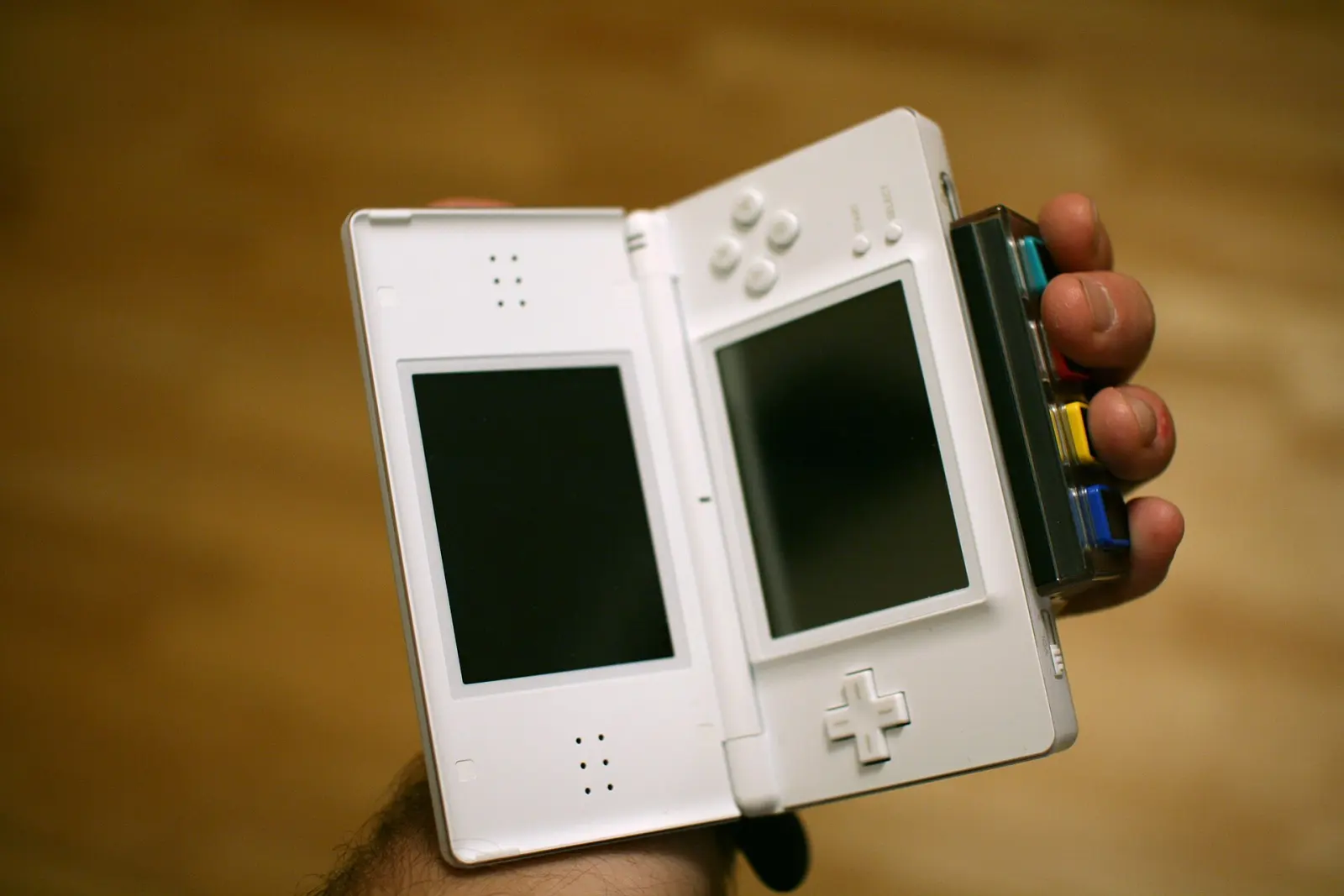
When Nintendo introduced the DS in 2004, it placed the system within its handheld history without presenting it as a straightforward continuation of the Game Boy line. Its most visible departure was a clamshell body with two vertically arranged screens, one of them touch-sensitive and operated with a stylus. The device did not merely display a game; it offered another surface for tapping, writing, pointing and organising information.
The initials DS referred to “dual screen”. The folding design protected the screens when the system was put away and, when opened, brought together a main display and another that could become an active part of the interface. This combination did not prescribe one way to play. It left developers to decide what belonged on each screen and which actions might move to touch.
The touchscreen as part of a game’s vocabulary
The second display could serve different purposes: showing a map or inventory, keeping instructions in view, or becoming a space for drawing and direct action. The stylus enabled gestures beyond traditional buttons, while the built-in microphone offered another form of interaction. These tools expanded the possibilities for design without requiring innovation to be presented solely as a leap in graphical power.
Two screens, however, did not guarantee an inventive design. Their potential depended on how each game used them. In some, the lower display complemented the action; in others, it could become the centre of the experience. This flexibility allowed games that made touch essential to coexist with those closer to the conventions of a button-led handheld.
The dual-screen layout also raised a question of composition: how should attention be divided between two small surfaces, and what information should remain visible without interrupting play? The hardware affected not only controls but also how a game could be read. On the DS, the interface was not merely a layer over the image; it was part of the way of playing.
Playing nearby, communicating without wires
The DS also included wireless communication. Local connections let nearby systems share experiences without cables, while Wi-Fi made connections over compatible networks possible. PictoChat, included with the system, allowed users to send messages and drawings to other DS consoles nearby. The handheld could be a solitary experience, but it could also link people in the same place.
That social dimension did not automatically turn every session into a group activity. It added possibilities: playing together, communicating or sharing a game when other systems were within reach. Portability therefore meant more than carrying a game from one place to another; it also let the console become part of everyday gatherings.
A console that sought to broaden the idea of its audience
Nintendo directed some of its marketing towards teenagers and young adults as well as people already familiar with its systems. The strategy aimed to prevent the DS from being seen only as a children’s product. At the same time, its library could bring together games accessible to people with different levels of gaming experience and titles for established players.
That breadth cannot be explained by the hardware or advertising alone. It also depended on the games and the different ways of approaching them. One player could rely on familiar controls and conventions; another could encounter an interface built around touching, drawing or acting on information on-screen. The DS did not erase differences between audiences, but it offered a shared platform for varied practices.
The initial reception also showed that launching a platform required more than an appealing presentation. The November 2004 US release was accompanied by strong demand and production adjustments. Japan received the system in December that year; Europe and Australia followed in 2005. Those staggered dates reflect the material work behind a global launch: production, availability and regional schedules mattered alongside design.
A family of models, with changes and trade-offs
The original idea remained recognisable through several revisions, though the models did not all retain the same features. Introduced in 2006, the DS Lite kept the two-screen layout and compatibility with Game Boy Advance cartridges while reducing size and weight and offering brighter screens.
The DSi added cameras and new features but removed the Game Boy Advance cartridge slot. The DSi XL, meanwhile, enlarged the screens. Each revision shifted the balance between dimensions, functions and continuity with the existing library. These were not merely cosmetic changes: they altered the relationship between the device and the games it could use.
The DS family illustrates a familiar tension in hardware design: preserving a recognisable identity while revising its limits. The folding dual-screen layout served as both a visual signature and an interface principle. But each model’s changes involved concrete decisions about what to keep, add or leave behind.
Understanding the DS as an object and a play environment
The Nintendo DS is best understood by considering the device, its interfaces, its connectivity and the games made for it together. The touchscreen changed the relationship between hands, stylus and image; the hinge protected the displays and brought them together when the system was opened; wireless communication extended the experience beyond a single unit. None of these features explains the platform on its own, but together they outline its possibilities.
Its historical contribution is not proof that every handheld innovation must use two screens. The DS made another route visible: changing how people interacted with and used a console in everyday life, rather than presenting each generation solely as a graphical advance. It also showed why platform design cannot be separated from a game library: technical features gain meaning through the games and practices they make possible.
- Decade
- 2000s
- Region
- Global
- Level
- Enthusiast
- Entities
- Game Boy, Nintendo, Revisiones, Mappa, Nintendo DS
Sources and references
- Historia de Nintendotranslate.google.com · 2026-11-10
- Historia de Nintendo: origen y evolución | Guiamodconsolasguiamodconsolas.com · 2026-11-10
- Diez años de Nintendo DS nos dejan nueve consolas ...www.xataka.com · 2026-11-10
- Todas las consolas de Nintendo: Historia completa con ...es.ign.com · 2026-11-10
- Videoconsolaes.wikipedia.org · 2026-11-10