From discs to a portable library
At the start of the twenty-first century, listening to music away from home often meant carrying a CD player and a limited selection of discs. Digital players changed the relationship with a collection: songs stored as files could be gathered on one device and organized with computer software. Apple introduced the first iPod on 23 October 2001. It had a 5 GB hard drive and an interface for browsing music; its promise of “1,000 songs in your pocket” captured the prospect of carrying far more than a single disc could hold.
The change was not simply about storing more songs. Music no longer had to stay tied to a physical medium that had to be swapped to move from one album to another. Listeners could browse a saved library and make selections to suit the moment. This did not mean that CDs disappeared at once, or that everyone had equal access to players, computers, or internet connections. It did make a different way of carrying and arranging personal music imaginable.
Listening alone, choosing on the move
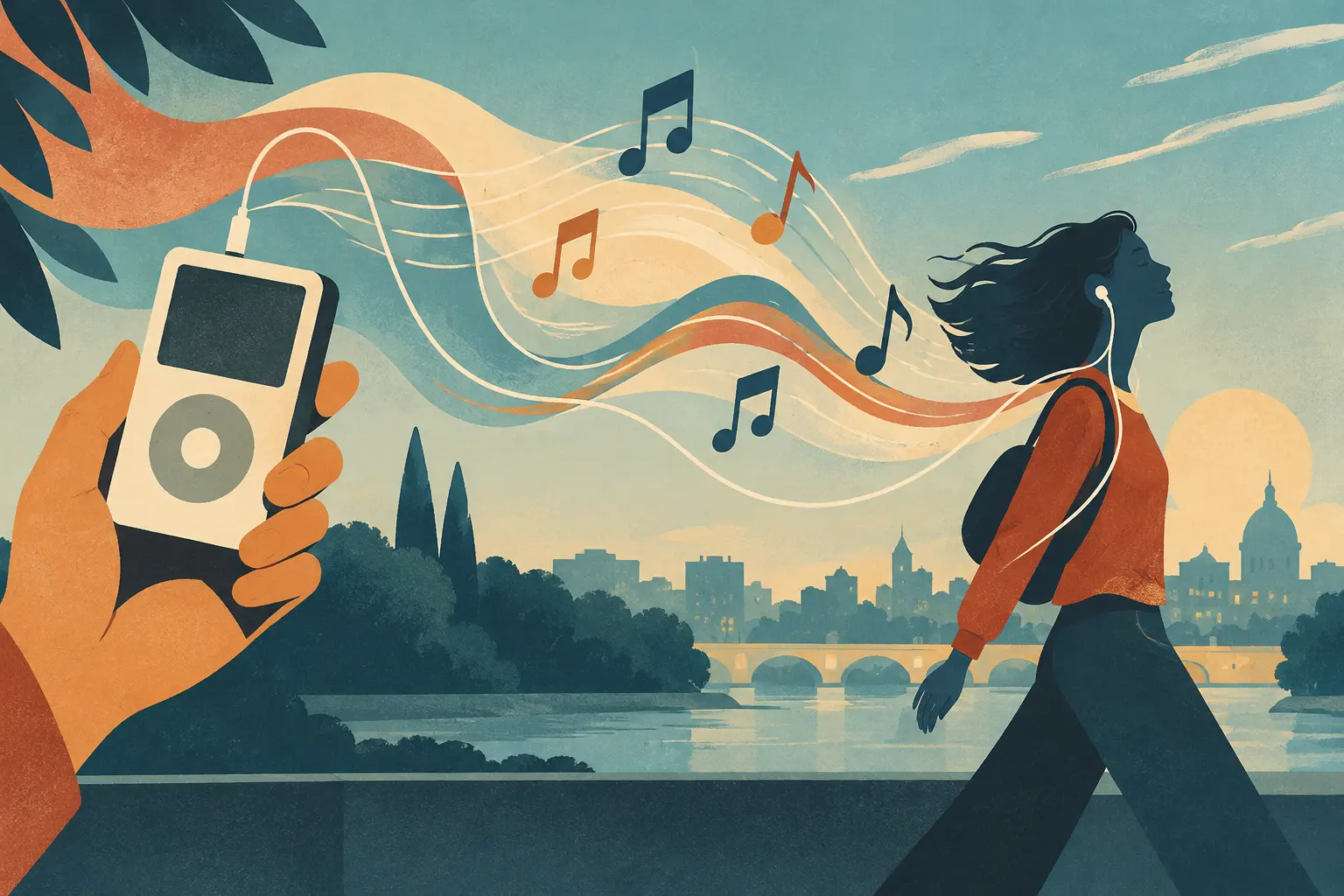
A portable player could accompany familiar activities—walking, travelling, or exercising—with more music than a CD could hold. Headphones made listening a personal experience, partly separated from the sounds around the listener. Carrying a soundtrack of one’s own became an everyday possibility for people with a device and digital music, though practices varied with resources, locations, and personal routines.
The way listeners navigated their collections mattered, too. The iPod’s wheel let users browse lists and artists with a thumb; other models had different controls and approaches to file management. The innovation was not only a smaller device, but a way to handle a large library while on the move. That convenience, however, depended on preparing the collection and transferring it from a computer.
The computer as library and link
Apple’s original model connected the iPod to iTunes to organize and transfer music. Instead of loading each album separately, users could build a library on a computer and sync a selection to the player. Taking music out of the home therefore depended on a chain of tasks: obtaining songs or files, sorting them, and deciding which part of the collection to copy onto the device.
The iTunes Store, launched in 2003, added a digital purchasing channel to this system. That same year, iTunes arrived on Windows, extending its availability beyond Macintosh computers. The device, software, and commercial catalogue were linked as parts of an integrated experience. This was not the only way to listen to digital music: players from other manufacturers, shared files, and collections assembled through different means all existed. Apple’s example shows how a player could shape not only listening but also the organization and acquisition of music.
A new routine, not a universal experience
Music in a pocket shifted the balance between collection and selection. Rather than deciding which disc to bring, listeners could access a larger library; rather than playing an album in its original order, they could skip tracks or make playlists. In some contexts, this flexibility encouraged more personal and fragmented listening, but it did not immediately replace earlier practices. Radio, CDs, home stereo systems, and shared listening remained part of musical life.
The iPod made a transformation visible, but its history cannot be reduced to one product or to nostalgia shared by everyone. For some people, it was a practical way to carry music; for others, the cost of the device, the need for a computer, or the time required to digitize and organize files could be barriers. Technology entered everyday life in different ways, shaped by the circumstances of each household.
From dedicated player to phone
As phones gained music playback and connected features, the standalone player lost prominence in Apple’s product line. In May 2022, the company discontinued the iPod touch and noted that its music offering was available on other devices. That commercial ending did not erase the routines associated with the player: carrying a personal collection, choosing the next song, and listening through headphones while travelling.
The player’s evolution also reveals a tension in digital life: a device can make an everyday activity easier while depending on software, file formats, and synchronization systems. The library became portable, but it still had to be built and organized, and access to that possibility was unequal. Its legacy lies in the combination of mobility, personal choice, and listening increasingly tied to devices and services.
- Decade
- 2000s
- Region
- North America
- Level
- Introduction
- Entities
- Internet, Sounds, Macintosh, iPod
Sources and references
- iPod - Wikipedia, la enciclopedia librees.wikipedia.org · 2026-11-10
- El iPod, la historia del dispositivo que Apple casi no fabricóokdiario.com · 2026-11-10
- La historia completa del auge y la caída del iPod.translate.google.com · 2026-11-10
- iPOD CLASSIC: El adiós a un grandesolaris525.wordpress.com · 2026-11-10
- Obsolescencia programadaes.wikipedia.org · 2026-11-10