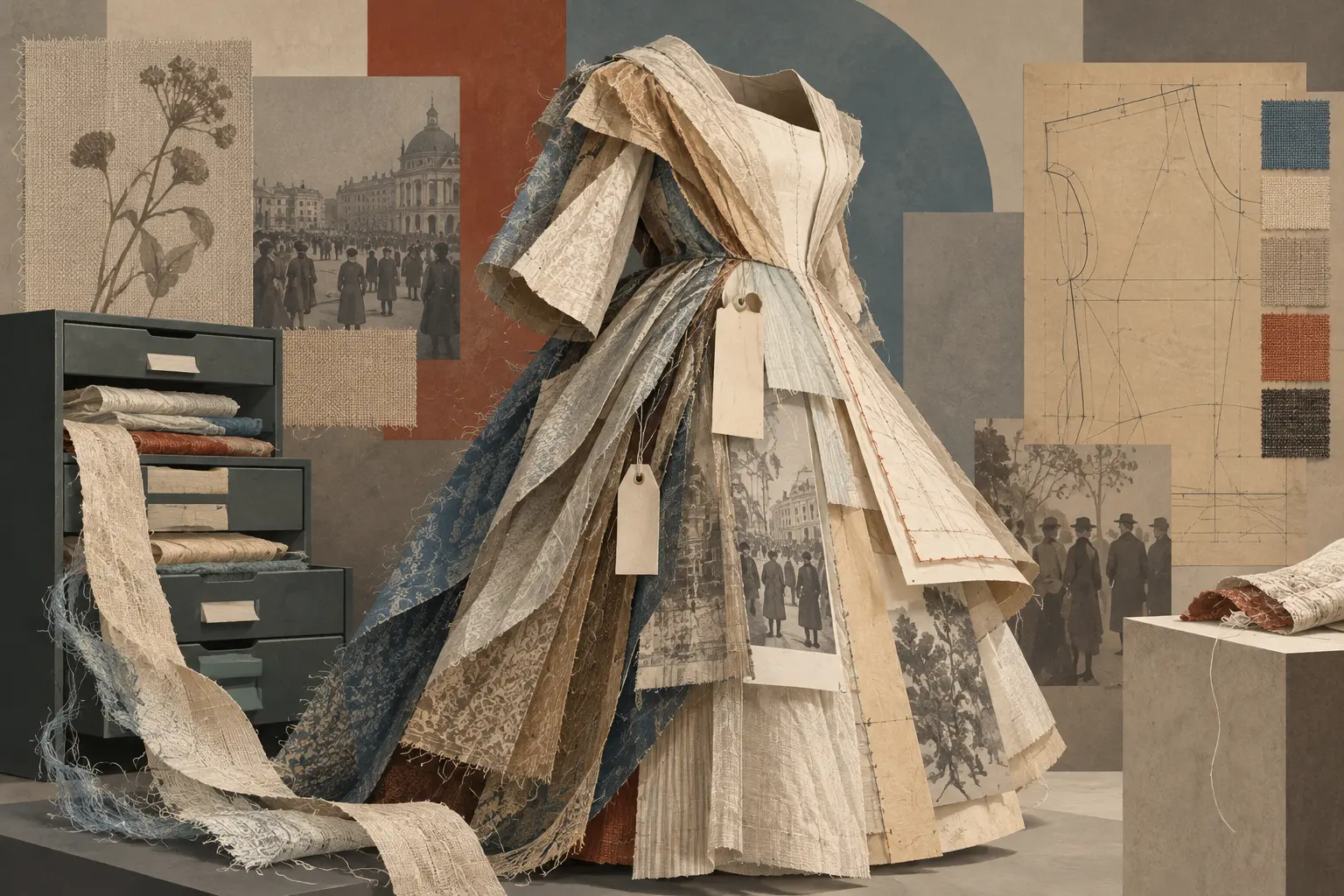
Fashion museums preserve fragile objects, but their work does not end with protecting them from deterioration. A garment can also tell us about its wearer, how it was made and the social relations surrounding it. Treating clothing as a document changes how it is catalogued and displayed: conservation must care for the fabric while preserving clues to its history. The available sources describe research, preventive conservation, exhibitions and digital archives, but do not establish a single model shared by all institutions.
Clothing as historical evidence
Elizabeth Ann Coleman argues that clothing helps us understand history and culture because it communicates information about its wearer and carries messages from the past. This shifts attention away from the famous or visually striking item alone, toward the evidence it contains. Materials, construction and traces of use can prompt questions about production and social experience; on their own, however, they do not provide complete answers. Interpretation depends on documenting those clues and relating them to context, rather than assigning them an automatic meaning.
One academic source in the evidence places an important change around the middle of the twentieth century. As fashion expanded in Western popular culture, museums began adding contemporary garments to their exhibitions and archives. A collected object could therefore share its period with garments still circulating outside the museum. The boundary between past and present became less straightforward: an item could be historical to an institution while also belonging to an active material culture.
Conservation without erasing traces
Textile care poses a dual challenge. Museums must limit the deterioration of vulnerable materials while preserving the information an object can provide. Preventive conservation addresses this through planning and attention to storage, display and transit conditions. A document from Spain’s Institute of Cultural Heritage refers to preventive conservation work on a textile collection in storage and exhibition spaces, as well as on objects in transit. It confirms that these tasks are part of institutional work, but gives no protocols, environmental parameters or measured outcomes.
It is also worth avoiding an overly broad claim in the original article: the sources provided do not show that museums can ensure the longevity of collections through plans that avoid treating individual items. The institutional source describes conservation responsibilities, not that specific method. This distinction matters: describing documented aims and tasks is more reliable than offering a general guarantee unsupported by data.
From storage to public research
The image of the museum as a storeroom for celebrated dresses is inadequate. An institutional description characterizes fashion museums as living archives that investigate how objects were made and activate them through exhibitions, publications, loans and digital archives. “Living” does not mean that collections are handled freely; it indicates that their cultural value is also developed through research and forms of access.
Exhibition adds a narrative dimension. Displaying a garment involves choosing what information will accompany it and what will remain outside the gallery. Coleman identifies technical and narrative difficulties in exhibiting clothing. Fragility imposes physical limits, while the museum’s account creates connections to contexts that may not fit inside a display case. Interpreting a garment means acknowledging both constraints rather than treating an exhibition as a neutral window onto the past.
Digitisation does not replace the object
Digital archives can make information easier to consult and extend access beyond the gallery. They can also bring together documentation that might otherwise be scattered. But the evidence supplied does not describe specific systems, the size of digitised collections or the actual reach of that access. It therefore cannot support claims that digitisation is complete or that availability is globally uniform.
A digital representation does not replace the material object either. It can show details and circulate records, but it does not remove the need to conserve the garment or exhaust what can be learned from it. This distinction helps frame digitisation as a layer of documentation and consultation, not a definitive solution to textile fragility. Broader access and physical conservation are complementary tasks, not substitutes.
What enters the archive, and what does not
Thinking of clothing as an archive raises questions about selection. One academic source asks what narratives determine which garments enter museum collections and which become textile waste. The question points to a structural limit: an archive is not a complete record of all clothing produced, but a selection shaped by institutional decisions and interpretive frameworks. The evidence provided does not detail which groups or garments are represented in specific collections, so it cannot establish particular biases.
The shift toward living archives does not mean abandoning the display case or treating every garment as a transparent story. It means connecting care, research and access while making clear what is known and what remains uncertain. When a museum documents materials, use and context without concealing the limits of its sources, clothing can be read as historical and cultural evidence. That is a concrete contribution: preserving not only an object, but also the conditions for asking what counts and which stories have been left out.
- Decade
- 1970s
- Region
- Global
- Level
- Introduction
- Entities
- Museum
Sources and references
- La indumentaria como archivo: enfoques y problemáticaswww.academia.edu · 2026-10-21
- La indumentaria como archivo: enfoques y problemáticasdspace.palermo.edu · 2026-10-21
- Museos de Moda y Conservación Textil | PDF | Museo | Ropaes.scribd.com · 2026-10-21
- Museos de moda del mundo: archivos vivosinstitutodemoda.com · 2026-10-21
- CVs y resúmenes - ipce.cultura.gob.esipce.cultura.gob.es · 2026-10-21