Video game preservation has ceased to be a purely technical task to become an exercise in cultural memory. For decades, the focus was on hardware viability and data integrity, but current evidence suggests that preserving a game involves much more than maintaining a functional file. According to Harkai (2022), the goal is not only to preserve the object but to ensure its playability and the surrounding context. This distinction is fundamental to understanding how current institutions approach digital heritage, where the user experience and complementary documentation are as important as the code itself.
The paradigm shift in conservation
Traditionally, preservation was associated with the physical stability of media. However, technological obsolescence threatens not only physical media but also the cultural interpretation of games. Harkai (2022) notes that the video game industry looks back at a decades-old history, and that defining works of early gaming require care that goes beyond simple backup. The current challenge is to maintain the ability to play, not just the existence of the game. This implies a redefinition of what is considered a cultural artifact in the digital realm.
The role of manuals and documentation
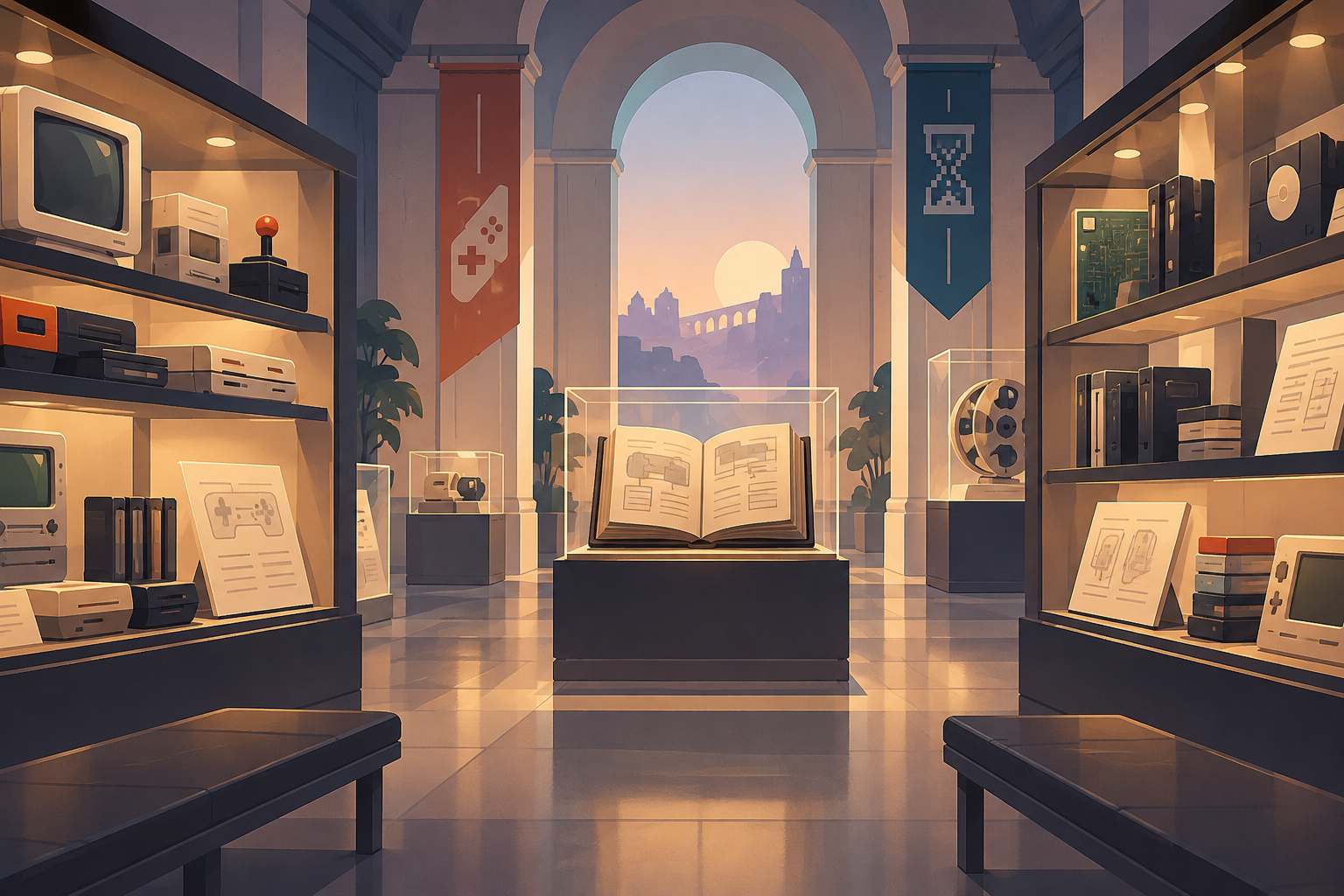
Instruction manuals, booklets, and technical documentation are key pieces in this new vision of preservation. These documents are not mere accessories but an integral part of the gaming experience. Documenting these elements allows us to understand how users were expected to interact with the software at the time. Museum institutions are incorporating these materials into their collections, recognizing that the context of use is as valuable as the final product. This practice helps reconstruct the relationship between the player and the machine.
Institutions as spaces for cultural renewal
Museums and archives are emerging as spaces for cultural renewal where video games are studied as an industry and social phenomenon. The Video Game Museum, for example, works on the recovery, documentation, and cataloging of historical heritage related to video games. Similarly, MUVIC, the Museu del Videojoc de Catalunya, is dedicated to preserving, studying, and disseminating the history of video games through exhibitions. These institutions do not just store objects but facilitate research and education, transforming the public perception of video games as a legitimate form of art and culture.
Social memory and gaming practices
Preservation must also address social gaming practices. How games were played, with whom, and in what contexts are aspects that define the cultural experience of video games. The collective memory of these practices is an essential component of heritage. By documenting these dynamics, conservators can capture the community dimension of gaming, which is often lost when only the software is preserved. This includes everything from local competitions to group gaming sessions, all forms of interaction that bring the digital product to life.
Obsolescence as a dual threat
Technological obsolescence represents a dual threat to video game heritage. On one hand, physical media degrade or become incompatible with modern hardware. On the other hand, a lack of documentation and context can lead to a loss of cultural meaning. Harkai (2022) emphasizes that maintaining playability is crucial to prevent games from becoming inaccessible relics. This requires a proactive strategy that includes emulation, format migration, and the preservation of original execution environments.
The industry as a social phenomenon
Video games have experienced a vertiginous rise at the technological, economic, and social levels, establishing themselves as a cultural industry and one of the most influential mass media. This status requires a preservation approach that recognizes its complexity. It is not just about saving files but understanding how these products have shaped contemporary culture. Academic research and museum practice are converging to address this complexity, offering theoretical and methodological frameworks for long-term preservation.
Towards integral preservation
In conclusion, video game preservation is an integral process that combines technique, documentation, and social memory. Evidence suggests that museums and archives act as spaces where digital culture is renewed, studying video games as an industry and social phenomenon. By distinguishing between the physical object and the experience it generated, conservators can offer a more complete view of heritage. This approach not only protects games for future generations but also validates their place in cultural and technological history.
- Decade
- Contemporary
- Region
- Global
- Level
- Enthusiast
- Entities
- Museum, Museo del Videojuego
Sources and references
- Preservación de los videojuegos y su papel como patrimonio ...translate.google.com · 2026-10-19
- Museos y videojuegos. La renovación de los espacios ...www.researchgate.net · 2026-10-19
- La resignificación del museo según la ...tecrea.net · 2026-10-19
- Qué hacemos | Museo del Videojuegowww.museodelvideojuego.com · 2026-10-19
- La importancia de conservar los videojuegos con Artemio ...www.diariodemexico.com · 2026-10-19
- MUVIC – Museu del Videojoc de Catalunya | Castellanomuvic.cat · 2026-10-19