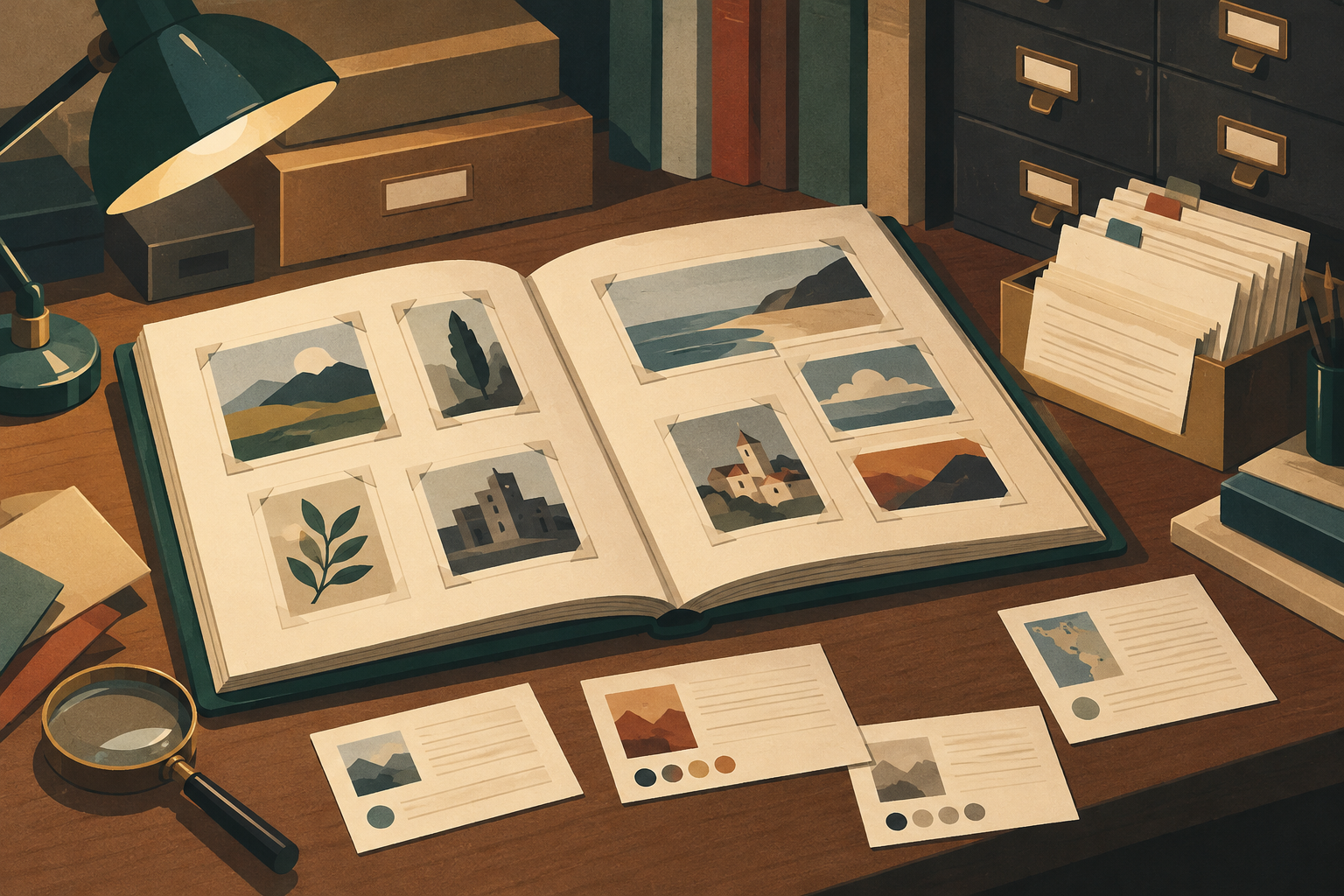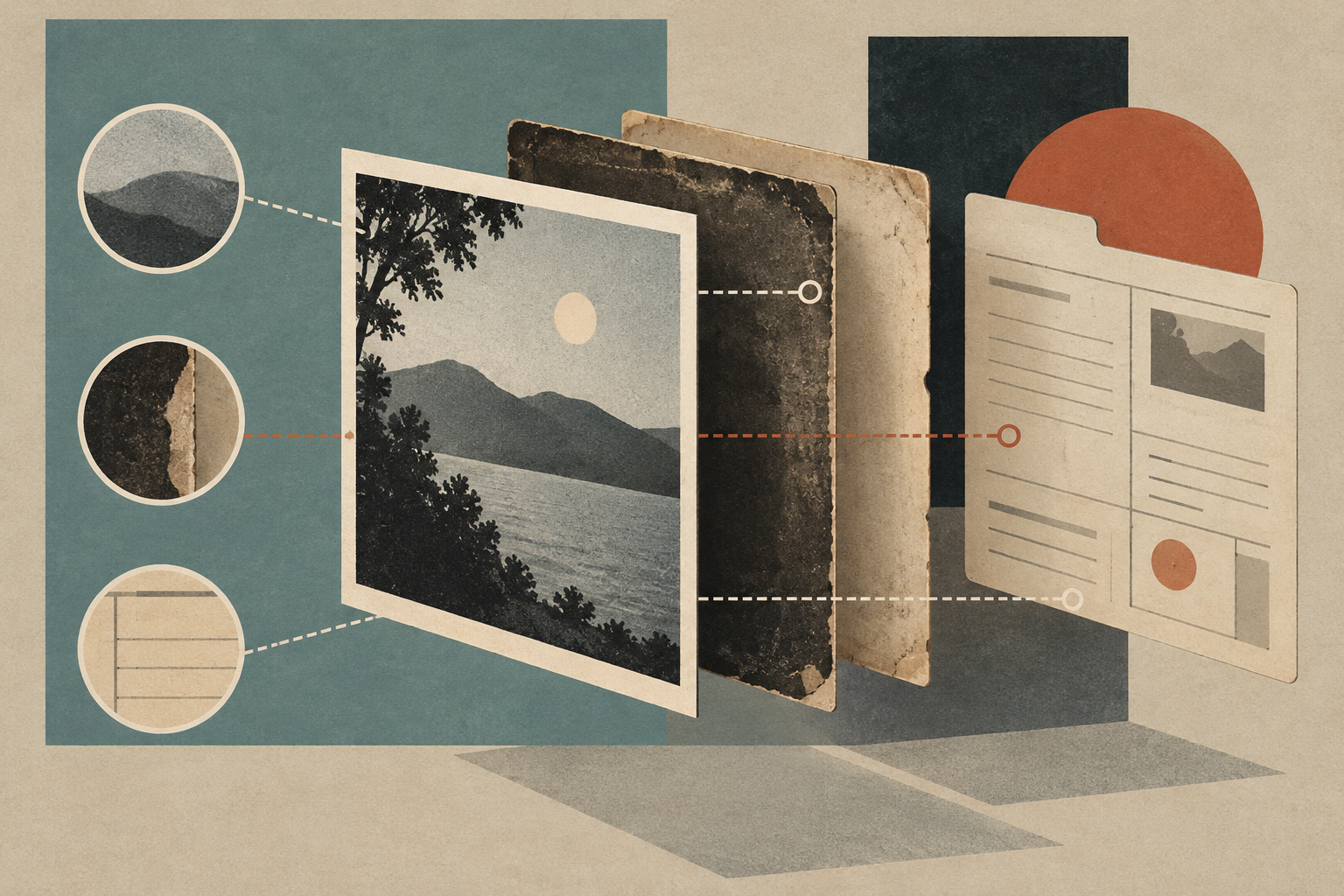
A photograph can seem to offer immediate evidence: something stood before a camera, and now we can look at it. Yet that sense of direct access can blur the difference between what is visible and what is known. The image shows a scene; the object that preserves it has a material history; and the archive that holds it may offer information about its circulation, cataloguing, or place in a collection. These layers are related, but they are not interchangeable. Reading a photograph rigorously means attending to all three—and recognizing when information is missing.
Isabel Argerich’s research on photography and archives offers a starting point for considering how images become part of documentary collections. Other work on historic photographic holdings in Spanish institutions places cataloguing and collection history within that inquiry. Together, these perspectives suggest a more precise question than “What do we see?”: What do we know, how do we know it, and what remains unverified?
The image is not the object
The represented subject usually commands our attention. But a photograph is also an object made through a process and preserved on a support. Its material characteristics can be described and examined; they cannot be inferred automatically from the scene it depicts. The evidence available here identifies no particular photograph and establishes no specific technique for an individual object.
The distinction matters because two different questions are often conflated. One concerns what appears in the image; the other asks how the photographic object was made and how it reached us. A photograph showing a particular scene does not, by itself, establish when it was taken, who made it, or under what circumstances it was preserved.
An archive adds context, not automatic certainty
Once an image enters a collection, it may be linked to records, groupings, and cataloguing data. Such information opens paths for research: it can help establish how a collection is organized or what documented relationships a photograph has to other items. The collection’s own history may also matter to understanding the image’s place within it.
But an archive does not make every entry self-evidently true. Provenance and context require identifiable sources, and a catalogue description is not necessarily complete proof of authorship, date, or intention. Studies of historical collections and photographic archives underline the importance of these mediations; the bibliographic details available here, however, are not enough to attribute specific findings to each study.
Three layers for a cautious reading
It helps to distinguish three layers of analysis. First, what is visible: figures, objects, and relationships that can be described without confusing description with interpretation. Second, the material object: its support and features, insofar as they have been examined and documented. Third, contextual information: provenance, cataloguing, or collection history, where sources support it.
This separation does not impoverish interpretation; it makes it more useful. It keeps claims proportionate to the evidence and leaves open questions the record cannot answer. If a catalogue entry offers no verifiable attribution, the rigorous response is not to fill the gap with a plausible guess, but to identify the limit.
What an isolated image cannot prove
A photograph alone does not prove who made it, when or where it was taken, or why. Such conclusions may become defensible when checked against documentation and other evidence, but they do not follow simply from the presence of a scene inside the frame. Even an identification that appears obvious requires us to distinguish what we observe from information supplied by an outside source.
Caution also guards against the authority of labels. An attribution repeated in records may guide research, but treating it as fact requires knowing its basis. In this case, the evidence provided establishes a general framework for thinking about photography, archives, and collections; it does not supply the file of a particular object from which to reconstruct that object’s biography.
A history that acknowledges its limits
Studying preserved photographs means attending both to what they show and to the documentary conditions of their survival. An archive can enrich the account, and material examination may reveal details the image does not. At the same time, each claim should make its basis clear: visual observation, examination of the object, or information supported by sources.
That method does not resolve every uncertainty, and it should not pretend to. Its concrete result is a more responsible reading: describe the image, ask about the support and process, examine the record, and distinguish evidence from interpretation. When documentation is insufficient, saying so is part of the photograph’s history too.
- Decade
- Contemporary
- Region
- Global
- Level
- Enthusiast
- Entities
- No linked entities
Sources and references
- Fotografía y archivodoi.org · 2026-10-16
- Fondos de fotografía antigua sobre el arte aragonés en la Biblioteca Nacional y unas notas sobre el Museo del Prado y el Archivo Histórico Nacionaldoi.org · 2026-10-16
- Una mirada documental de la fotografía underground a través del fanzine Rockocó. Análisis del Archivo Miguel Trillo en el Museo Nacional Centro de Arte Reina Sofía (MNCARS)doi.org · 2026-10-16
- Fotografía amateur en España: conceptos, historiografía y métodosopenalex.org · 2026-10-16
- Memorias de archivosopenalex.org · 2026-10-16