A film is not its file
Researching a film through documents means distinguishing the work from the traces left by its production, preservation, cataloguing or circulation. A catalogue can identify materials and organise information; a historical study can offer an interpretation of the past. Neither is equivalent to watching the film, and neither alone justifies claims about how its audiences experienced it.
The supplied bibliography points to two related but distinct fields: the construction of the past through cinema and the history of film documentation. This distinction suggests a useful question: what kind of claim does each document support?
Historical context, not a substitute
The volume Historia y cine. La construcción del pasado a través de ... presents cinema as a place where representations of the past are constructed, involving decisions by producers, screenwriters and directors, as well as the possible use of historical imagination. This invites us to analyse films as interpretations, not as transparent windows onto the events they depict.
Interpretation must remain attributable to its source. The supplied record identifies the volume’s general subject, but does not provide the full discussion of its chapters. It is therefore reasonable to identify the methodological issue, but not to attribute more specific conclusions to the book than the evidence supports.
Documentation has a history too
The article “La Documentación Fílmica: marco contextual histórico” places film documentation itself in a historical trajectory. Archives, collections and cataloguing practices matter because they shape what can be located and studied. But a record that helps a researcher find a film is not the film, and the existence of an archive does not prove that its documentation is complete.
UNESCO’s text on museums and film archives offers another caution by distinguishing memory from history. This distinction helps prevent recollection or an institutional account from being treated automatically as sufficient proof. Records can support questions and comparisons; interpretation should explain what is preserved, what the source describes and what remains beyond its reach.
Authenticity and the limits of evidence
A work recorded in UC3M addresses the authenticity of historical reality in cinema and mentions how documentaries can present archival images to support a claim of authenticity. This does not establish that every archival image is misleading, or that archival material guarantees accuracy. It does remind us that using archival footage is a narrative choice worth examining: what is shown, how it is identified and what function it serves.
Likewise, a document about a proposed cinema museum records planning and orientation materials for an exhibition. It may be a source for studying an institutional proposal, but it is not enough to claim that the project was completed or that its exhibition received a particular response.
The question of theatre and video remains open
Comparing a film’s reception in a cinema and on video would require evidence describing both situations—for example, identifiable and comparable sources on exhibition, circulation or reception. The references available here do not provide that body of evidence. We therefore cannot claim that reception changed, or in what direction. We can state the limit precisely: a film file may help reconstruct context, but it cannot turn a hypothesis about viewers into a documented fact.
Reading traces without confusing them with the work
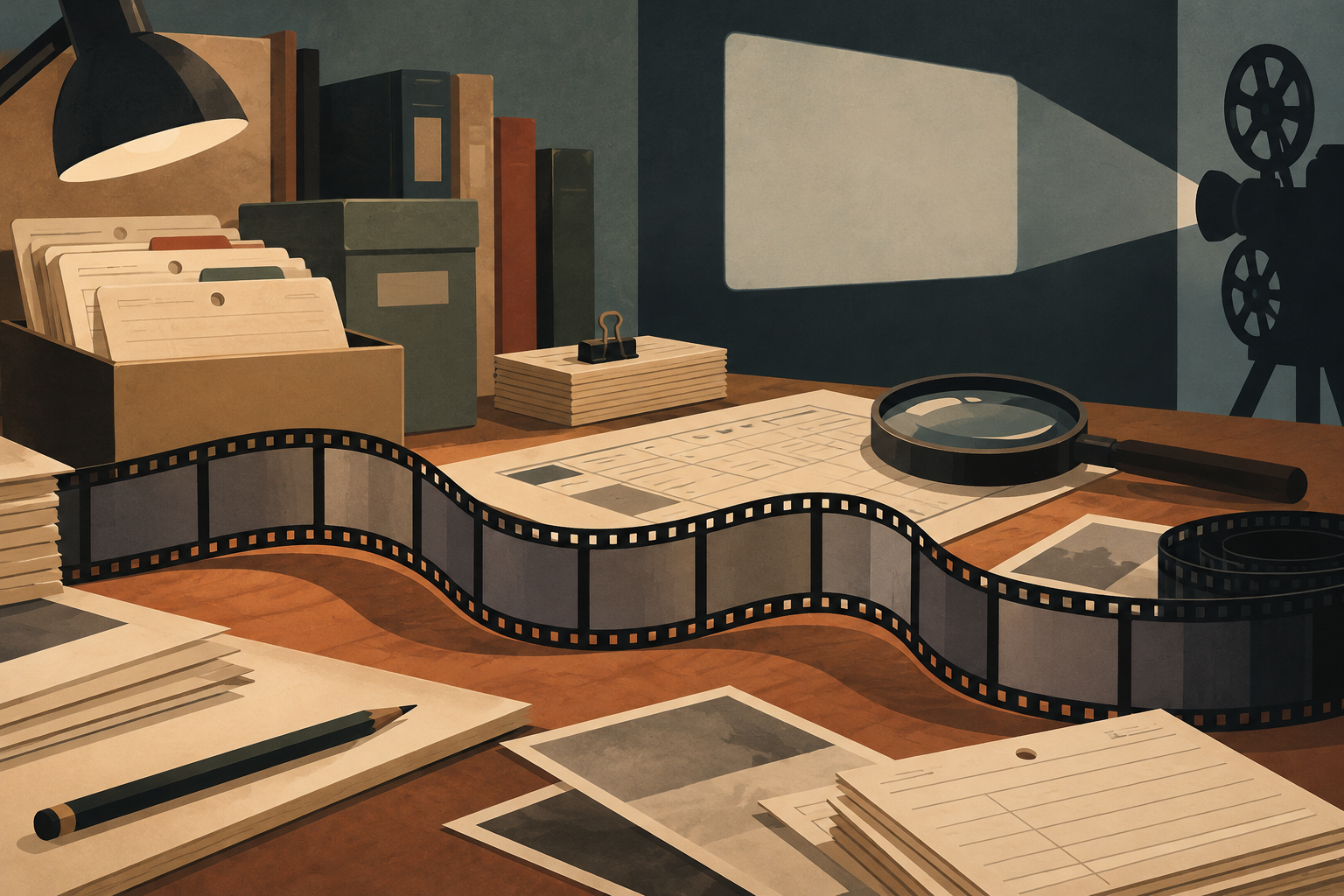
Film documents are useful when we make clear what they record and what they do not. A catalogue organises; an archive preserves; a study interprets; a film represents. These are related sources, not interchangeable ones. Keeping their functions distinct makes it possible to study cinema without replacing the work with nostalgia or asking a source to answer questions it was not created to address.
- Decade
- 1980s
- Region
- Global
- Level
- Enthusiast
- Entities
- Museum
Sources and references
- PROYECTO DE CREACIÓN DE UN MUSEO DE CINE EN ...eldocumentalistaudiovisual.com · 2026-10-08
- Historia y cine. La construcción del pasado a través de ...ifc.dpz.es · 2026-10-08
- La Documentación Fílmica: marco contextual históricorevistas.ucm.es · 2026-10-08
- Museos y archivos del cineunesdoc.unesco.org · 2026-10-08
- La "Realidad" histórica en el cine: el pese del presentee-archivo.uc3m.es · 2026-10-08