When a car enters a museum, it ceases to be a transport tool and becomes a document. This transition is neither automatic nor innocent; it depends on how the object is documented, preserved, and presented. In the Spanish context, institutions like the Museum of the History of Automobiles in Salamanca or the MAHI in Arteixo illustrate how the physical collection is complemented by thousands of parts, accessories, and objects that allow the reconstruction of the context of use. Evidence suggests that preservation is not limited to the chassis or engine, but encompasses the documentary management that organizes cultural activities and exhibitions, transforming vehicles into heritage.
The boundary between object and archive
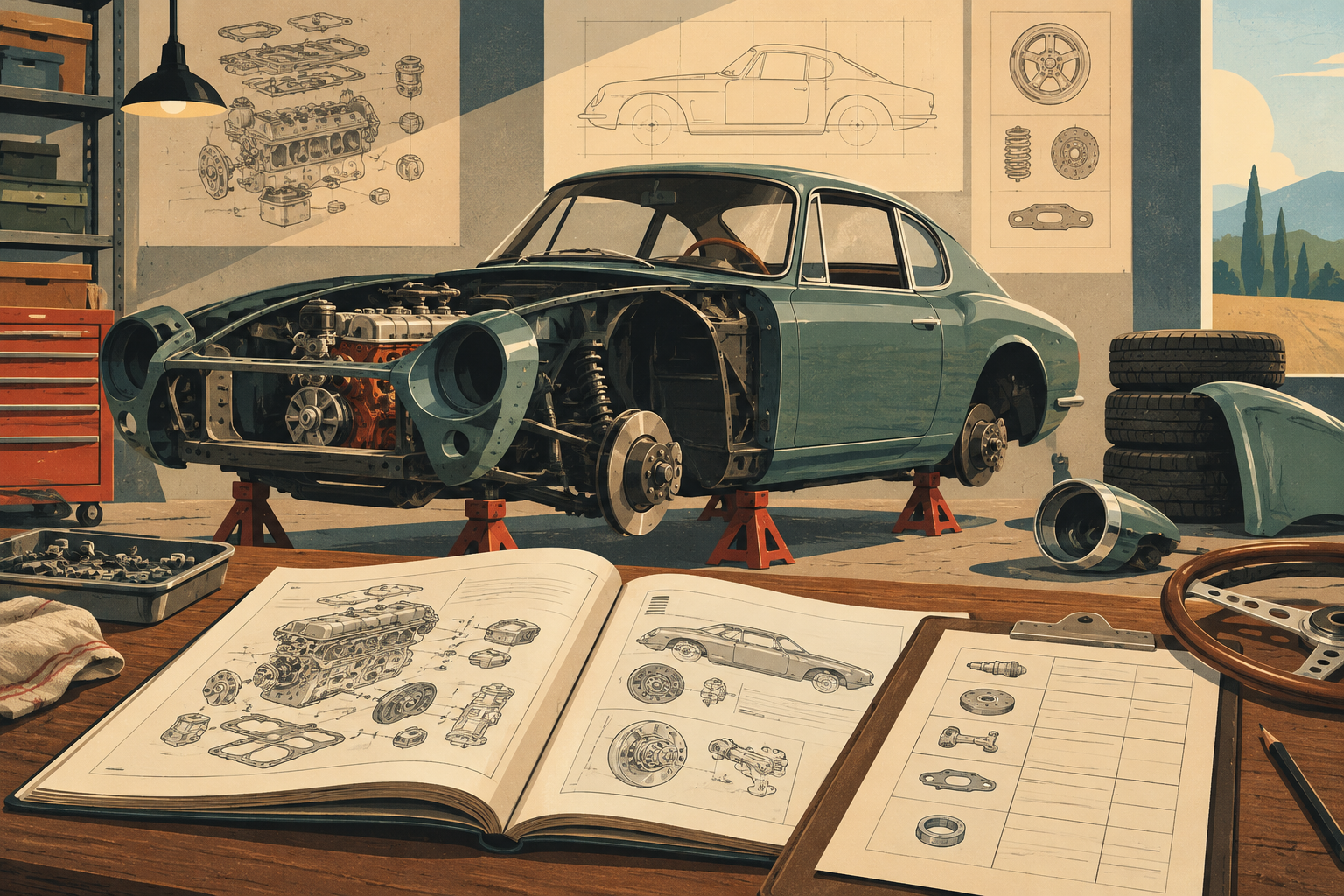
The fundamental distinction in motor museography lies in separating verifiable performance from inherited reputation. A workshop manual or a parts catalog does not only describe how the vehicle worked, but establishes a standard of verification. Without this documentation, the object is exposed to subjective interpretation and legend. Available evidence indicates that museums use documentary management to structure the narrative, preventing popular memory from replacing technical data. This is crucial for understanding how the authority of an object is built in a showcase or an exhibition workshop.
The role of technical documentation
Manuals and catalogs act as anchors of reality. In the case of replicas or historical vehicles, such as the 1885 Benz Tricycle mentioned in sources about the MHAS, documentation allows distinguishing between the original and the recreation. The precision of technical data, from engine specifications to seat materials, defines the integrity of the object. However, evidence also shows that not all preserved objects have the same documentary depth. Some vehicles arrive at museums with a rich history, while others rely on the subsequent reconstruction of their context. This documentary asymmetry is a constant challenge for curators.
Contexts of use and everyday life
Beyond engineering, motor museums seek to capture the experience of use. Photographs, personal objects, and accessories that accompany vehicles in collections like the Gómez Planche in Salamanca offer a window into the everyday life of their owners. These elements are not mere set dressing; they are witnesses to the social practices associated with the motor. Evidence suggests that the inclusion of these objects in exhibitions enriches public understanding, connecting technology with culture. It is not just about seeing a car, but about understanding how it was lived with, how it was maintained, and what it meant in its time.
Preservation as a cultural practice
Preserving a vehicle is a cultural decision. It involves choosing which aspects of the object are preserved and which are left to the passage of time. Evidence from academic publications on archives in science and technology museums points out that documentary management is key to organizing these decisions. Not everything is preserved equally; elements that add historical or technical value are prioritized. This active selection transforms the object into an educational and cultural resource. Preservation is not passive; it is a continuous process of interpretation and presentation that requires resources and expertise.
Limitations of available evidence
Although the provided evidence offers a clear view of the importance of documentation and preservation, it has limitations. Specific restoration processes and the exact technical criteria followed by Spanish museums are not detailed. Furthermore, information on the number of objects preserved varies between sources, making precise comparison difficult. Evidence is also limited regarding public perception and the real impact of these exhibitions on road or cultural education. More research is needed to understand how visitors interpret these objects and what they learn from them.
Towards a more critical museography
The future of motor museums lies in a more critical and transparent museography. This involves not only displaying vehicles but explaining how they have been preserved, what documentation supports them, and what interpretations are offered. Evidence suggests that museums are beginning to adopt this approach, but there is still a long way to go. Collaboration between institutions, collectors, and academics is essential to improve the quality of documentation and presentation. Only in this way can it be guaranteed that preserved objects remain relevant and useful for future generations.
Conclusion
Motor museums are much more than collections of cars and motorcycles. They are cultural archives that preserve the history of technology and society. The key to understanding their value lies in the documentation that accompanies them and the way they are presented to the public. By distinguishing between the verifiable and the inherited, these museums offer a deeper and more nuanced view of motor culture. Available evidence supports the idea that preservation and documentation are fundamental pillars of this practice, although there is still work to be done to improve the transparency and accessibility of these resources.
- Decade
- 1990s
- Region
- Spain
- Level
- Enthusiast
- Entities
- Museum, SEAT, Triciclo Benz
Sources and references
- Mucho más que cochesrevista.dgt.es · 2026-10-13
- El archivo en los museos de ciencias y tecnologías | Tábulapublicaciones.acal.es · 2026-10-13
- El automóvil como archivo: qué conservan los museos del motorwww.retropause.com · 2026-10-13
- Guía de Museos de automoción en Españawww.feva.es · 2026-10-13
- Oficina de Turismo de Salamancawww.facebook.com · 2026-10-13
- un paseo por la historia de la automoción en Españawww.youtube.com · 2026-10-13