The management of heritage collections is often mistakenly associated with mere asset accounting. However, institutional evidence suggests that documentation acts as a fundamental interpretive mechanism. It is not just about knowing which object exists, but about understanding the cultural fabric that gave it relevance. This article analyzes how conservation manuals and museum plans transform the record into a tool for reconstructing social memory, moving beyond the reductionist view of the object as a simple commodity or ornament.
The structure of integrated recording
Modern institutional manuals have evolved from simple inventory lists to integrated work systems. The manual of the Chilean Heritage Documentation Center, for example, establishes two well-defined and integrated work areas: collection registration and documentation, and vocabulary normalization. This distinction is crucial. Vocabulary normalization is not merely a linguistic exercise, but a tool to ensure that descriptions are consistent and understandable over the long term. By integrating these areas, institutions ensure that each item is not only identified by its name but situated within a coherent semantic framework that facilitates its study and conservation.
Context as a conservation factor
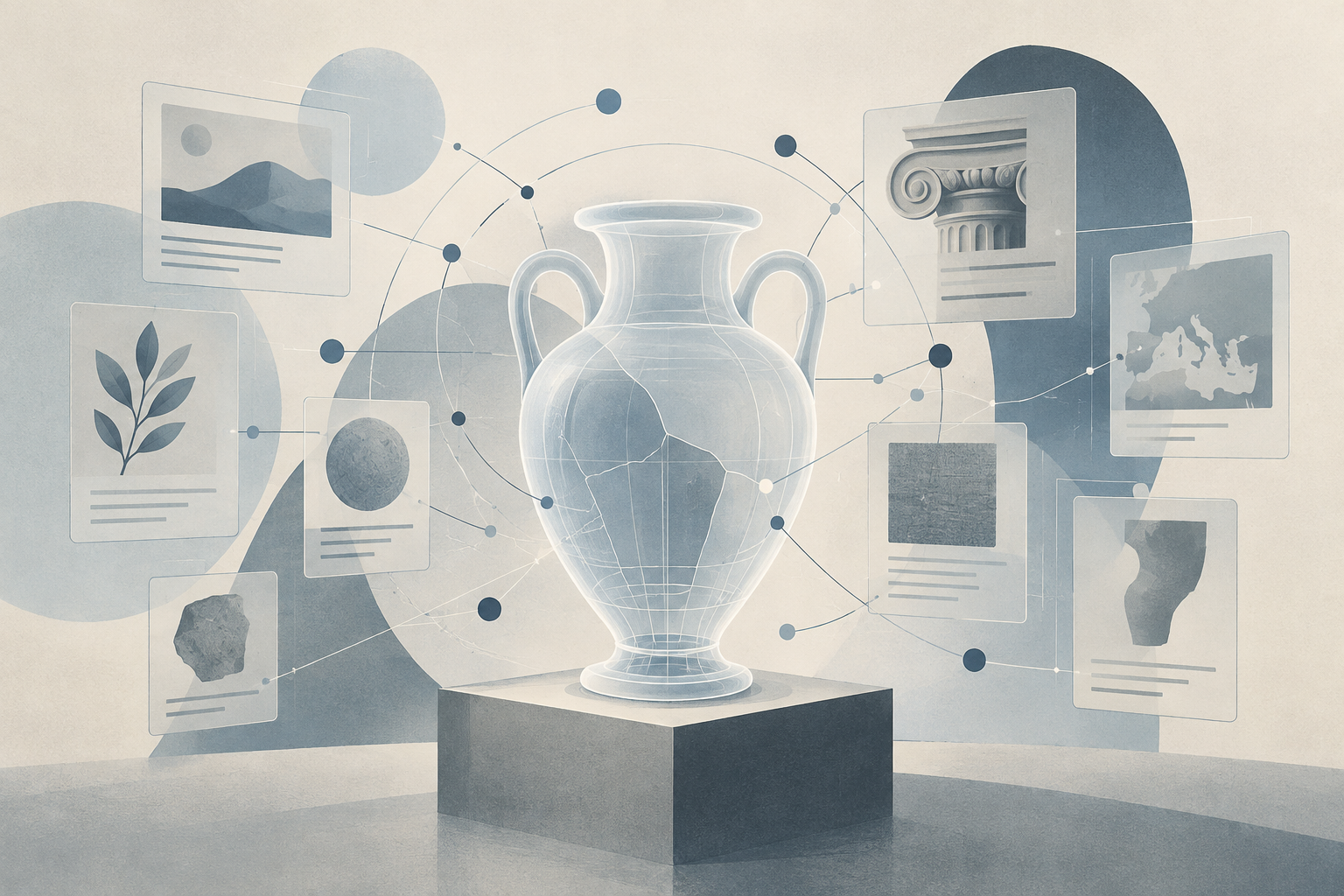
Preventive conservation has ceased to be a purely technical discipline to become a contextual analysis. The IberoMuseos guide for the elaboration of conservation plans explicitly states that documentation must include the analysis of the cultural asset and the context that may influence its conservation state. This implies that the physical and social environment of the object is part of its integrity. An object does not exist in a vacuum; its preservation state is linked to the conditions in which it was created, used, and stored. Therefore, documenting the context is not an optional complement, but a central variable in risk assessment and conservation planning.
The risk of documentary dissociation
One of the greatest dangers to the integrity of collections is the separation between the object and its history. The ICCROM risk management guide for museum heritage identifies the dissociation of documents from a museum's archive as a significant threat. This dissociation can lead to mechanical damage, irreversible adhesion of pages, dissolution of inks, contamination, and mold growth, but also to a deeper conceptual loss: the disconnection of the object from its narrative. When the documents that explain the origin, use, or meaning of a piece are separated from it, the piece becomes an orphaned artifact. The integrity of the collection depends, therefore, on keeping matter and memory together.
Design as a way of life
At the intersection of design and heritage, documentation acquires an anthropological dimension. An academic article on design and cultural heritage argues that design has shaped the world in which we live and has improved our lives in ways we can barely imagine. From this perspective, conserving a design object is not just preserving its aesthetic form, but understanding how it has influenced human life. Documentation must capture this symbiotic relationship between object and user, revealing how design decisions have configured routines, spaces, and social behaviors. This elevates documentation from a technical record to a testament to the human condition.
Decoration as social testimony
The interpretation of heritage spaces, such as museums, often focuses on the staging of objects. However, sources such as UNESCO suggest that some architects and designers see museums as a means to highlight objects, often valuable from an aesthetic point of view, but decontextualized. Rigorous documentation allows going beyond decoration. It transforms decoration from mere ornamentation into a testimony of everyday life. Each documented element, from a measurement to a reasoned classification, adds a layer of meaning that enriches the understanding of the past. It allows researchers and curators to interpret not only what objects occupied a space, but who used it and under what social conditions.
Normalization as an interpretive bridge
Vocabulary normalization, mentioned in the Chilean manuals, acts as a bridge between the diversity of collections and the need for a common language. Without this normalization, descriptions can be ambiguous or inconsistent, hindering comparison and analysis. By standardizing terms, institutions facilitate collaboration among specialists and allow documentation to be a living tool, capable of adapting to new interpretations without losing its rigor. This process is essential for documentation not to become a dead archive, but a dynamic knowledge base that supports research and conservation.
Limitations and challenges of verification
Despite the importance of documentation, there are limits to what can be verified. Manuals and guides provide theoretical and methodological frameworks, but practical application varies according to the resources and capacity of each institution. The evidence presented comes from institutional and academic documents, which guarantees their validity as a reference, but does not allow evaluating the real effectiveness of these practices in all contexts. Moreover, the reconstruction of cultural context is an interpretive process that always involves a certain degree of subjectivity. Documentation can reduce uncertainty, but not eliminate it entirely. Recognizing these limits is essential to maintain intellectual honesty in heritage management.
Conclusion: Documentation as an act of memory
The documentation of heritage collections is, ultimately, an act of memory. It is not just about preserving objects, but preserving the relationships that surround them. By integrating registration, vocabulary normalization, and contextual analysis, institutions create a fabric of meaning that allows future generations to understand not only what was preserved, but why and how. This approach transforms documentation from an administrative task into a tool of cultural interpretation, capable of revealing the complexity of human life through the objects it left behind.
- Decade
- Contemporary
- Region
- Global
- Level
- Enthusiast
- Entities
- Museum
Sources and references
- Manual de Documentación - de Colecciones Patrimonialeswww.cdbp.gob.cl · 2026-10-19
- PLAN CONSERVACIÓN PREVENTIVA MUSEO SEFARDÍwww.cultura.gob.es · 2026-10-19
- Guía para la Elaboración e Implantación de Planes de ...www.ibermuseos.org · 2026-10-19
- Guía de Gestión de Riesgos para el Patrimonio Museológicowww.iccrom.org · 2026-10-19
- La Conservación: el porvenir del pasadounesdoc.unesco.org · 2026-10-19
- Diseño y patrimonio cultural: cómo asegurar la conservación ...turia.uv.es · 2026-10-19