The negative as a matrix
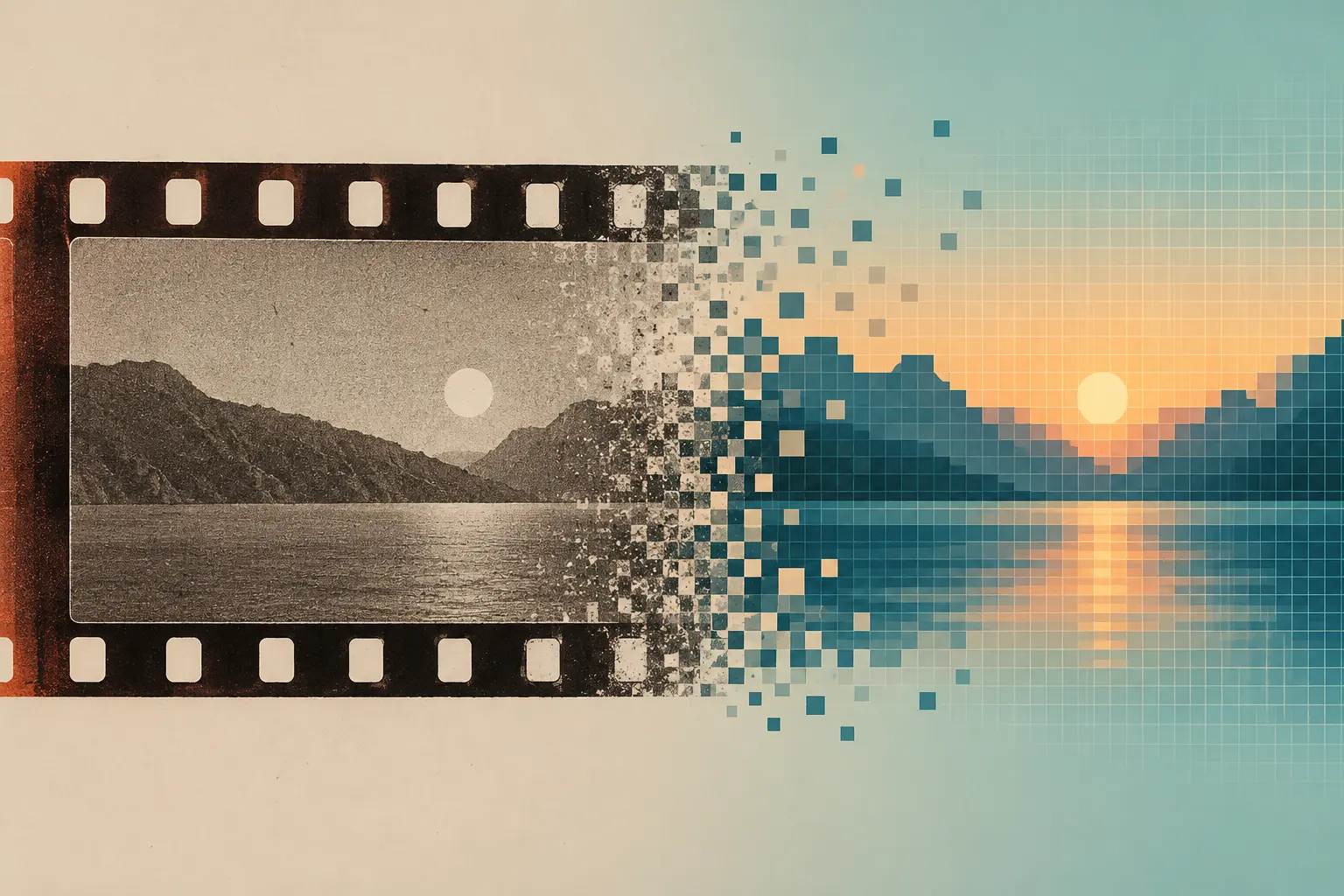
For much of photography’s history, an image formed when light acted on a photosensitive material. In negative-positive processes, the negative—on film or a plate—was a physical matrix: it preserved an image from which positive prints could be made. Digital photography replaced that matrix with electronically captured data. The camera changed, but so did the way images were made, preserved, and reproduced.
The transition became visible in the final decades of the twentieth century. The first digital camera appeared in 1990, but that milestone did not bring an immediate end to chemical photography. Film, electronic sensors, and different ways of making and sharing images coexisted for years. The history of the medium is not divided by an overnight switch.
From physical prints to circulation on screens
With film, an exposure had to be processed before the image became visible. The negative made it possible to produce positive prints on paper, but each print involved a material stage of work. In digital photography, capture becomes electronic information that can be viewed, duplicated, and transmitted without producing a physical copy at every step.
That changed the everyday circulation of photographs. One file can move from screen to screen and be reproduced many times without a new printing process for each copy. Taking a photograph also became separate from immediately making a print: an image can be stored and widely circulated without ever being fixed on paper.
Digital does not mean that an image has no support. Film and prints are material objects; a file depends on storage devices and software capable of reading and displaying it. These are different forms of existence and preservation, each with its own technical conditions. Digital photography displaced the material negative, but it did not eliminate dependence on a support.
An image that is also a construction
Photography has carried particular authority as a record of reality. But a camera has never provided a wholly neutral view: choosing a position, a frame, and the moment to release the shutter already involves decisions. Digital photography expanded the possibilities for intervention after capture, from retouching elements and changing color to combining images.
That does not make every digital photograph false, just as film did not guarantee objectivity. The difference is that digital manipulation can alter an image without leaving the obvious signs of a traditional montage. In photojournalism and other documentary uses, the capture process is therefore only part of the story. It also matters what happened to the image afterward, who selected it, and the context in which it is presented.
A photograph can be both a record and a construction. It may document an exposure to light, yet its final appearance depends on choices made during capture, processing, and editing. Reading it critically does not mean dismissing it as evidence; it helps define what it can support and what it cannot prove on its own.
The instant and time
The digital transition also makes the proximity between photography and video more visible: many devices can produce both kinds of image. Sharing tools and visual parameters, however, does not make their languages equivalent. As the UOC analysis of photography and video explains, framing, composition, and lighting matter to both, but audiovisual work organizes them over time.
Photography often concentrates meaning in a single image. Video, by contrast, uses duration, movement, and editing to create relationships between shots and build rhythm. The technical ease of switching between stills and video does not replace the narrative decisions that distinguish each form.
What changed, and what remains
Digitization transformed how photographs are recorded, copied, and circulated, and with it how their provenance and credibility are assessed. But a support does not by itself determine an image’s meaning or use. Composition, lighting, point of view, and selection still shape what we see.
Understanding the move from negative to file means recognizing a material as well as a cultural transformation. Three questions remain essential when interpreting a photograph carefully: what process produced it, what support it exists on, and in what context it is presented.
- Decade
- 1990s
- Region
- Global
- Level
- Introduction
- Entities
- No linked entities
Sources and references
- El factor temporal y el ritmo como distintivo entre fotografía y vídeodoi.org · 2026-10-28
- Historia de la fotografía: Cada período, movimiento y ...translate.google.com · 2026-10-28
- Historia de la fotografía - Wikipedia, la enciclopedia librees.wikipedia.org · 2026-10-28
- Fotografía e historia en América Latinaissuu.com · 2026-10-28
- La historia del fotoperiodismo y su impacto en la sociedadmymodernmet.com · 2026-10-28