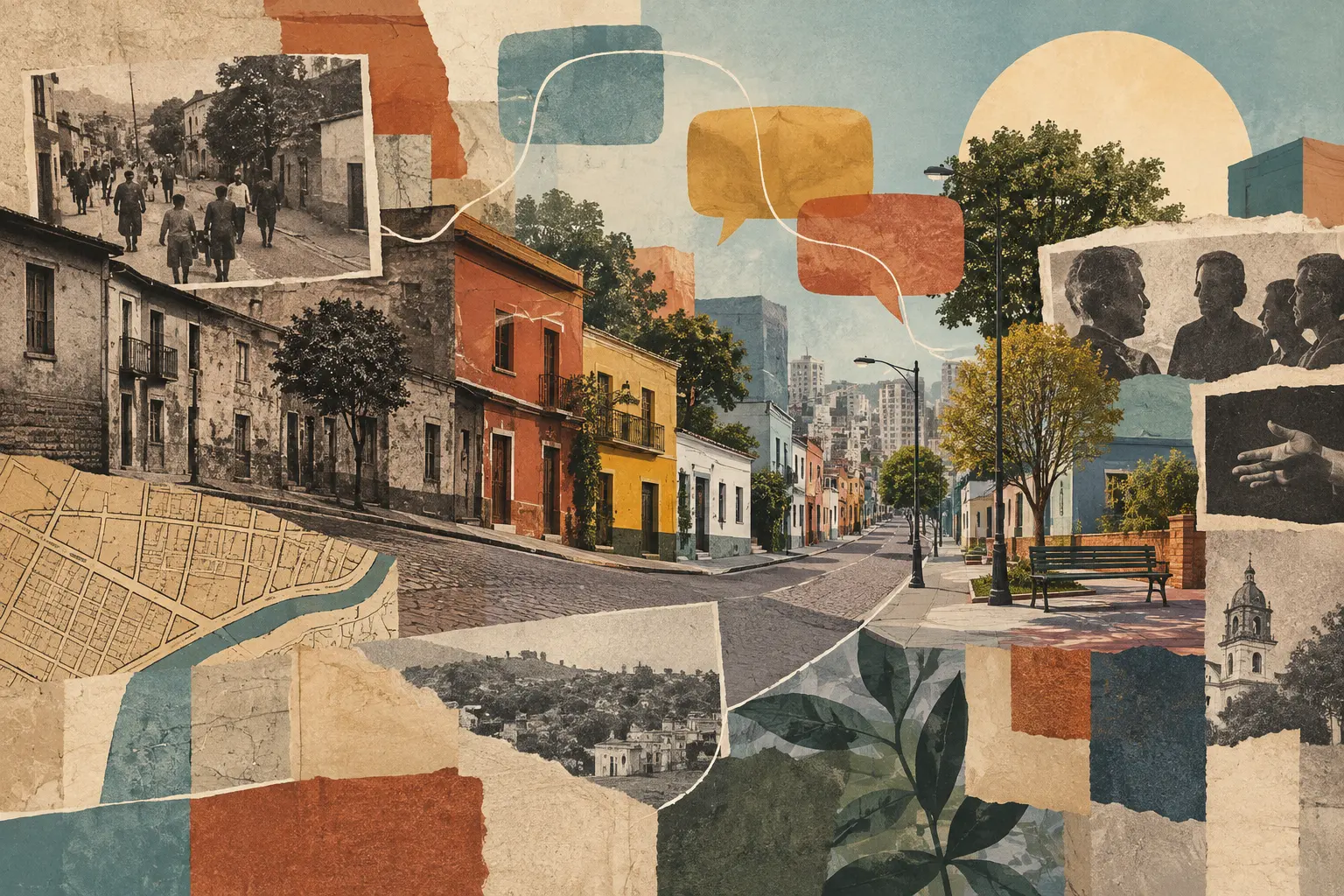
History at human scale
A neighbourhood’s history can begin with a simple question: what was this place like before I arrived? An answer might come from an older resident’s memory, a family photograph, a map or a house that no longer stands. None of these traces tells the whole story by itself. Together, they can show how a place changed and how the people who lived there experienced those changes.
Colombian historian Mauricio Archila Neira argued for using oral sources to approach people and experiences often left out of official narratives. In his work on workers, he shifted attention away from leaders, strikes and organisations towards values, customs, language, leisure and everyday life. His aim was not to test a prior idea of what the working class ought to be, but to understand how particular people faced the circumstances of their time.
Changing scale does not mean abandoning wider processes. A life story or neighbourhood account can illuminate social change, but it needs to be placed in context. An individual experience is not an automatic miniature of society as a whole: it is one possible entry point into broader questions, and its reach must be argued.
What an interview remembers
Archila distinguishes oral sources from a memory that simply exists, untouched, waiting to be collected. An interview takes shape through dialogue: the interviewer brings questions and listens from a particular position; the narrator remembers from the present, selects what matters and may fall silent, forget or rearrange events. This does not make the source worthless. Its situated character is part of what the historian must interpret.
Memory does not preserve every event with equal weight. An interview may contain silences, hesitation and vivid recollections. Rather than treating these only as errors to correct, a researcher can ask which experiences mattered, which are difficult to recount and what conditions made the conversation possible—or constrained it. Archila notes, for instance, that interviewing women could pose barriers when he, as a male researcher, asked about aspects of their lives that did not readily emerge in conversation. Time and trust could open some of that discussion, but they did not erase the initial imbalance.
It also matters who is considered an accessible source. In his research, Archila found union and political leaders more available for interviews than workers without public recognition. As a result, even a project intended to hear underrepresented voices can reproduce part of the imbalance it seeks to address. Asking who agreed to be interviewed is as important as asking who is absent and how that absence shapes the account.
Connecting the traces
Historians need not choose between testimony and written records as though one were inherently superior. Different sources answer different questions. An interview may reveal how someone perceived wages, neighbourhood relations or a change in the area; statistics may be better suited to reconstructing wage or price series. A photograph shows a place at a particular moment but cannot, on its own, explain how different households used it. An institutional document may record a decision without showing how those affected experienced it.
Archila advocates combining oral, written and visual sources, while also considering traces such as architecture, monuments and other material expressions. Corroboration is not a mechanical search for one version that cancels out the rest. It helps researchers examine what each account supports, where sources disagree and which questions remain. Convergence among several testimonies matters, but it does not automatically turn a shared recollection into a universal experience.
Colombian educator Pedro Molano brought this principle into a proposal for the classroom. He suggests linking family memories and everyday life to national and international events, and comparing physical changes in a neighbourhood—such as infrastructure—with shifts in residents’ ideas and experiences. A timeline can bring the two scales together: personal and family events on one level, and wider events taking place in the same years on another.
This approach reveals events occurring at the same time without confusing coincidence with proven cause. The fact that a local change coincided with a national event is not enough to show that one produced the other. The connection can guide an inquiry; documents, testimony and other evidence help establish what relationship can be supported.
Generalising without flattening difference
Archila points to a common confusion: the belief that generalisation requires erasing differences. If several interviews reveal a pattern, that regularity may help explain a process, provided researchers specify whom it includes and the context in which it arose. Variations matter too: they may show how the same change was experienced differently according to social position, gender, generation or household circumstances.
An individual voice should not automatically stand in for an entire group, but neither must it be discarded for failing to be statistically representative. Archila preferred to ask what the lives of people without public recognition could reveal, without requiring each person to embody a class or community in advance. The next task is to interpret these experiences alongside other sources, distinguishing what is shared from what is particular.
Molano advances a related idea in education: making local history with and from the community. The work can involve interviews, family documents, audiovisual material and images, with students, teachers and residents participating in the research. The neighbourhood then becomes more than a backdrop: its streets, transformations and memories become part of the historical questions.
Sharing the history is part of the work
For Archila, reconstructing the history of a neighbourhood, an Indigenous community or a workers’ group means that the people concerned should be able to encounter and comment on the account. Findings can be shared in different forms—a book, teaching materials, a video or a talk—but this is more than a way to circulate results. It opens the interpretation to discussion and recognises that historical knowledge affects the communities whose lives it describes.
Returning a history does not mean that every interpretation must match every participant’s recollection, or that a community has a single voice. It means making clear how the account was built: which testimonies it includes, what other sources accompany them and what conclusions the researcher draws. Keeping these elements distinct prevents the narrative from confusing one person’s words with the analysis developed from them.
A rigorous neighbourhood history promises neither total memory nor a uniform view. It seeks to understand life in a particular place without separating it from the changes that shape it, and to hear different voices without turning any one of them into a spokesperson for all. Local history is reconstructed through that tension: between individual experience and context, remembered accounts and other traces, and research and the people it concerns.
- Decade
- 1990s
- Region
- Global
- Level
- Introduction
- Entities
- Mappa
Sources and references
- Reconstruir las historias de vida, de comunidad, de barrio...www.mineducacion.gov.co · 2026-10-27
- Fuentes orales e historia obrerabooks.openedition.org · 2026-10-27
- Historia de los Barrios de Treinta y Tres Catálogo en líneapmb.parlamento.gub.uy · 2026-10-27
- México-Tenochtitlanes.wikipedia.org · 2026-10-27
- San José (Costa Rica)es.wikipedia.org · 2026-10-27