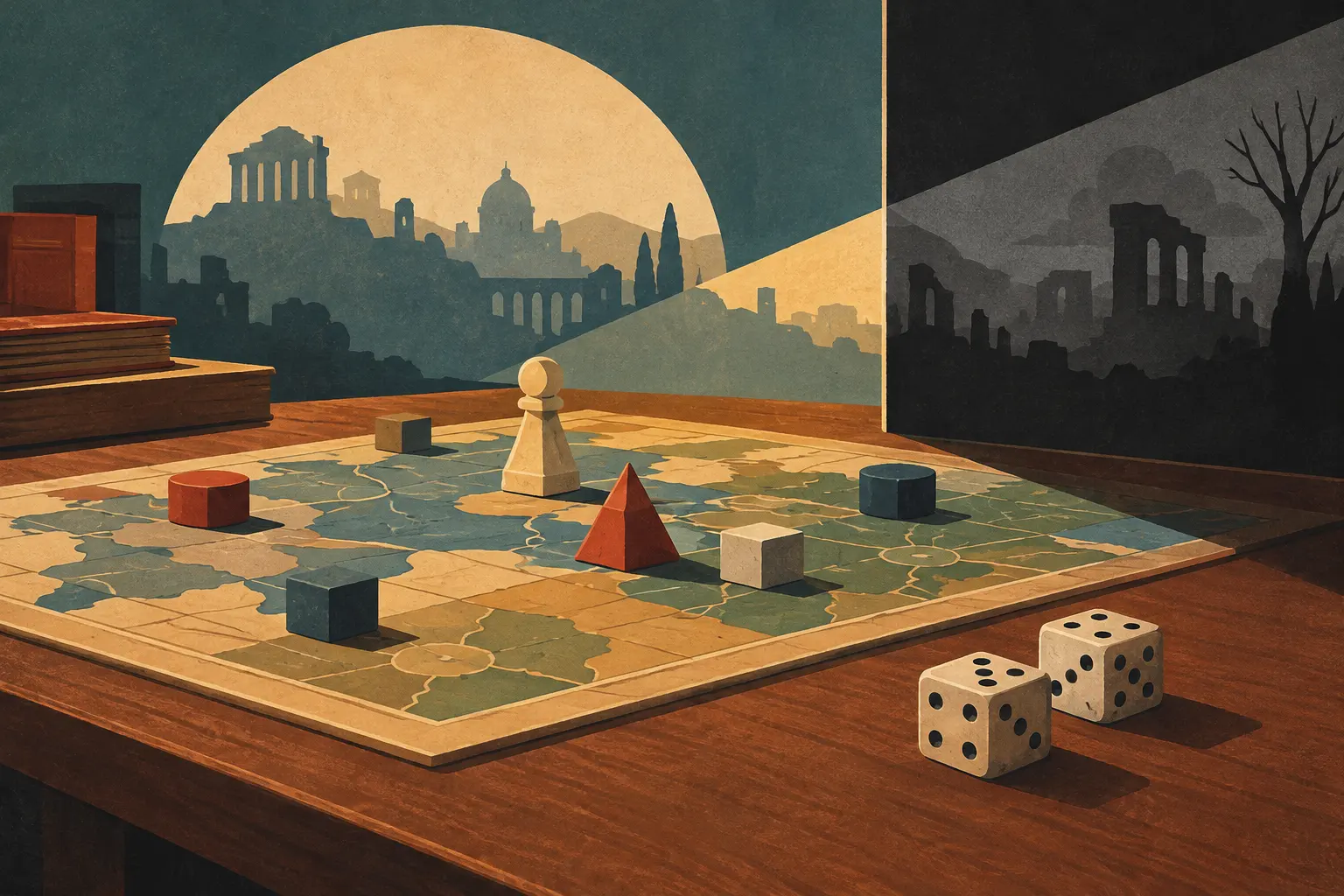
The question underlying any historical simulation game is not whether the game is faithful to the facts, but what kind of reality it allows to be constructed. When sitting in front of a board representing a war, an economic crisis, or a political period, the player does not access raw history, but a version processed by a rule system. This distinction is fundamental to understanding the nature of this genre within contemporary material culture. It is not a mere aesthetic recreation, but a logical structure that imposes limits on the participant's agency. Recent academic research, particularly the work of Jan Gonzalo Iglesia, has focused on this tension between play and memory, posing the central question: what history do we play? This question does not seek to delegitimize entertainment, but to analyze how game mechanics select, omit, or emphasize certain aspects of historical reality, transforming complex events into binary or probabilistic decisions.
The architecture of restriction
Unlike open-play toys, which allow for free and endless interpretation, historical simulation board games operate within a closed framework. Rules are not just instructions for winning, but definitions of what is possible. If a game about the Spanish Civil War does not include mechanics to represent famine or propaganda, it is not that the designer forgot these elements, but that the system has decided they are not part of the playable experience. This architecture of restriction turns history into an optimization problem. The player must manage resources, move units, or make strategic decisions within the parameters set by the board. In this sense, the game functions as a simplified model of reality, where social, economic, and human complexity is reduced to quantifiable variables. This reduction is not a defect, but the condition of possibility for the game to exist. However, it implies an inevitable loss of nuances that traditional historical narrative tries to preserve.
The game as a cultural document
Available evidence suggests that these games are not neutral. They act as cultural documents reflecting contemporary interpretations of the past. When a game is published, it encapsulates a specific view of history that is current at that time. Rules, components, and art are not just entertainment tools, but expressions of how a society understands its own background. For example, the way figures are represented, the language used in cards, or the victory structure can reveal ideological biases or narrative priorities. Studying these games means analyzing not just a leisure product, but a piece of material culture that dialogues with historiography. Comparing different editions or versions of the same title can reveal changes in historical narrative that the box does not explain. A reissue may soften conflicts, update terminology, or add elements that were considered inappropriate or irrelevant in the original version. These changes are valuable for understanding how historical memory is negotiated and adapted to present times.
The distinction between education and entertainment
It is crucial to distinguish between simulation as an educational tool and as an entertainment product. Although many historical simulation games are sold with the 'educational' label, their main function remains ludic. The goal is not to transmit a history lesson in a linear way, but to offer a decision-making experience under uncertainty. Confusing both purposes can lead to false expectations. A player who expects to learn the complete history of a period through a three-hour game will face inevitable frustration, as the game only offers one facet of that reality. On the other hand, a historian using the game as a primary source must be aware of its limitations. The game is not an archive, but an interpretation. Its value lies in its ability to generate empathy with the decisions of historical actors, not in its factual accuracy. This distinction does not diminish the game's value, but places it in its correct context: a space for exploring possibilities, not for verifying facts.
The mechanical selection of reality
Game mechanics are the language through which history is translated into action. Each mechanic, from combat to diplomacy, implies a set of assumptions about how the world works. If a game uses dice to resolve combat, it assumes that uncertainty is a central factor in war. If it uses event cards, it assumes that history is full of surprises and changes of direction. These assumptions are not necessarily false, but they are a selection. Other mechanics could have represented war differently, for example, through attrition or morale systems. The choice of one mechanic over another is a design decision with narrative consequences. When analyzing a game, it is important to identify these decisions and ask what is gained and what is lost by choosing one over the other. Mechanics are not just tools, but an epistemological stance on the nature of history.
The impact of edition and version
The history of a game does not end with its release. Editions, reprints, and revised versions are part of its cultural life. Every change, no matter how small, can alter the player's experience and, by extension, the interpretation of history. A change in the balance of forces can make a historical faction appear more powerful or weaker than it was. A modification in victory rules can change the focus of the game, for example, from territorial conquest to political survival. These changes are not always intentional; sometimes they are adjustments to improve playability, but they have an impact on the narrative. Comparing versions is a powerful tool for game culture scholars. It allows seeing how interpretations of history evolve over time and how designers respond to criticism and changes in the social context. This evolution is a reflection of history itself, which is never static but constantly reinterpreted.
The limits of verification
Although historical simulation games can be rich in detail, it is important to recognize the limits of what they can verify. They are not primary sources, but secondary ones, and their value depends on the quality of the research behind their design. However, even the best-researched games have inherent limitations to their format. The complexity of human history cannot be fully captured on a board. There are aspects of the historical experience, such as fear, hope, fatigue, or morality, that are difficult to quantify and, therefore, difficult to represent. This does not mean the game is useless, but that it must be used with awareness of its limits. The player must be aware that they are interacting with an abstraction, not reality. This awareness is part of the cultural experience of the game. By recognizing the limitations, one can better appreciate the designer's skill in creating a coherent and meaningful experience within a restricted framework.
Conclusion
Historical simulation board games are decision systems that structure the understanding of the past. They are not mirrors of reality, but filters that select and organize information. Their value lies in their ability to offer an immersive experience in a historical context, allowing the player to explore the consequences of different decisions. However, this value must be understood in the context of its limitations. The game does not replace historiography, but complements it, offering a unique perspective on how history is experienced and interpreted. By analyzing these games, we do not just study a leisure product, but a form of culture that reflects and shapes our relationship with the past. The question of what history we play remains relevant, not only for designers but for everyone seeking to understand how we build our collective memory through play.
- Decade
- Contemporary
- Region
- Global
- Level
- Enthusiast
- Entities
- Jan Gonzalo Iglesia, Juegos de mesa de simulación histórica
Sources and references
- “homo ludens”: representaciones de la evolución biológica ...www.academia.edu · 2026-10-23
- ¿Qué historia jugamos? Una aproximación al estudio de los juegos de mesa de simulación históricadoi.org · 2026-10-23
- Feliu, Torruella - La Simulacion y Los Juegos | PDFid.scribd.com · 2026-10-23
- CASA_RIQUEZA_78.indd 1 07/12/2023 23:11:18www.iberoamericana-vervuert.es · 2026-10-23
- Ponencias sobre Videojuegos y Historia | PDFes.scribd.com · 2026-10-23