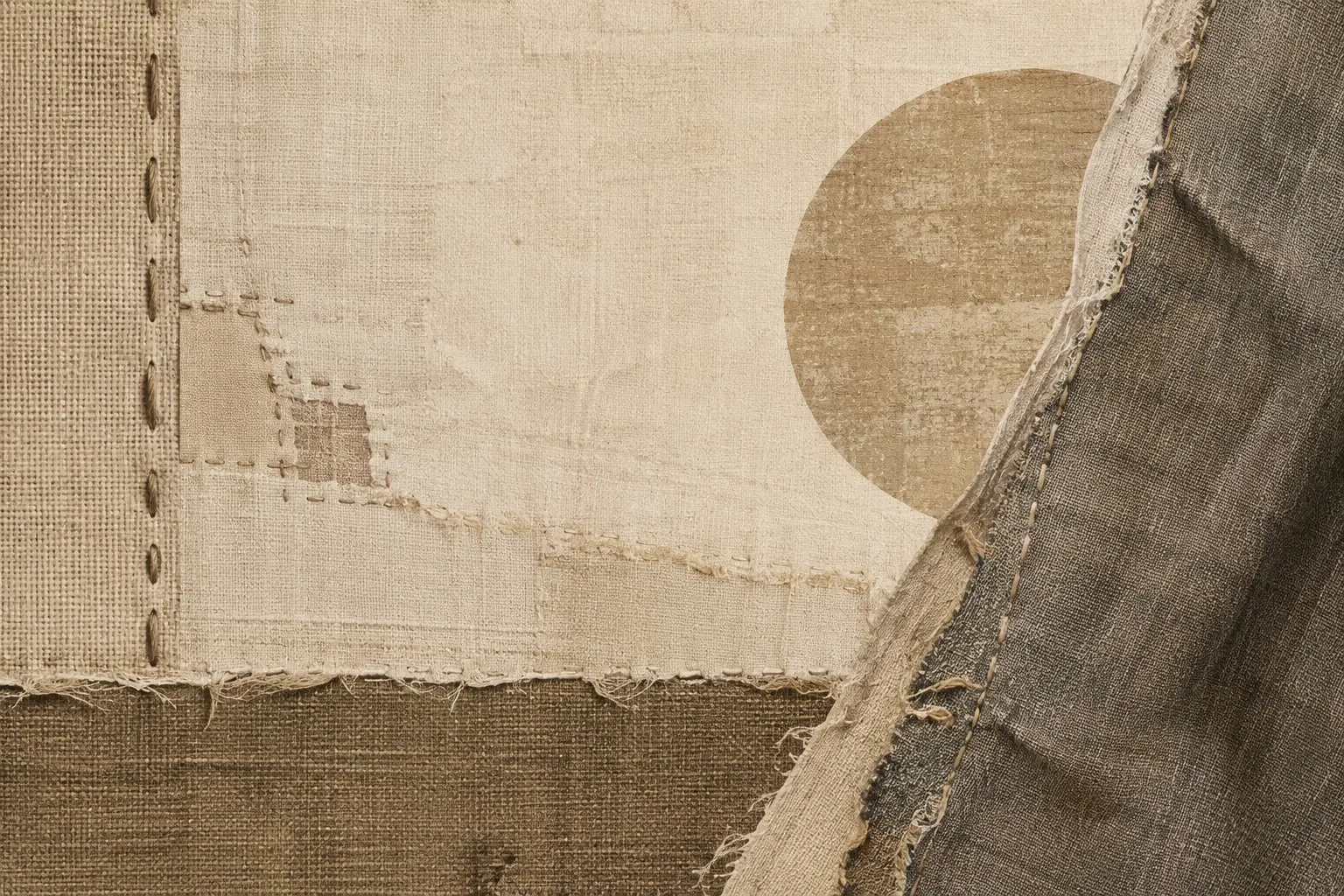
Clothing has traditionally been studied through the lens of haute couture or advertising, approaches that tend to privilege commercial imagery over lived reality. However, a growing body of academic and museum sources proposes a conceptual shift: treating the garment not as a consumer object, but as a material archive. This perspective allows for the investigation of fashion as a complex social practice, where every stitch, fabric, and shape records specific identities, roles, and historical contexts. This article explores how cultural institutions are redefining their relationship with clothing, integrating physical conservation with theoretical research to offer a deeper understanding of material culture.
From Display Case to Document
For decades, fashion museums have functioned primarily as spaces for aesthetic exhibition, where the value of a garment was measured by its rarity or its association with famous designers. This approach, while valuable for design history, often ignored the social dimensions of everyday use. Recent sources, including graduate studies at institutions like FIT in New York, suggest that fashion should be explored through art historical methodologies and innovative cultural studies approaches. In this framework, the garment becomes a document requiring critical reading, similar to a manuscript or a historical photograph. It is not just about admiring the beauty of a fabric, but decoding the social practices that produced and used it.
The Role of Academic Institutions
Universities and research centers play a central role in this redefinition. Master's programs in fashion and textile studies, such as those offered at FIT, incorporate supervised field experiences in museums, archives, and conservation centers. This integration of theory and practice allows researchers to understand how textile memory is managed. Evidence indicates that these institutions do not just preserve objects, but generate knowledge about how society constructs its identity through clothing. By combining technical conservation with theoretical research, fashion is prevented from being reduced to a mere image industry, recognizing it as a legitimate and complex field of study.
The Importance of Primary Sources
To avoid generalizations about what people actually wore, it is crucial to rely on primary sources. Photographs, inventory records, and personal correspondence offer concrete data that contrasts with the idealizations of advertising. Advertising, by its nature, presents a curated and aspirational version of fashion, while the archive preserves the marks of real use: wear, repairs, and adaptations. By studying these sources, researchers can distinguish between fashion as spectacle and fashion as everyday practice. This distinction is fundamental to understanding how people negotiated their identities within the social structures of their time, using clothing as a tool for expression and adaptation.
Museums as Memory Laboratories
Institutions in Europe and North America are transforming their collections into memory laboratories. The Fashion Institute of Technology Museum in New York, for example, maintains a permanent collection of approximately 50,000 garments and accessories. This magnitude is not just a logistical achievement, but a database for cultural analysis. Clothing exhibitions in museums in London and New York have evolved to include narratives that go beyond the chronology of designers. Themes such as gender, social class, and migration are explored, using garments as material evidence. This approach allows visitors to understand fashion not as an isolated luxury, but as a social phenomenon that affects all layers of the population.
The Tension Between Consumption and Material Culture
One of the central problems in the study of clothing as an archive is the tension between consumption and material culture. Fashion is inherently ephemeral, designed to be discarded or replaced quickly. However, when a garment enters an archive, its consumption cycle stops, and it becomes an object of study. This process of musealization involves a selection: which garments are preserved and why? The narratives that determine which garments form part of the historical collection reflect the values and biases of the time when those decisions are made. Therefore, the archive is not a neutral reflection of society, but an active construction that requires constant critical review to avoid the perpetuation of stereotypes or the exclusion of marginalized voices.
Interdisciplinary Methodologies
The study of clothing as an archive requires interdisciplinary methodologies that combine art history, anthropology, and cultural studies. These disciplines offer tools to analyze not only the form of the garment, but also its context of production and consumption. Art history provides the framework for understanding aesthetic evolution, while anthropology helps interpret the social and symbolic meanings of clothing. Cultural studies, for their part, allow for the examination of power dynamics and identity construction. This convergence of perspectives enriches the understanding of fashion, revealing the complexities of how people use clothing to navigate their social and political environments.
Towards a More Inclusive Textile Memory
The future of clothing as an archive points towards a more inclusive and representative textile memory. This involves expanding collections to include not only haute couture, but also everyday clothing, workwear, and costumes from diverse communities. By doing so, museums and archives can offer a more complete view of social history. The conservation of these garments requires specialized techniques, but their value lies in their ability to tell stories that would otherwise have been forgotten. Ultimately, treating clothing as an archive is recognizing that fashion is a form of social writing, where every garment is a page in the history of humanity.
- Decade
- Contemporary
- Region
- Global
- Level
- Introduction
- Entities
- Museum, Museo del Instituto de Tecnología de la Moda
Sources and references
- Estudios de moda y textiles: historia, teoría y práctica ...translate.google.com · 2026-10-22
- La Conservación del vestuario: punto de encuentro de ...unesdoc.unesco.org · 2026-10-22
- Los mejores —y más elegantes— museos de moda del mundo.es.qz.com · 2026-10-22
- EXHIBICIONES DE INDUMENTARIA EN LOS MUSEOSrevistaconserva.cl · 2026-10-22
- El archivo y lo análogo como MEMORIA, haciendo resistencia ...valeriaakl.substack.com · 2026-10-22
- La indumentaria como archivo: enfoques y problemáticasdialnet.unirioja.es · 2026-10-22