The preservation of objects with cultural value has evolved from mere physical custody to a complex management of their meaning. In the context of contemporary art and retro objects, the institution does not only protect the material but facilitates the transmission of memory. The Reina Sofía Museum, for example, defines its objectives around conservation and transmission, recognizing that value lies in the ability to generate dialogue. This perspective places the object not as a static relic, but as an active node in material culture. Digitalization enters this scenario not as a replacement, but as a tool that modifies the relationship between the viewer and the piece, allowing access that transcends the spatial and temporal limitations of physical exhibition.
Physical Integrity as a Limit
The central challenge of traditional conservation is maintaining the material integrity of the object. However, this integrity is fragile and subject to degradation. Digital conservation projects, such as the one carried out at the Ipiranga Museum in Brazil, demonstrate that the creation of large-scale 3D models allows documenting the current state of the pieces. This process does not eliminate the need to care for the original, but offers a layer of information that persists even if the physical material suffers damage. Digitalization thus acts as a memory insurance, capturing details that might be lost over time.
The Archive as Witness
The digital archive functions as a silent witness. In the case of electronic art, preservation requires not only the physical support but also bibliographic and audiovisual files that provide context. These documentary files allow access to primary sources and oral documentation, enriching the understanding of the work. The digital witness is not an identical copy, but a representation that adds layers of interpretation. It allows new generations to explore the design and context of a retro object without relying exclusively on its physical presence, offering a more complete view of its history.
The Gap Between Original and Representation
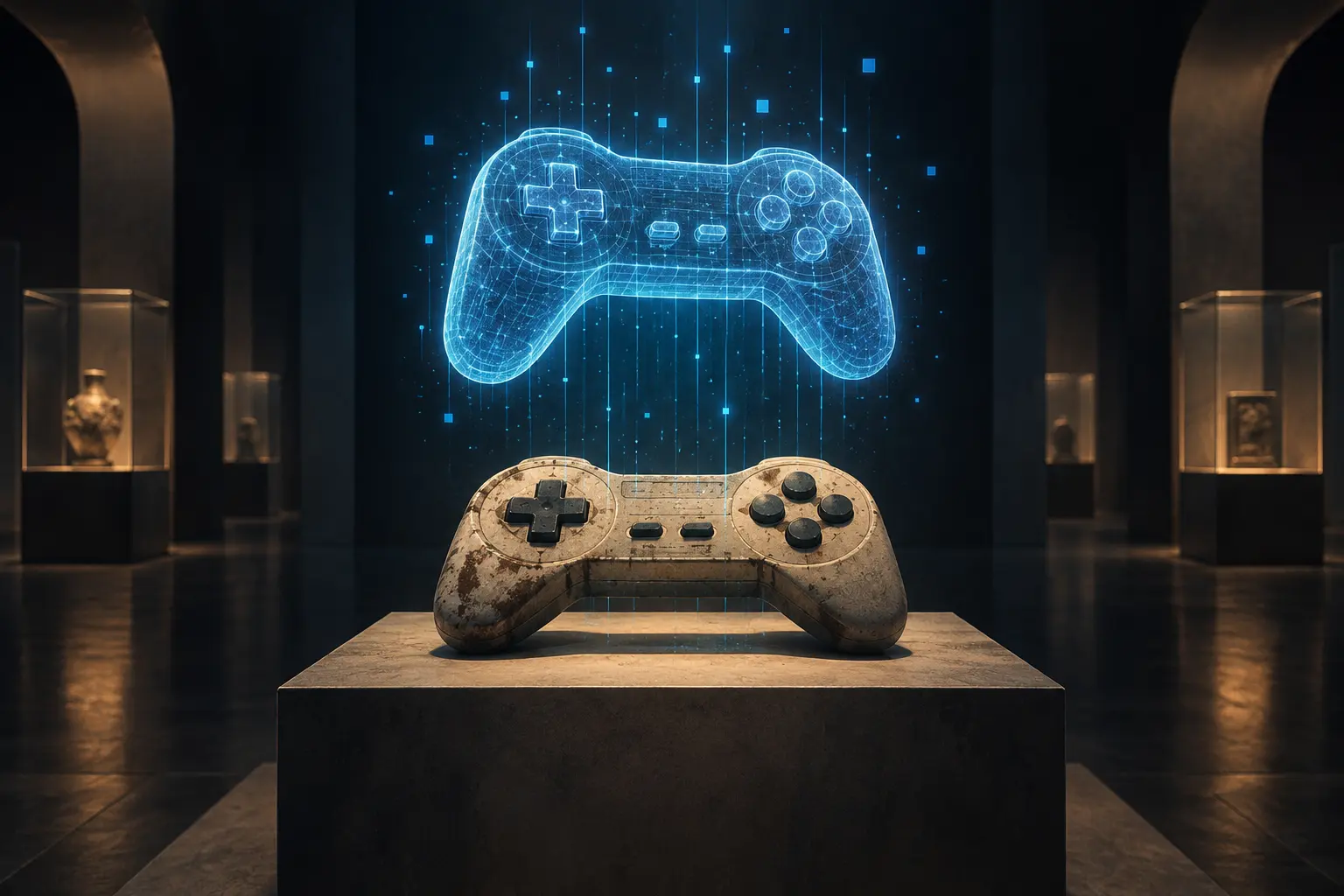
It is crucial to understand that the transition to digital format does not erase the differences between the original and its representation. The physical object possesses a unique materiality, textures, and defects that define its authenticity. The digital representation, on the other hand, is an abstraction that facilitates access but loses that tactile quality. This gap introduces new layers of interpretation, where the viewer must be aware that they are interacting with a mediation. Digitalization does not eliminate the singularity of the object, but contextualizes it within a broader information ecosystem.
Cultural Context and Access
Digitalization facilitates access to cultural contexts that would otherwise be inaccessible. By connecting history with current technology, institutions offer a more complete view of material culture. This is particularly relevant for retro objects, whose value often lies in their ability to evoke collective memories. The digital archive allows these memories to be shared and reinterpreted, fostering a continuous dialogue between the past and the present. Technology acts as a bridge that unites the historical experience with the contemporary possibilities of exploration.
Implications for Curation
For curators, digitalization implies a redefinition of their roles. It is no longer just about protecting objects, but managing information flows. The integration of 3D models and digital archives into the conservation strategy requires new technical and theoretical competencies. Curators must decide which aspects of the object are essential for its digital representation and how to present them without distorting their meaning. This work requires a delicate balance between fidelity to the original and the utility of digital access.
Although digitalization offers significant advantages, it has limits. Not all aspects of an object can be captured digitally. The complete sensory experience, including weight, temperature, and sound, is lost in the translation to pixel. Furthermore, digital technology is subject to obsolescence, which poses long-term challenges for the preservation of the digital archives themselves. It is necessary to recognize these limits to not overvalue the capabilities of digitalization as a unique solution to conservation problems.
Conclusion
Digital preservation is not a replacement for the physical object, but an extension of its cultural life. By acting as a witness, the digital archive allows retro objects to remain relevant in a world increasingly mediated by technology. The key is to recognize the tension between matter and information, and to use digitalization to enrich, not replace, the object experience. Institutions that achieve this balance offer the public a deeper understanding of material culture, connecting historical memory with the possibilities of the present.
- Decade
- Contemporary
- Region
- Global
- Level
- Enthusiast
- Entities
- Museum, Museo Reina Sofía, Museo Ipiranga
Sources and references
- DEPARTAMENTO DE CONSERVACIÓN-RESTAURACIÓN ...www.academia.edu · 2026-10-23
- Museo de Arte y Diseño Contemporáneo: orígenes, desarrollo institucional y contexto de un museo en movimientodoi.org · 2026-10-23
- El arte es un juego: El desplazamiento cultural de los videojuegos de artefactos cotidianos a objetos de arte contemporáneo legitimadosopenalex.org · 2026-10-23
- Conservación digital del Museo Ipiranga en Brasilwww.autodesk.com · 2026-10-23
- conservación del arte electrónico: ¿qué preservar y cómo ...www.annetteweintraub.com · 2026-10-23