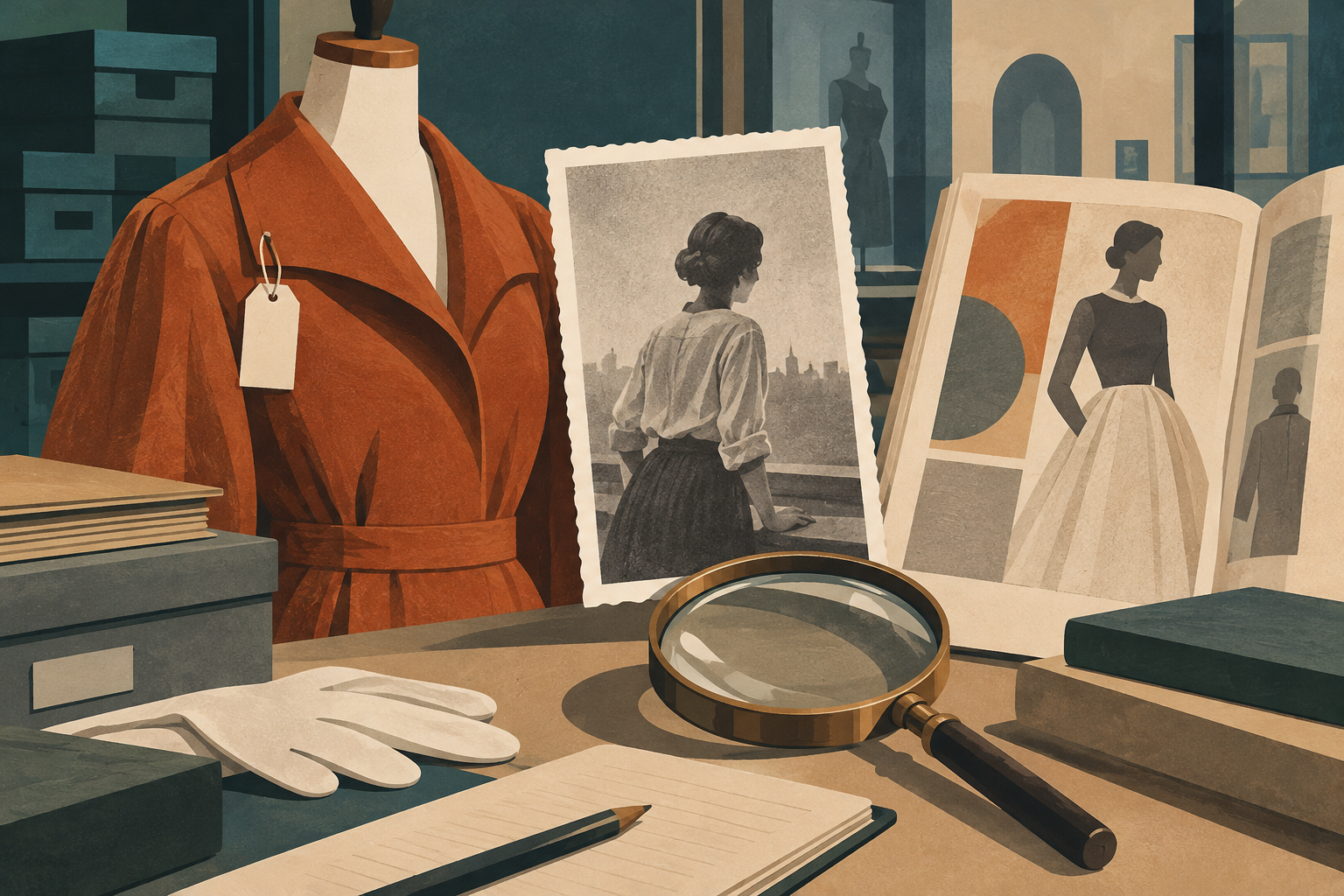
A preserved garment lets us examine materials and construction; a photograph may show how it was worn, but only in a particular situation; a magazine records images and arguments, not necessarily the everyday lives of its readers. Studying fashion means comparing these sources while keeping their limits in view. The Spanish collections and exhibitions discussed here provide a starting point: they document objects, images and publications, but do not by themselves justify claims about what everyone wore.
One garment is not a custom
Fashion includes clothing and accessories, but also the practices of making, circulating and wearing them. The Museo del Traje’s virtual exhibition presents the relationship between clothing, customs and fashion as part of a historical overview. That approach helps pose a more precise question than “What was fashionable?”: what kind of evidence does each object preserve, and what part of dress does it leave out?
An exhibited garment provides material evidence about the object that reached the museum. It does not, on its own, show how many people wore similar items, how often they were used, or how they were adapted to different contexts. To answer those questions, the object would need to be compared with other sources, such as photographs, records, publications or attributable testimony. The supplied material does not give individual use histories for the garments mentioned, so it would be unwise to assign any one of them a specific biography.
A photograph shows a situation, not a population
Images can bring clothing closer to its context of use, but they remain partial records. The Biblioteca Virtual del Patrimonio Bibliográfico lists 116 photographs in its collection on fashion, sewing and costume history, alongside books, magazines, manuscripts and explanatory plates. The range of formats matters: it shows that a photograph need not stand alone and can be compared with printed or written material.
An image fixes who appears, which parts of an outfit are visible and how a scene is presented. It does not automatically establish whether the clothing was commonplace or exceptional, borrowed or workwear, or chosen for a particular occasion. Nor can the people photographed represent an entire city or period without further evidence. An image becomes more useful when the document can be identified, dated on sound grounds and related to other sources. The information supplied here describes the collection but does not identify individual photographs; conclusions about particular people or garments are therefore not warranted.
Magazines and catalogues have purposes
A fashion magazine and an exhibition catalogue do different jobs. A magazine can be evidence for studying published images and arguments; without supporting evidence, it is not a neutral record of what its readers wore. The catalogue La moda imposible. Moda de vanguardia, 1960–2010 places its subject within a museum collection and an explicit timeframe. It is evidence of what the exhibition chose to present and preserve, not a census of everyday dress from 1960 to 2010.
The publication En Madrid. Una historia de la moda, 1940–1970 is described as a collective exhibition for research and dissemination. The Community of Madrid page describes a journey through different worlds of fashion, from sewing workshops to runways. These descriptions show that an exhibition can bring different fields together; they do not prove that every social group was represented equally. Assessing that representation would require the full contents, object records and selection criteria, which the available excerpts do not provide.
Connecting sources without conflating them
The proceedings Tejidos, moda y cuerpos include a discussion of women who innovated in local fashion and textile technologies during the 1970s. This opens a path for research into design and textile production, but the supplied excerpt does not name those women or describe particular garments. It is more responsible to leave the question open than to fill in details by inference.
Comparing sources is productive when their differences remain clear. A garment provides evidence about an object; a photograph, about a particular visual representation; a magazine, about published material; and a catalogue, about exhibition selection and interpretation. When sources converge, they may support a hypothesis about a practice or scene. Turning that hypothesis into a historical claim requires identifiable references and context that the material provided here does not always supply.
What the evidence supports—and what remains open
The sources establish that collections and exhibitions address fashion, costume, sewing and the relationship between clothing and customs. They also show that the records available can include photographs, magazines, books, manuscripts and plates. These are concrete details about resources and about some institutions’ approaches to fashion history.
On their own, they cannot establish which garments were most common, who wore them, how dress varied by class or place, or what wearers thought it meant. Titles and summaries are not enough to describe individual objects or determine when they were worn. Those questions require examination of the full records and comparison of their evidence.
Reading fashion as social practice therefore begins with a simple discipline: do not ask a single image or garment to stand for a population. A preserved object, photograph and publication can bring us closer to actual uses when they are identified, contextualized and compared; otherwise they remain valuable but limited clues. That distinction makes for a more careful history of clothing, one that does not confuse what a source shows with what still needs to be demonstrated.
- Decade
- 2000s
- Region
- Spain
- Level
- Enthusiast
- Entities
- Museum, Museo del Traje
Sources and references
- Así fue... Exposición: En Madrid. Una historia de la moda, ...www.comunidad.madrid · 2026-10-11
- La moda imposible. Moda de vanguardia, 1960 - 2010www.cultura.gob.es · 2026-10-11
- La moda en la historia - Museo del Trajemuseodeltrajevirtual.com · 2026-10-11
- Cuando la moda entra en el museo: colección, contexto y ...www.retropause.com · 2026-10-11
- Coleccion de Moda, Costura e Historia del Trajebvpb.mcu.es · 2026-10-11
- Tejidos, moda y cuerposhistoriadeldisseny.org · 2026-10-11
- publicacióngestiona3.madrid.org · 2026-10-11