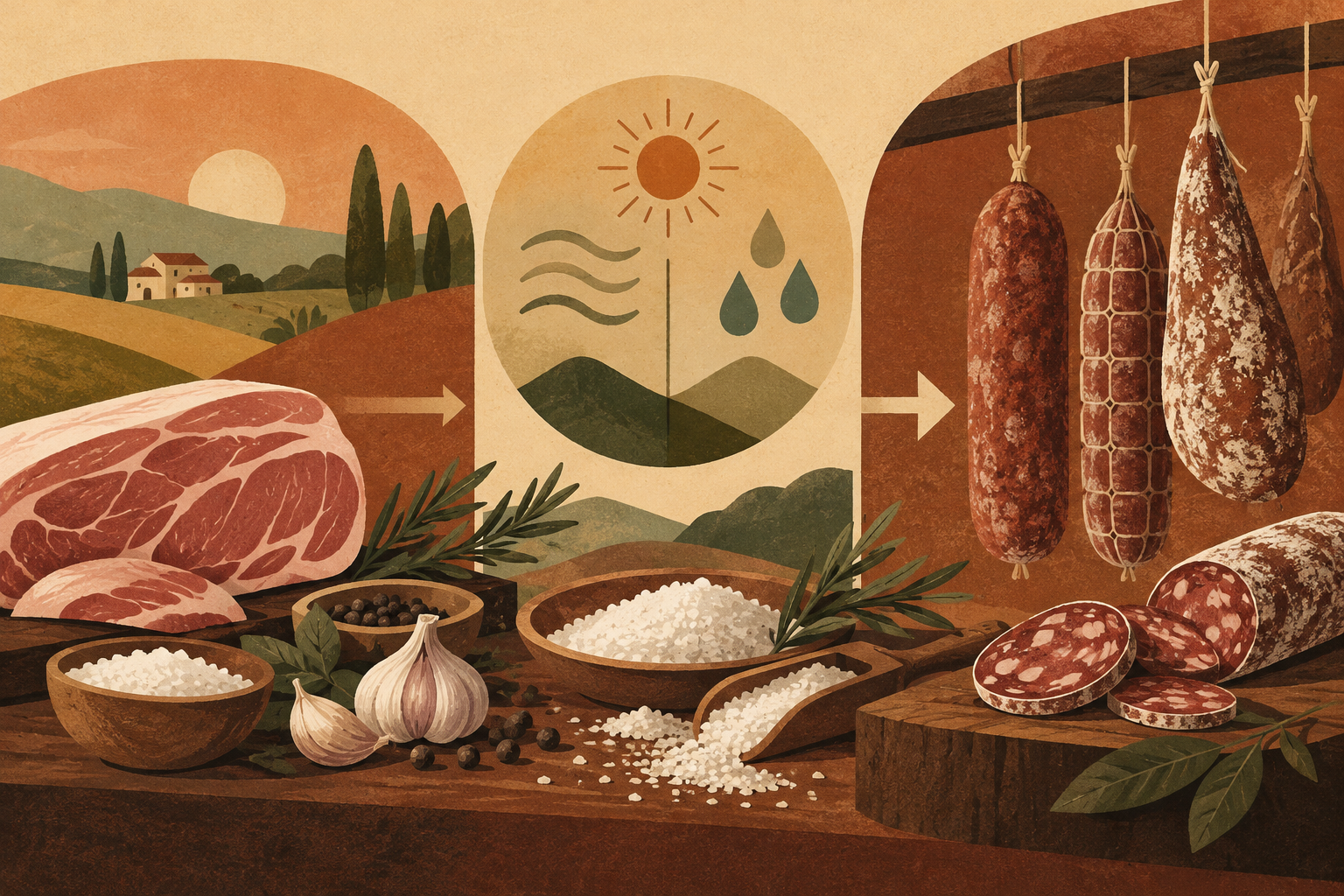
The history of food is often told through scarcity, but artisanal sausage has its origins in the opposite problem: surplus. It is not a modern invention or a recent gastronomic trend, but a practical and documented response to the need to manage meat that could not be consumed fresh. This practice, which has millennial roots, laid the foundations for what we now understand as quality charcuterie, radically different from massive industrial production.
The Logic of Surplus
Documentary sources indicate that sausage making arose specifically as a way to preserve surplus meat. In the early periods of this practice, preservation was not a luxury but a logistical necessity. Leftover meat from slaughters or hunting, which would otherwise be lost, was transformed into a stable product. This transformation was not arbitrary; it followed a logic of total utilization that defined the product's identity. The purity of the piece was the guiding principle, moving away from any adulteration that would compromise the integrity of the food.
Purity vs. Additives
One of the clearest distinctions between artisanal and industrial sausage lies in composition. While industrial products, according to specialized literature, abuse flours and additives to extend shelf life and reduce costs, artisanal sausage is based on natural processes. This difference is not minor: it implies a production philosophy where the quality of the primary ingredient is irreplaceable. The absence of artificial fillers forces the artisan to master curing and drying techniques with a precision that modern technology cannot always fully replicate.
Millennial Roots
Although industrialization transformed the scale of production, the basic preservation techniques have an antiquity exceeding three thousand years. This longevity suggests that the method has proven its effectiveness over centuries. It is not a static technique, but accumulated knowledge that has survived profound social and economic changes. The persistence of these practices in various cultures confirms that the relationship between meat, salt, time, and air is a universal constant in the history of human food.
The Case of Requena
Today, this tradition is not a museum memory, but a living economic and cultural activity. Communities like Requena, in Spain, have turned this heritage into a pillar of their local identity. The city annually celebrates the Artisanal and Quality Sausage Fair, an event that has accumulated more than three decades of history. This fair is not simply a market; it is a meeting space where product excellence is validated. The 31st edition, for example, was held from February 6 to 8, consolidating the event calendar that attracts producers and consumers interested in authenticity.
Beyond Commerce
The relevance of these fairs transcends the commercial. They function as cultural meeting spaces that highlight the importance of craftsmanship in Spanish gastronomy. By bringing producers together, a network of knowledge and mutual recognition is created. Quality is not imposed; it is demonstrated. In this context, sausage ceases to be a simple food and becomes a symbol of regional identity and respect for traditional processes. The fair acts as a quality filter, where the producer's reputation is at stake before the community.
Innovation and Tradition
Although the base is traditional, the sector is not static. There is a combination of traditional technique and innovation that allows offering a high-quality product in the current market. This does not mean abandoning purity principles, but adapting control and presentation methods to contemporary expectations. Artisanal sausage represents a bridge between past and present, where history is not preserved in a jar, but lived in each piece made. Innovation here is subtle, focused on efficiency and food safety without compromising flavor or texture.
Conclusion
Artisanal sausage is, in essence, a lesson in historical efficiency. It was born from the need not to waste and evolved into a high-end product thanks to technical mastery. Today, its value does not reside only in its taste, but in what it represents: a cultural continuity that resists industrial homogenization. Understanding its origin allows us to better appreciate the complexity of what we consume and the silent work behind each quality sausage.
- Decade
- 1990s
- Region
- Spain
- Level
- Introduction
- Entities
- Museum, Embutido artesano, Requena
Sources and references
- 😱🥩 ¿Sabías que los embutidos existen desde hace más de 3.000 años? ...www.instagram.com · 2026-10-19
- Requena celebra la XXXI Mostra d'Embotit Artesà i de Qualitat. ...www.facebook.com · 2026-10-19
- productos gourmet archivos - Página 2 de 4embutidoscastro.com · 2026-10-19
- Informe sobre Elaboración de Embutidos | PDF | Carne | sales.scribd.com · 2026-10-19
- Marca turística | Ayuntamiento de Requenawww.turismorequena.es · 2026-10-19