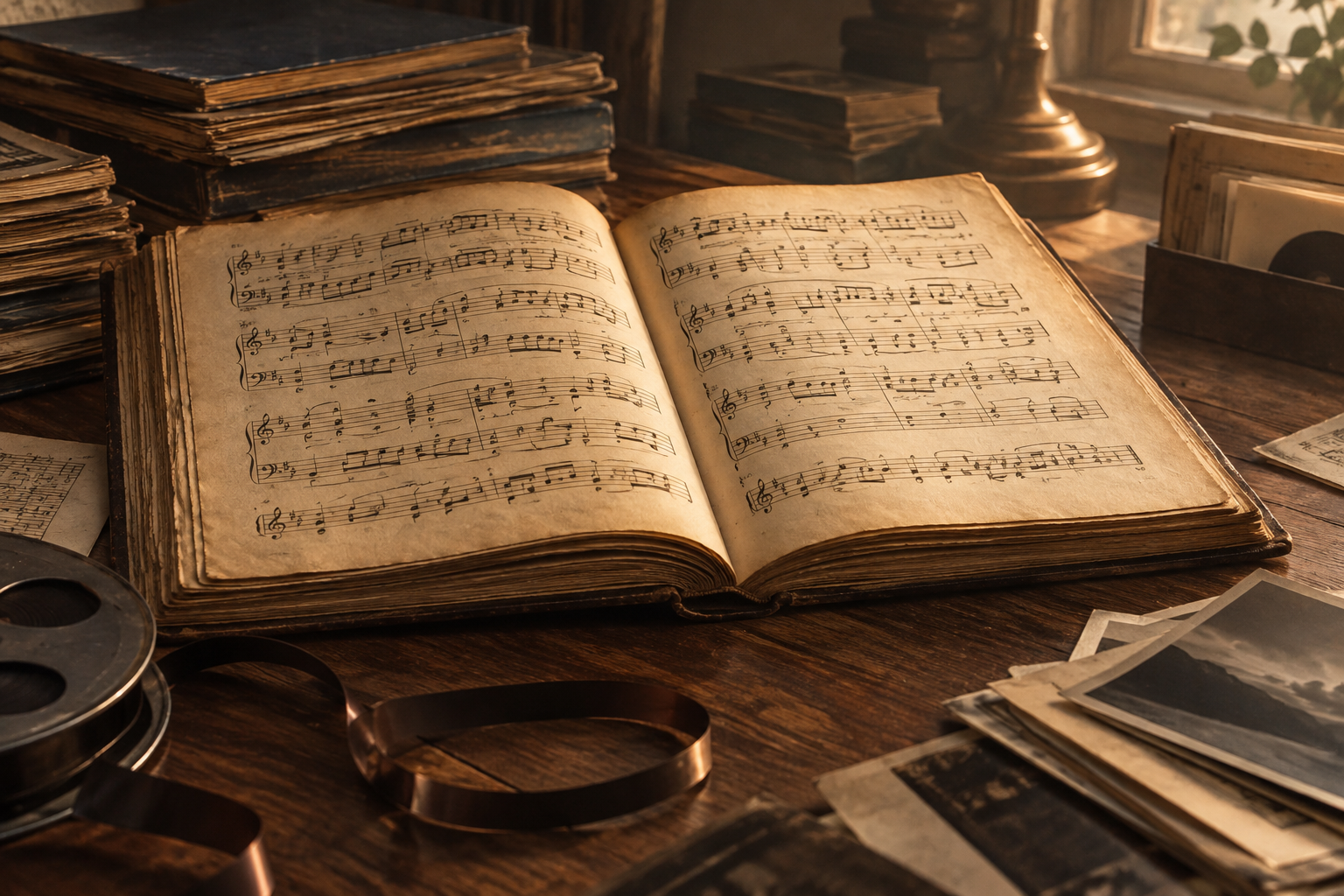
The management of musical archives has evolved from mere object custody to the construction of cultural contexts. Institutions like the Mariana Music Museum, which houses thousands of manuscripts from the 18th to the 20th centuries, demonstrate that the physical support is only the beginning of the story. Recent research, such as that published in Latin American Research Review on the Peruvian folk archive, reveals that these funds arise from transnational intellectual agendas and institutional challenges, not just technical preservation. In this framework, the archive ceases to be a static repository and becomes a moving space, where the past is heard in the present. Contemporary projects, such as the one by the Chillán Municipality on Claudio Arrau, integrate paper conservation workshops with musical dissemination, showing that support preservation and work interpretation are complementary processes. This vision allows distinguishing between the edition, the recording, and the manuscript, offering a more precise narrative on how sound culture is transmitted and transformed across generations.
From Custody to Context Construction
Traditionally, the musical archive was understood as a place of rest, a space where sound objects or their written representations were stored to prevent deterioration. However, current evidence suggests a paradigm shift. The administration of these funds no longer limits itself to physical conservation but involves the creation of meaning networks. The Mariana Music Museum, inscribed in UNESCO's Memory of the World, is a clear example of this transition. By housing approximately four thousand manuscripts spanning from the 18th to the 20th century, the institution does not just protect paper but offers a continuous historical testimony. This collection reflects how music has been a vehicle for identity and expression over two centuries, transforming the archive into a living document that requires constant interpretation.
The Case of the Peruvian Folk Archive
The complexity of archival management is highlighted in recent studies on folk music. An article published in the Latin American Research Review analyzes the troubled management of authentic sounds in Peru between 1949 and 1952. R. Chocano's research reveals that the folk musical archive does not arise from nothing but from a transnational context where specific intellectual agendas converge. These agendas were related to ideas about folk music and the institutional challenges of the time. This finding is crucial because it demystifies the idea that archives are neutral deposits. On the contrary, they are the result of political, academic, and cultural decisions that define what is preserved and how it is presented to the public. The transnational nature of these agendas shows that national borders do not limit the circulation of musical ideas, but rather that archives are nodes in a global network of cultural exchange.
The Archive as a Moving Space
The notion of a static archive is challenged by the idea of a moving space. This perspective, explored in contexts such as the Reina Sofía Museum, invites us to think of the archive not as an end, but as a continuous process. In this model, the past is not something dead that is observed, but something that is heard in the present. Listening becomes the main tool for accessing the archive, allowing current generations to interact with past works in an active manner. This dynamic approach recognizes that the value of a musical archive does not reside solely in the integrity of its objects, but in its ability to generate new interpretations and connections. The movement is not only physical but conceptual, as it implies the constant recontextualization of pieces within current cultural discourses.
Conservation and Dissemination in Chillán
Contemporary projects illustrate how theory is applied in practice. The Chillán Municipality in Chile has developed initiatives centered on the figure of Claudio Arrau. One of these projects, titled “Claudio Arrau and Chilean Music: Valuation,” integrates paper archive conservation workshops with musical dissemination activities. This combination is significant because it demonstrates that technical preservation and artistic interpretation are not opposite processes but complementary ones. By teaching the community to care for physical documents, it also fosters greater respect and understanding for the musical content these documents contain. Paper conservation thus becomes an act of cultural preservation, where the physical support is the medium for accessing the sound experience. This local management model offers an alternative to large institutions, showing that archives can be tools for community cohesion and cultural education.
Distinguishing Between Edition, Recording, and Manuscript
To understand the depth of a musical archive, it is necessary to distinguish between the different types of documents that compose it. The printed edition, the sound recording, and the original manuscript are three distinct entities that offer different perspectives on the same work. The manuscript reveals the composer's intentions, corrections, and marginal notes that do not appear in the final edition. The recording, on the other hand, captures a specific interpretation at a given moment, adding the temporal dimension and the voice of the performer. The edition, in turn, standardizes the work for mass dissemination. An archive that integrates these three elements allows for a richer and more nuanced narrative. By studying the relationship between these supports, researchers can trace the trajectory of a work from its creation to its public reception, identifying the transformations it undergoes at each stage. This distinction is fundamental to avoid the conflation of concepts and to appreciate the complexity of sound culture.
Intellectual Agendas and Institutional Challenges
The formation of musical archives is deeply linked to the intellectual agendas of their creators. In the case of the Peruvian folk archive, it was observed how ideas about authenticity and national identity influenced the selection of pieces. These institutional challenges include funding, the training of specialized personnel, and the definition of access policies. The transnational nature of these agendas implies that archives are also spaces of negotiation between different cultural traditions. The management of authentic sounds, as mentioned in the cited research, is a troubled process that requires a constant review of selection and presentation criteria. This means that archives are not fixed entities but evolve as cultural perspectives and institutional priorities change. Understanding these factors is essential for responsible and ethical archival management.
Implications for Contemporary Sound Culture
The vision of the archive as a moving space has significant implications for current sound culture. In an era dominated by the digital flow of music, the importance of physical archives and their historical context becomes more relevant than ever. These archives offer a material anchor and a historical depth that digital platforms cannot replicate. By integrating conservation with dissemination, institutions can create bridges between the past and the present, allowing historical music to remain relevant for current audiences. This approach fosters a more conscious and critical listening, where the listener does not just consume sound but explores the layers of meaning that surround it. Sound culture, therefore, is not just a product of the present but the result of a historical accumulation that is constantly renewed through interaction with archives.
Conclusion
The musical archive has ceased to be a simple deposit of objects to become a dynamic space of cultural construction. Through cases such as the Mariana Music Museum and the projects of the Chillán Municipality, it is evident that archival management requires an integration of technical preservation with artistic interpretation. Research on the Peruvian folk archive highlights the importance of intellectual agendas and institutional challenges in the formation of these funds. By distinguishing between edition, recording, and manuscript, the understanding of how music is transmitted and transformed across generations is enriched. This perspective invites us to rethink the role of archives in contemporary society, not as museums of the past, but as laboratories of the present where sound culture is renewed and reinterpreted. In this context, listening becomes the key to accessing the richness of these moving spaces.
- Decade
- 1990s
- Region
- Global
- Level
- Enthusiast
- Entities
- Museum, Museo Reina Sofía, Sounds, Cuatro, Museo de Música de Mariana
Sources and references
- La valoración de colecciones como herramienta para la ...revistas.javeriana.edu.co · 2026-10-18
- Museo Claudio realizará taller de conservación de ...m.facebook.com · 2026-10-18
- Archivo del Museo de Música de Mariana, siglos XVIII-XIXwww.unesco.org · 2026-10-18
- Escuchar un paíswww.museoreinasofia.es · 2026-10-18
- La accidentada gestión de sonidos auténticos: Agendas ...www.cambridge.org · 2026-10-18
- 🥼SIMPOSIO SOBRE ARCHIVOS MUSICALES ● 2026 El ...www.instagram.com · 2026-10-18