A file is not a film
Cinema research involves working with materials that are not the work itself: catalog records, photographs, production documents, posters and academic writing. The proposal for a cinema museum in Spain, for instance, lists production stills and documents from sets and post-production among the materials that might be preserved. The distinction is fundamental: an archive can bring us closer to a film’s circumstances, but it is not the film and cannot by itself recreate how it looked in a cinema.
Film documentation has its own history and systems of description. Domínguez-Delgado’s article places the creation of film archives and cinema museums within that context. The supplied record mentions fields such as accession number, title, filmmakers, genre and shooting dates. These are useful for identifying and organizing records; on their own, they do not explain what a work meant to the people who saw it.
What each source can answer
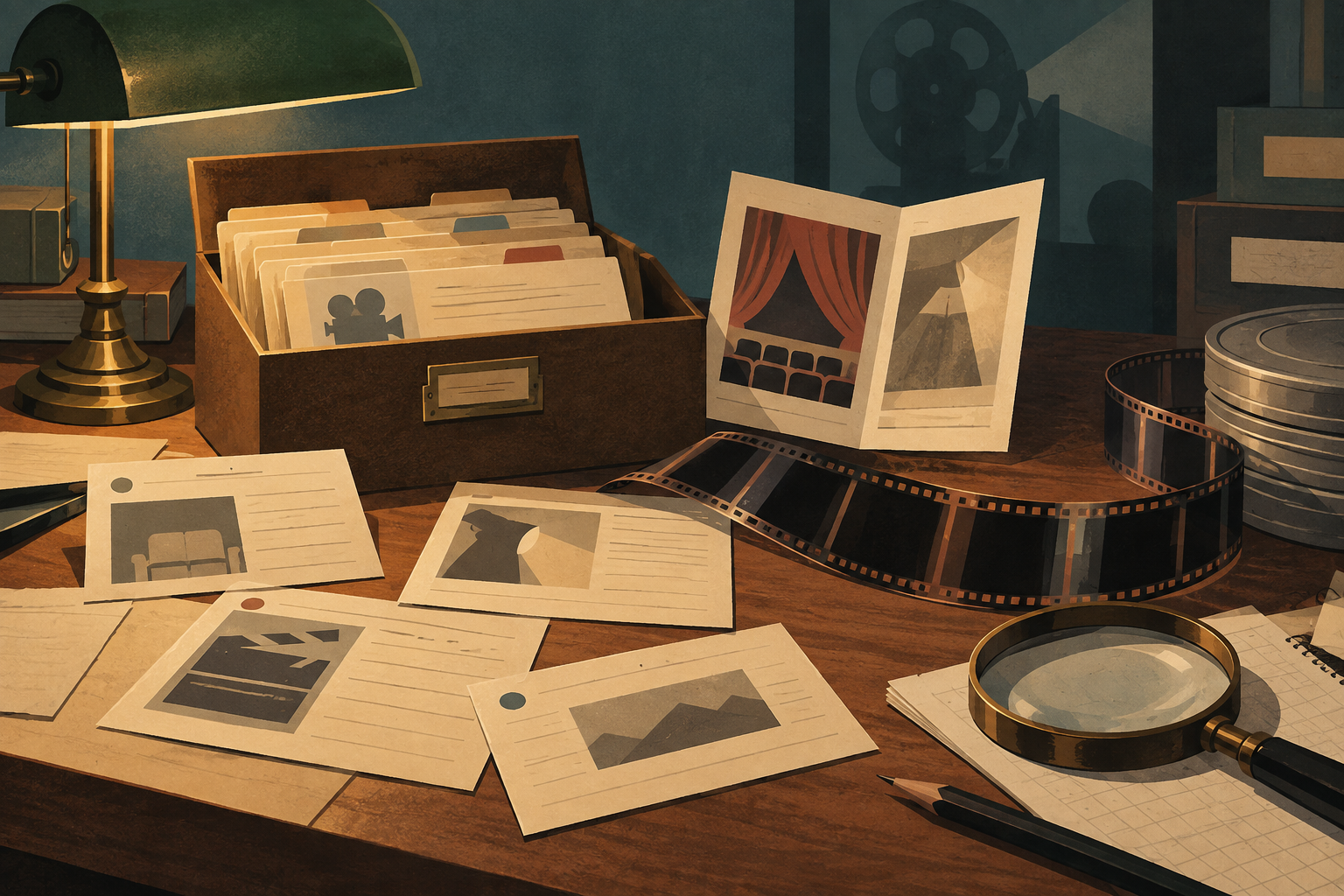
A production still may offer evidence about a moment in production; a poster or programme may document a mode of public presentation; a catalog entry may help establish how a film was described. These are different questions. Start by asking what the object is, who made or assembled it—if known—and which aspect of cinema it allows us to observe.
The Madrid filmographic survey published by the regional government offers another kind of approach: it organizes information about films and locations associated with the city. The supplied excerpt, for example, mentions a film’s screening at the Real Cinema and locates its shooting in several places. This shows what a survey can contribute, but it does not by itself establish audience reception or the full conditions of exhibition.
From promotion to reception
Posters and promotional materials can be used to study what was advertised and how a film was made visible. They are not neutral transcripts of the work; they record a presentation of it. A claim about reception requires evidence suited to that question, not just a surviving poster or catalog entry.
The same caution applies to comparing cinema screenings with home video. The question of how reception may have changed between the two is worthwhile, but the references available here do not, by themselves, document a specific comparison of audiences, home editions or viewing practices. A responsible investigation would leave that question open until it had gathered relevant sources. Memories of watching a home copy should not be turned into a general conclusion about how a film was seen.
The archive has limits too
A catalog makes accessible what it describes, but its fields define which information becomes visible. The presence of a title, genre or shooting date does not guarantee that every related document survives or that the description answers every question. Likewise, the absence of a detail in one record does not prove that the corresponding event never occurred; it may simply mean that the source does not mention it.
Research on the social history of cinema faces specific difficulties, as the title of Gil Gascón, Chicharro Merayo and Gómez Segarra’s article on Alba de América (Orduña, 1951) indicates. The supplied record identifies the subject and object of study, but it is not enough to attribute conclusions to the article that are not present in the evidence provided. Making that limit visible is not an editorial weakness; it is a necessary boundary.
Reading without collapsing the layers
A careful method separates three levels: the film as a work; the documents that identify, produce or promote it; and the scholarly interpretations that examine those materials. Historia y cine discusses cinema as both a documentary source and a historical agent, a formulation that encourages us to consider its value for studying the past while remembering that such use requires context and analysis.
It also matters to state what cannot be concluded. A still image cannot replace a sequence; a catalog entry cannot demonstrate reception; and a museum proposal listing possible holdings does not prove that every item is preserved or accessible. Distinguishing observation, source and interpretation lets readers follow the steps from document to claim.
The trace and the work
Related documents are not mere accessories: they make it possible to ask questions about production, classification, promotion and memory. Their strength lies in showing aspects that a film copy does not record in the same way. Their limit is just as clear: no single item contains the whole history of a work or the experience of watching it.
Studying cinema through its traces does not mean replacing films with nostalgia or an idealized archive. It means specifying what each source preserves, what it leaves out and what evidence would be needed to go further. A file can guide our attention; conclusions should remain proportionate to the evidence.
- Decade
- Contemporary
- Region
- Spain
- Level
- Enthusiast
- Entities
- Museum
Sources and references
- Las dificultades de la investigación en historia social del cine: Alba de América (Orduña, 1951)doi.org · 2026-10-05
- Eta y el Cine. Las fuentes de información de los profesionales del cineopenalex.org · 2026-10-05
- Historia y cine. La construcción del pasado a través de ...ifc.dpz.es · 2026-10-05
- La Documentación Fílmica: marco contextual históricorevistas.ucm.es · 2026-10-05
- PROYECTO DE CREACIÓN DE UN MUSEO DE CINE EN ...eldocumentalistaudiovisual.com · 2026-10-05
- Cine y casi cine 2002www.museoreinasofia.es · 2026-10-05
- BVCM01017 Madrid y el cine. Panorama filmográfico de ...www.madrid.org · 2026-10-05