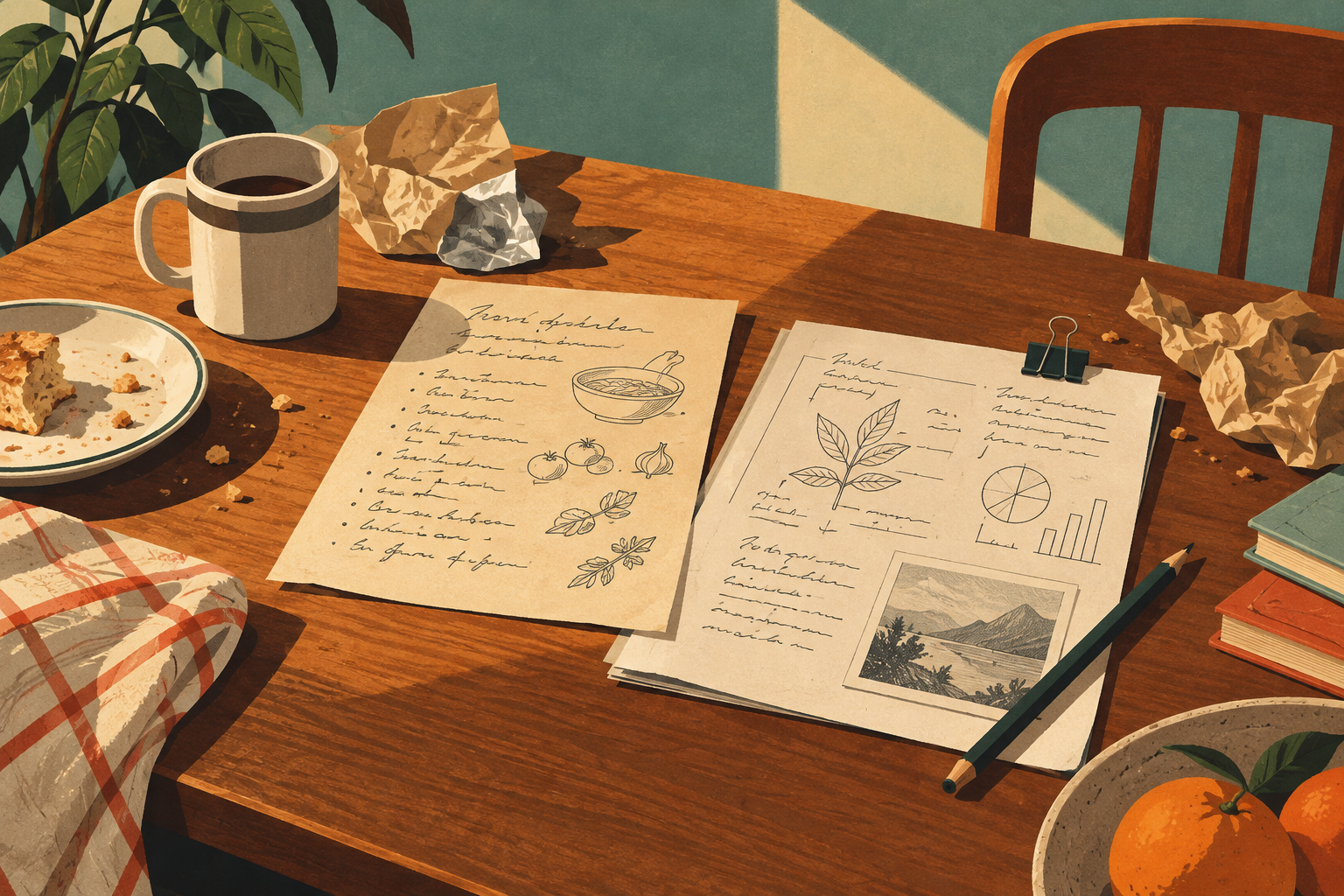
Food is more than a menu
Food history can study far more than ingredients and recipes. The available evidence includes a social perspective: a 2009 article on food historiography says this approach argued for attention to how food was distributed through history. That shifts the question from “what was eaten?” to others: who could access particular foods, how they were distributed, and what social relationships those practices expressed. It is a useful lead, not a complete answer about household habits, advertising or sweets in any particular period.
The distinction matters for a section devoted to packaging, advertisements and recipe books. An advertisement documents a promotional strategy; by itself, it does not prove that people bought the product or made it part of everyday life. A recipe records a proposed or preserved preparation, but it cannot show how often people cooked it. Research begins by distinguishing these kinds of traces rather than treating them as interchangeable accounts of experience.
What historiography contributes
The Dialnet study “La historia de la historia de la alimentación” offers an entry point into food historiography and explicitly mentions the social perspective and food distribution. Its title points to a double subject: studying food and examining how its history has been written. The latter helps identify how research questions and methods change over time.
A 2009 article titled “De panzas y prejuicios: la historia y la comida” provides another reference for considering the relationship between food and historical interpretation. The supplied record identifies it as an article in Revista de Historia Iberoamericana, but provides neither its text nor a detailed abstract. It would therefore be unjustified to attribute specific arguments to it here beyond what its title and bibliographic record establish.
Bibliographies and overviews are not consumption records
The bibliography on food and gastronomy history catalogued by the Universitat Autònoma de Barcelona helps locate books in Spanish and French published between 1980 and 2018. Its value is orientational: it maps a body of writing and suggests further reading. It does not, by itself, establish what a population ate or how food was advertised.
“Alimentos con historia,” published by Mercasa, works similarly. The available excerpt places foods in relation to major events in human history and mentions Ismael Díaz Yubero. It provides a broad framework for understanding how the history of a food may intersect with other historical processes. The excerpt does not, however, identify an advertising campaign, a particular package or a specific household practice. A broad frame should not be mistaken for evidence about an individual case.
The Spanish frame and its limits
The Fundación Juan March presents a series called “Historia de la comida en España.” Its description says that the arrival of foods from the New World began an exchange between the Americas and Europe, presented as the basis of a major revolution. The page also credits a lecture by María de los Ángeles Pérez Samper. This institutional source helps locate a subject and a contribution, but the supplied excerpt gives neither the lecture date nor its full contents.
The Universidad Complutense record for “Patrimonio Comestible: Una historia de dulces y de sus…” describes work on the history and origins of popular sweets in the Valencian Community. It is directly relevant to sweets and food heritage, although its date is later than the requested priority period of 1970–2009. It should not be treated as proof of the historical popularity of a particular sweet without consulting the work and its sources.
Advertising, practice and memory
To distinguish commercial promotion from household practice, it helps to seek different kinds of sources and ask what each one records. The results provided include no advertisements, dated packaging, specific recipe books or consumption surveys. They therefore cannot securely reconstruct a brand, a sweets craze or a family routine from the 1970s through the 2000s.
The blog post recalling food and “chuches” in the 1960s and 1970s says it gathers images of what its author remembers eating or seeing others eat. Such material can document memory and retrospective selection; it is not equivalent to a representative measure of consumption. Comparing a recollection with advertisements, recipe books, commercial records or social studies would be necessary before making broader claims. Those complementary documents are absent from the evidence supplied here.
Reading traces without overclaiming
The bibliographies and institutional overviews gathered here support treating food as a historical and cultural subject. They also reveal the limits of this evidence set: it offers references on historiography, food exchange, bibliographic mapping and sweets heritage, but no documentary series on packaging, advertising or everyday habits in a specific decade.
That limitation does not make the sources useless; it clarifies what they can do. A bibliography guides, an institutional summary frames a subject, an academic article may offer an argument that must be read in full, and a personal recollection preserves a situated perspective. Keeping those distinctions visible is the first step in turning the table into history without confusing promotion with practice or individual memory with a general custom.
- Decade
- 2000s
- Region
- Spain
- Level
- Introduction
- Entities
- María de los Ángeles Pérez Samper
Sources and references
- De la mesa al archivo: cómo la alimentación se convirtió en ...www.retropause.com · 2026-10-10
- LA HistORiA de LA HistORiA de LA ALiMentAciÓndialnet.unirioja.es · 2026-10-10
- Alimentos con historiawww.mercasa.es · 2026-10-10
- Yo fuí a EGB.Los años 60's y 70's.Alimentación y "chuches"yofuiaegb.blogspot.com · 2026-10-10
- Bibliografía sobre historia de la alimentación y ...ddd.uab.cat · 2026-10-10
- Historia de la comida en Españawww.march.es · 2026-10-10
- Patrimonio Comestible: Una historia de dulces y de sus ...docta.ucm.es · 2026-10-10