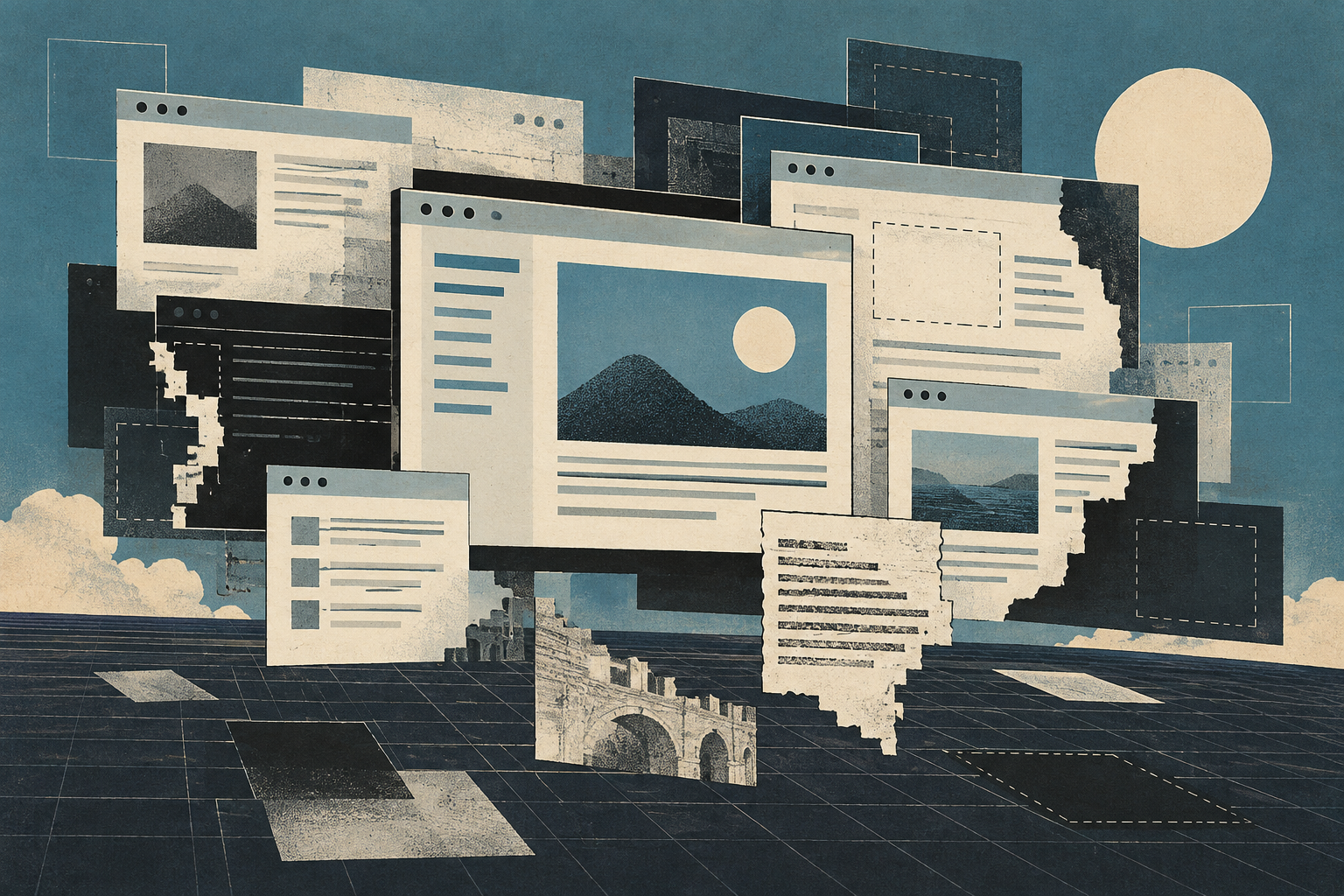
An old page can look like a window into the past: text, links, images, and an address that can still be read. But a preserved capture is not the whole service, nor necessarily a complete representation of what every person encountered. Reconstructing a vanished website means paying attention to what the archive shows as well as what it could not save. That distinction matters when studying use: an image can attest that some content was recorded, but on its own it cannot prove how long it lasted, who saw it, or how the service worked as a whole.
What a web archive preserves
The National Library of Spain describes its Spanish Web Archive as a collection of harvested websites, including blogs, forums, and different kinds of documents and media. This description conveys the range of materials that may be included, but it does not justify assuming that every site is preserved in full or to the same depth. A web archive is a documentary collection. Researchers should identify the object in front of them—a page, a capture, or an associated resource—before using it to support a claim.
The distinction matters because a page is only one part of a service. A saved page may preserve text and images while offering no way to observe forms, responses, account access, changes over time, or interactions between users. Missing parts should not be completed by imagining how the service must have worked. Describe the available trace literally and keep hypotheses separate from it.
A capture is not a launch date
A date associated with a capture may indicate the time of harvesting or recording documented by the source; it should not automatically be presented as the launch of a site or service. Nor does an approximately dated recollection, by itself, confirm a publication date. A chronology requires evidence that specifically addresses the event—for example, institutional documentation or a contemporary source that identifies it.
The supplied sources include surveys of Internet history and its beginnings in Spain, as well as broader accounts of its history and development. Such texts provide context, but their existence does not date every captured page or individual experience. Analysis should keep three things distinct: when an item was documented, when an event is said to have occurred, and when someone remembers using a service. Combining them creates false precision.
Reading silence without filling it in
A missing resource may not have been harvested, may not have survived, or may simply be absent from the capture available to us. Without further evidence, it may not be possible to determine which explanation applies. The absence of an element therefore does not prove that it never existed. The same caution works in reverse: a capture showing a feature or page does not prove that it was available to everyone, continuously, or for an extended period.
The soundest practice is to record what is visible, the collection’s stated scope, and the questions that remain unanswered. If a claim says a service changed, disappeared, or enabled a particular interaction, each part of that claim needs supporting evidence. When none can be found, the right conclusion may be that the surviving record cannot resolve the question.
Cross-checking sources with specific questions
A history of Internet use should not rest on one capture or on a general overview that merely mentions the subject. The National Library’s description helps define the kind of collection its web archive is; resources on Internet history from the Technical University of Madrid, ACTA, and the Universitat Politècnica de Catalunya provide different contexts for the networks and their development. Telefónica’s page also offers an account of that evolution. None of these references automatically replaces documentation specific to a vanished service.
Cross-checking is useful when each source is assigned a clear question. An archival description can explain what a collection gathers; a general history can situate a period; a capture can show particular content. If two documents seem to disagree, first check whether they refer to different scales, objects, or dates before deciding that one is wrong. The independence and relevance of sources matter more than simply accumulating links.
From trace to account, with limits in view
An archive can turn scattered fragments into investigable questions: what content was preserved, what types of material are collected, and what can be supported from them. It cannot by itself restore the full experience of connecting, browsing, or participating. A reconstruction must describe its limits alongside its findings, not hide them in a closing note.
It is also worth resisting a nostalgia that makes an experience seem uniform when the sources do not describe it that way. Without attributable testimony, functional documentation, or comparable captures, we cannot generalize about what people felt or did. A preserved record speaks clearly about what it contains; the editor should leave other questions open.
The responsible conclusion is neither that the archive preserved everything nor that nothing can be known. It is more specific: a web collection can document important traces, and each claim must fit the type and scope of the trace. Reading absences does not mean inventing what was lost. It means showing where the evidence ends and conjecture would begin.
- Decade
- 2000s
- Region
- Spain
- Level
- Enthusiast
- Entities
- Archivo de la Web Española, Internet
Sources and references
- Historia de internetwww.fib.upc.edu · 2026-10-10
- Historia de Internet: ¿cómo nació y cuál ha sido su evolución? -www.telefonica.com · 2026-10-10
- Historia de Internet y de sus inicios en Españaoa.upm.es · 2026-10-10
- Historia y evolución de Internetwww.acta.es · 2026-10-10
- Archivo de la Web Española | Biblioteca Nacional de Españawww.bne.es · 2026-10-10