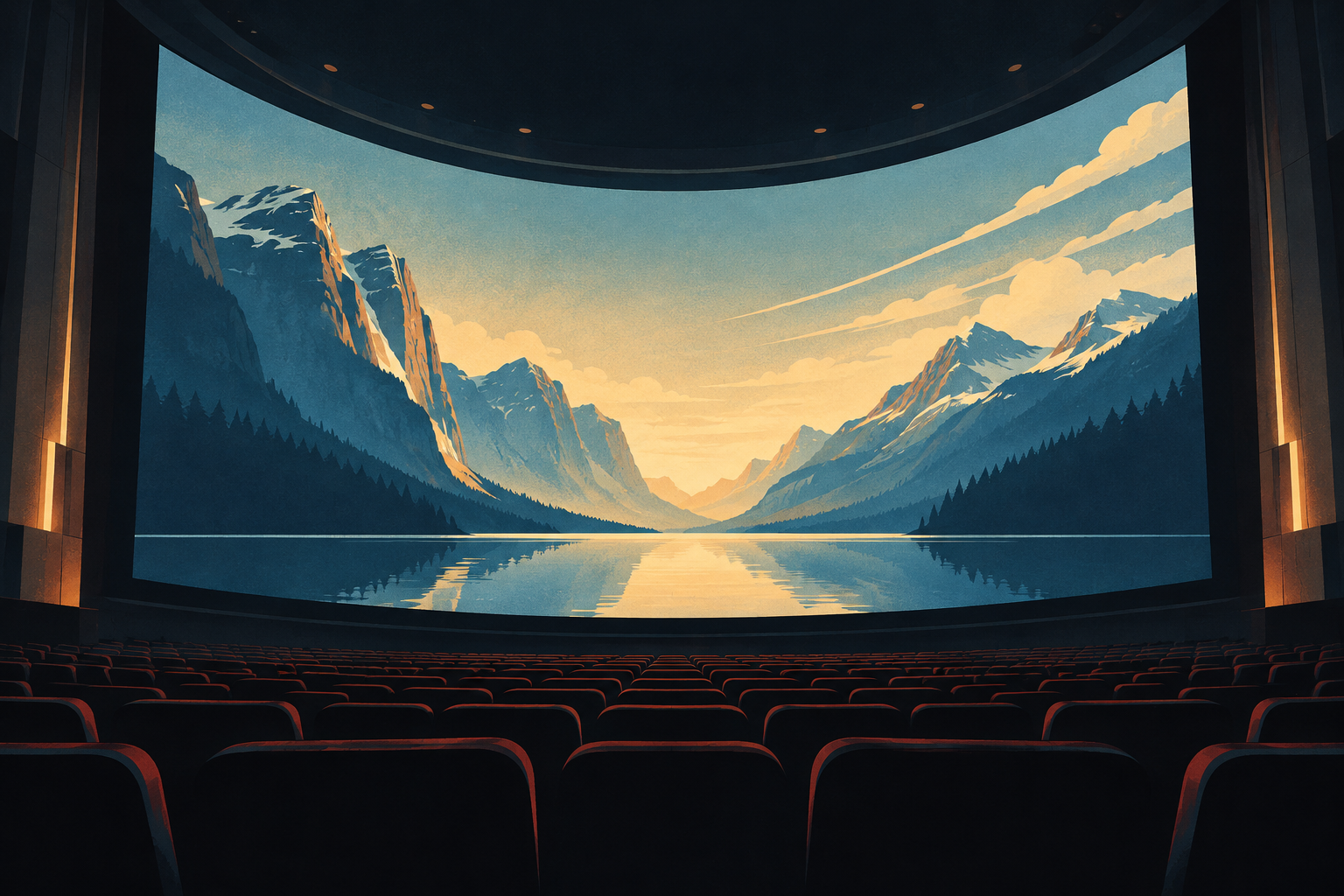
The 1970s were defined by a structural tension in the film industry. On one hand, the production of fundamental artistic works; on the other, the pressure from new entertainment media competing for the public's leisure time. In this context, the introduction of IMAX in 1970 represented a tangible attempt to regain the relevance of the movie theater through the physical scale of the image. It was not just about projecting a film, but about modifying the reception space to offer an experience that other formats could not replicate.
The Technical Response to Competition
Historical sources indicate that by 1970, cinema faced growing competition from other media. The industry's response was not only narrative but architectural and technical. IMAX emerged offering a screen ten times larger than the standard of the time. This specification was not a minor detail; it implied a complete reconfiguration of the theater. The viewer ceased to be a distant observer to become a participant immersed in a dominant visual field. This magnitude sought to justify the presence in person against the comfort of other domestic devices.
The Context of Special Effects
Parallel to the expansion of formats, the decade saw an evolution in visual narrative. Directors like George Lucas, influenced by Stanley Kubrick's works, began to explore new possibilities in special effects. This trend is clearly observed in later productions like Star Wars, but its roots lie in the experimentation of the seventies. Projection technology and visual narrative fed back into each other: the greater the technical capacity, the greater the ambition in constructing fictional worlds. The movie theater became the only place where this combination of scale and detail could be appreciated in its entirety.
Adaptation of Traditional Theaters
The adoption of new formats did not occur in a vacuum. Many emblematic theaters of the era, such as the Cine Alameda in Mexico City or the Cine Carrusel, underwent renovation processes during the 1970s. These interventions were not merely aesthetic; they responded to the need to adapt old infrastructure to the technical demands of new formats. The tension between preserving the architectural identity of a historic cinema and equipping it for high-scale projection defined part of the cultural infrastructure of the decade. These renovations allowed the big screen experience to reach broader audiences, beyond experimental facilities.
Immersion as Cultural Value
The paradigm shift was not only technical but perceptual. The introduction of IMAX and the evolution of special effects contributed to redefining cinema as an immersive experience. The theater ceased to be a simple container of light and sound to become a space of sensory immersion. This perception influenced how the audience valued attending the movies. The big screen was associated with superior quality, an authenticity that television could not offer. This cultural value was consolidated throughout the decade, establishing expectations that persist in the current industry.
Limitations of Historical Evidence
It is important to distinguish between documented facts and cultural interpretations. While the existence of IMAX in 1970 and its specification of a ten-times larger screen are supported by historical records, the exact magnitude of its impact on box office or public perception is harder to quantify. Available sources provide a general framework, but not granular data on immediate reception. Furthermore, the influence of directors like Lucas on projection technology is an indirect relationship; they took advantage of available tools, but did not necessarily design the projection formats themselves.
Legacy in the Digital Era
Although the 1970s are marked by celluloid, the decisions made then laid the foundations for the digital era. The search for immersion through physical scale anticipated current debates on virtual reality and high-definition projection rooms. The tension between technical innovation and the adaptation of traditional theaters remains relevant. Today, when projection formats are discussed, one is, in a way, continuing the conversation started in 1970. The big screen is not just a historical memory, but an active principle in the evolution of cinema.
Conclusion
The introduction of IMAX in 1970 was a milestone that redefined the relationship between the viewer and the image. By offering an unprecedented scale, the film industry responded to competition from other media and consolidated the movie theater as a unique experience space. This change, combined with the evolution of special effects and the adaptation of traditional theaters, marked the beginning of a new era in film reception. The lesson of the seventies is clear: technology does not only change how a film is seen, but how visual culture is lived.
- Decade
- 1970s
- Region
- Global
- Level
- Enthusiast
- Entities
- Televisión, Star Wars
Sources and references
- Capítulo cuarto. La «tercera vía» y el cine español middlebrow en la década de 1970doi.org · 2026-10-20
- CRONOLOGÍA DE LA HISTORIA DEL CINElas1000nochesyuna.com · 2026-10-20
- Películastranslate.google.com · 2026-10-20
- Nueve de los cines más representativos de los años 70s ...www.facebook.com · 2026-10-20
- Las 50 mejores películas de los años 70, ordenadaswww.fotogramas.es · 2026-10-20