Sound is not the only document
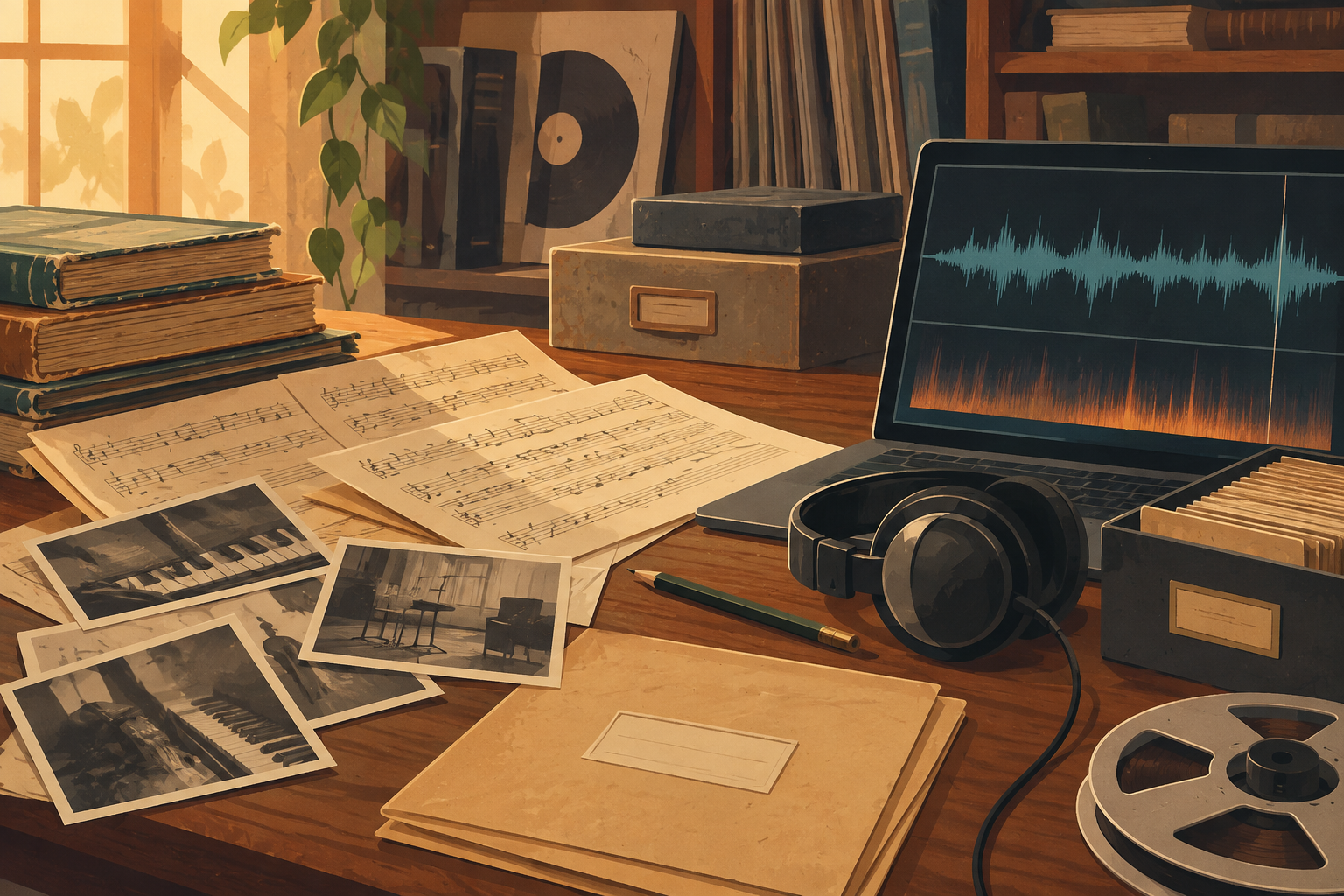
When we think about preserving music, it is easy to picture a recording kept safe and ready to play again. Yet the musical archives described by cultural institutions also include scores, photographs and other materials documenting collections and activities. Barcelona’s Museu de la Música, for instance, reports more than 60,000 items in its multimedia archive related to the collections and the museum’s activities, including photographs for identification and restoration. That number does not, by itself, tell a complete history. It does make one essential point visible: music leaves many kinds of traces.
A score records a written form of music; a photograph may document an object or an act of conservation; a file or archival note may help place an activity in context. None automatically replaces the experience of listening. Together, however, they can offer different ways into the same history.
Collecting also creates context
El Museo Canario describes a guided visit to its musical holdings centred on written music and scores kept in its archive. Spain’s Museo Nacional de Artes Escénicas says that much of its musical heritage comes from the Museo-Archivo del Teatro Real, created by its director Luis París in 1919. These are different cases, but both draw attention to an institutional history: materials arrive, are organised and become accessible within a particular setting.
The existence of a collection does not prove that it represents everything performed, heard or created in a place. Collections depend on what was kept, what entered an institution and what can be consulted. Acknowledging that limit does not diminish their value; it helps us read them carefully.
Musical activity leaves traces too
An exhibition organised in Bilbao in August 1983 for the 38th International Congress of Jeunesses Musicales shows how a public activity can generate its own documentary and exhibition framework. The available material identifies it as “Music in History” and links it to graphics and texts by Juan…; the supplied information does not allow us to complete the name or reconstruct the exhibition’s contents. That is exactly why it is worth distinguishing what is documented from what we might be tempted to add.
The ministry’s annex “Music Through Time” describes music as part of private celebrations, public events and historical happenings. This broadens the field: preservation is not only about keeping works, but also about attending to contexts of use and occasions when music participates in social life.
From the archive to a contemporary question
The 2024 article “Where Are the Songs? The Challenge of the Musical Archive in the Streaming Era” explicitly raises a question about archives and digital circulation. Its description mentions a conference and the presentation of a joint initiative by Subterfuge Records and Spain’s National Library. The available information does not justify claims about how that initiative works or what it achieved. It does show that current archival debate is not confined to older formats: it also asks what remains findable when music circulates in digital environments.
A 2005 academic paper on organising musical archives frames, in its title and summary, the need to gather and preserve this heritage appropriately, and connects music with cultural identity. The relationship between archive and identity is an important interpretive proposition, but it does not make any one collection a complete representation of a community.
Organising, describing and making visible
Preservation involves more than storage. Description, cataloguing and public presentation shape which materials can be found and what questions researchers or visitors can ask. A guided visit, a multimedia archive and a historical exhibition make heritage visible in different ways: they bring documents closer, shape a route and select points of attention.
This mediation has limits too. A guided visit is not the same as consulting an entire collection; a photograph of an object does not replace the object; a score does not necessarily contain every aspect of a performance. Documentation provides tools for studying music, but each kind of source is better suited to some questions than others.
A legacy made of layers
The available references sketch a varied landscape rather than a single history: archives associated with museums, scores, multimedia materials, exhibitions and debates about digital circulation. Together, they invite us to understand musical preservation as work carried out in layers. Sound matters, but so do the traces that let us recognise how heritage was gathered, described and presented.
The most cautious conclusion is also the most useful: we cannot reconstruct all musical life from the documents that survive, but we can study what they record, what relationships they suggest and where their silences lie. Music persists not only when it sounds again, but when its traces can be consulted and read in context.
- Decade
- 2000s
- Region
- Spain
- Level
- Enthusiast
- Entities
- Museum, Museo Nacional de Artes Escénicas, El Museo Canario
Sources and references
- la organización de archivos musicales marco conceptual ...agora.edu.es · 2026-09-30
- “Los Sonidos del Archivo”, una visita para conocer el ...www.elmuseocanario.com · 2026-09-30
- Archivo Musical - Museo Nacional de Artes Escénicasmuseodeartesescenicas.inaem.gob.es · 2026-09-30
- EDR | Museu de la Músicaajuntament.barcelona.cat · 2026-09-30
- ¿Dónde están las canciones? El reto del archivo musical en la ...www.iaph.es · 2026-09-30
- La música en la historia. Gráficos y textos de Juan ...bilbaomuseoa.eus · 2026-09-30
- La Música en el Tiempowww.cultura.gob.es · 2026-09-30