The missing unit: the complete broadcast
A television broadcast was more than the programme listed in a schedule. It also included advertisements, previews, announcements and transitions, arranged into a sequence that gave the viewing experience rhythm and continuity. Raymond Williams described this form as a planned flow: the published schedule did not necessarily match the sequence audiences saw, which incorporated materials of different kinds. In another approach, Jesús González Requena understood programming as a macro-discourse, bringing diverse discourses together within a shared continuity.
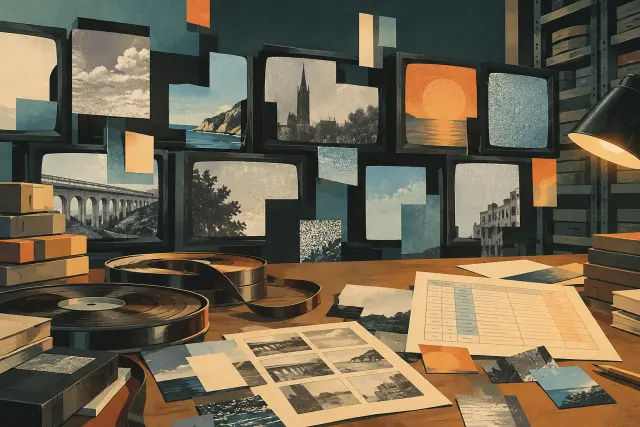
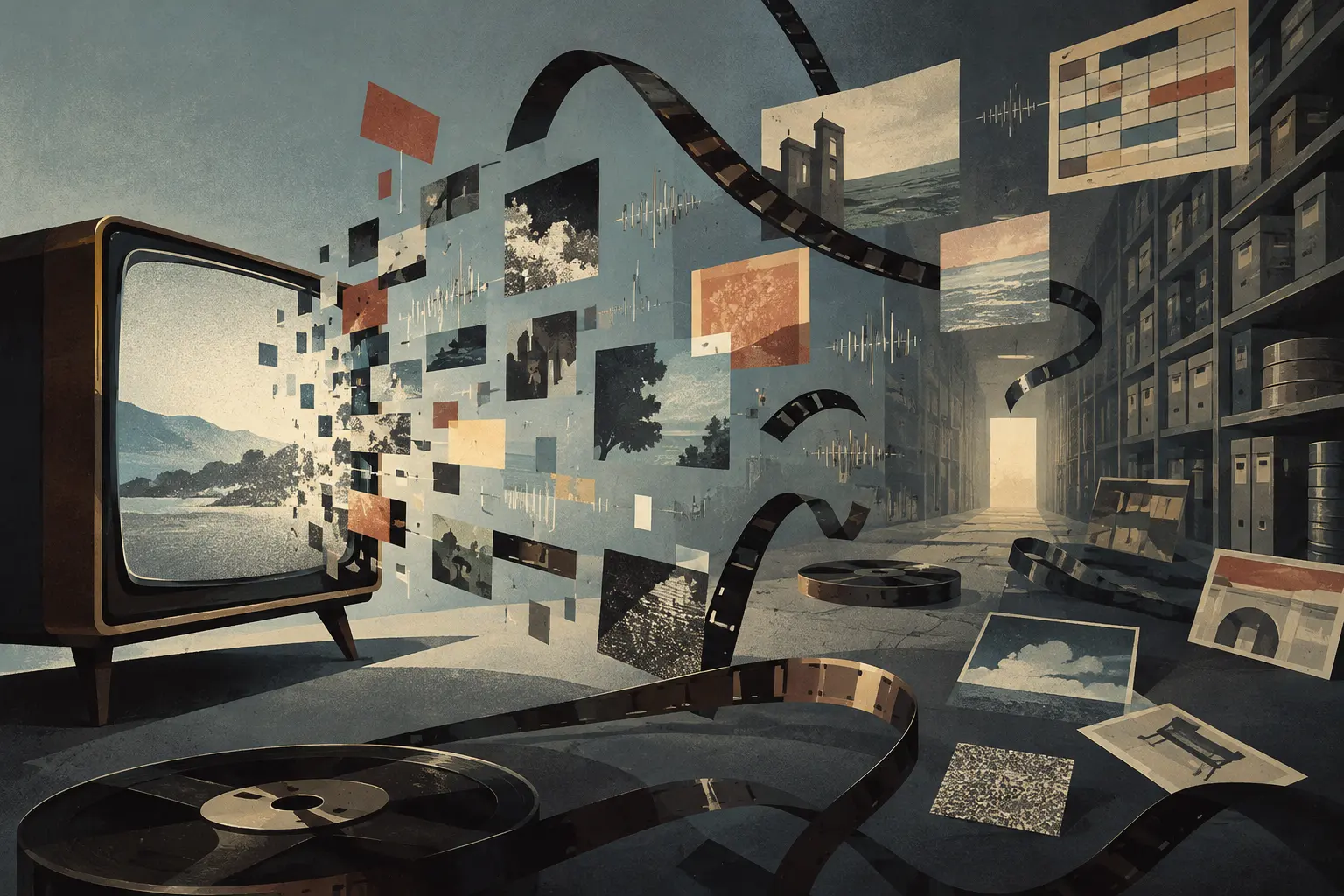
Archival practice often breaks that unity apart. An archive may preserve a programme without its commercial break, a news item detached from its bulletin, or a few episodes rather than an entire series. Advertisements and continuity segments may also be classified as independent objects. The surviving document is therefore more like one piece of a larger whole than a record of the flow in which it originally appeared.
The loss is not merely quantitative. Once an item is separated from its sequence and context, it becomes harder to study what came before and after it, how the schedule was organized, or how it connected information, entertainment and advertising. A fragment can be valuable, but it is not equivalent to the experience of a broadcast.
A recording technology that also made erasure possible
In television’s early years, live broadcasting left few records: transmitting did not mean recording. The arrival of videotape changed the technical and economic possibilities. It made it possible to preserve broadcasts and reuse them, but also to erase and record over the same tapes. In the industry, material was often retained for rebroadcast or production needs, rather than as a heritage collection.
Argentina’s case makes this uneven history clear. The country’s first official television broadcast, carried by Canal 7 on 17 October 1951, left no audiovisual record: cameras transmitted the events in Plaza de Mayo live. The expansion of recording did not eliminate loss. According to Elina Adduci Spina’s study of Argentina’s Historical Radio and Television Archive (RTA), much of what survived depended on operational decisions, available resources and private collections.
Even when a tape is kept, its contents may be inaccessible. The miniseries Los gringos, broadcast by ATC in 1984, was recorded on two-inch quadruplex tape. Of the twenty-one carriers retained, fourteen were affected by adhesive deterioration known as glue flange, which prevents playback. The study reports that seven carriers, corresponding to episodes 1, 2, 12, 14, 15, 18 and 19, could be digitized. The case distinguishes storing a carrier from effectively preserving the information it contains.
Traces that survive in other forms
The absence of images does not mean the absence of memory. Gente, an Argentine interview programme broadcast live in 1960, has no known visual records in the archive described by Adduci Spina. Its host, Augusto Bonardo, partially recorded the audio. Some discs entered the National Library, and decades later a digital copy was made for the RTA archive. The sound preserves voices and conversations. It cannot restore the programme’s visual staging on its own, but it offers another way to study the programme and its period.
Technical and administrative records also contain clues. In the official campaigns produced by ATC and broadcast in 1979, slates preceding the items record details such as titles, dates, machine and roll numbers, and the names of operators and directors. Although the campaigns are preserved separately from the television flow, this information helps researchers examine how they were made and circulated. Their context as state propaganda under the civic-military dictatorship is also part of their historical interpretation.
For Los gringos, production photographs, scripts preserved by Juan Carlos Gené and press coverage offer ways to investigate a series with an incomplete audiovisual record. These documents do not automatically recreate the missing broadcasts. They allow questions about filming, writing and public reception to be asked, and partial answers to be considered together.
A Chilean case shows another kind of related archive. Casa Museo Eduardo Frei Montalva describes a collection of 16 mm films produced during Frei’s presidency (1964–1970), much of it intended to publicize government activities and public works. After remaining with his family and the foundation bearing his name, part of the material was transferred to the National Film Archive in 2007 and 2012. In 2014, 23 reels and 35 rolls were digitized, representing nearly 300 of around 1,800 records. The images make it possible to study both the activities depicted and the government-communication purpose for which they were made.
The archive also shapes memory
Preservation is not only a matter of keeping objects safe. Decisions about what to select, how to describe it and who can access it help determine which past becomes visible. Material regarded as trivial, commercial or politically uncomfortable may be excluded from heritage narratives; if later recognized as a historical source, it returns to circulation under different conditions and with new meanings.
Adduci Spina examines this tension through RTA’s three case studies. The 1979 campaigns, for example, shifted from items designed for propaganda to materials that can be read critically as records of the dictatorship. Digitizing and publishing them expands their possible uses, but excerpting and separation from the original broadcast continue to shape interpretation.
Where and how material can be consulted matters too. The article describes Archivo Prisma, a platform created to provide online access to RTA’s sound and audiovisual records. In the case of Gente, excerpts were published, while consulting the complete records required a visit to the archive. Access is therefore not separate from preservation: the conditions of consultation affect what the public can know and how.
Reconstructing without pretending the gaps have vanished
Television history cannot be inferred from surviving programmes alone. To approach a broadcast, researchers need to relate recordings to schedules, advertisements, photographs, scripts, technical records, press coverage and home recordings. Each source answers different questions and has its own silences. A private collection may preserve something an institution did not, but its selection does not necessarily represent a full schedule; a script offers access to the written text, not to the broadcast realization.
Reconstructing television flow does not mean filling in missing material by force. It means reading each item alongside its carrier, metadata, related documents and access conditions, while distinguishing what is documented from what can only be inferred. Television was an experience organized in time and shared by diverse audiences; its archives, by contrast, are partial collections shaped by technical, institutional and private decisions.
Gaps do not make the medium impossible to study. They do require us to ask what has been preserved, what was left out and how that selection shapes our idea of television’s past. Those questions allow fragments to reveal more than the contents of a tape: they also show how television was produced, archived and interpreted anew.
- Decade
- 2000s
- Region
- Global
- Level
- Enthusiast
- Entities
- Televisión, Cineteca Nacional, Elina Adduci Spina, Requena, Argentina, Archivo Histórico de Radio y Televisión Argentina
Sources and references 5
- Museos del cine latinoamericanos Políticas de preservación fílmica en contextos conviviales y desigualesopenalex.org · 2026-11-14
- Memorias de archivosopenalex.org · 2026-11-14
- Preservación del patrimonio audiovisual de televisión El archivo de Televisión Española (TVE): de los orígenes a la digitalizaciónopenalex.org · 2026-11-14
- Paradojas y desafíos del patrimonio audiovisual televisivo. ...www.scielo.org.ar · 2026-11-14
- Recuerdos en movimiento: Archivo Audiovisual de CMEFMwww.casamuseoeduardofrei.cl · 2026-11-14