Format is not a neutral wrapper
A comic does not reach its reader as an abstract idea. It arrives in a specific printed form, with a particular length, binding and arrangement of pages. Those choices shape how it is read and what survives. Rubén Varillas’s article on magazines, fanzines, mini-comics, albums and graphic novels offers a useful starting point: treat formats as distinct publishing categories, not interchangeable names for any illustrated publication.
The distinction matters because a medium conditions the experience without determining it entirely. A magazine may gather instalments or varied material; an album may present itself as a more durable unit; a mini-comic may explore another scale and circulation. These are interpretive possibilities, not universal rules for every item. The available sources do not provide a comprehensive catalogue or assign a single function to each format.
The magazine as periodic, material object
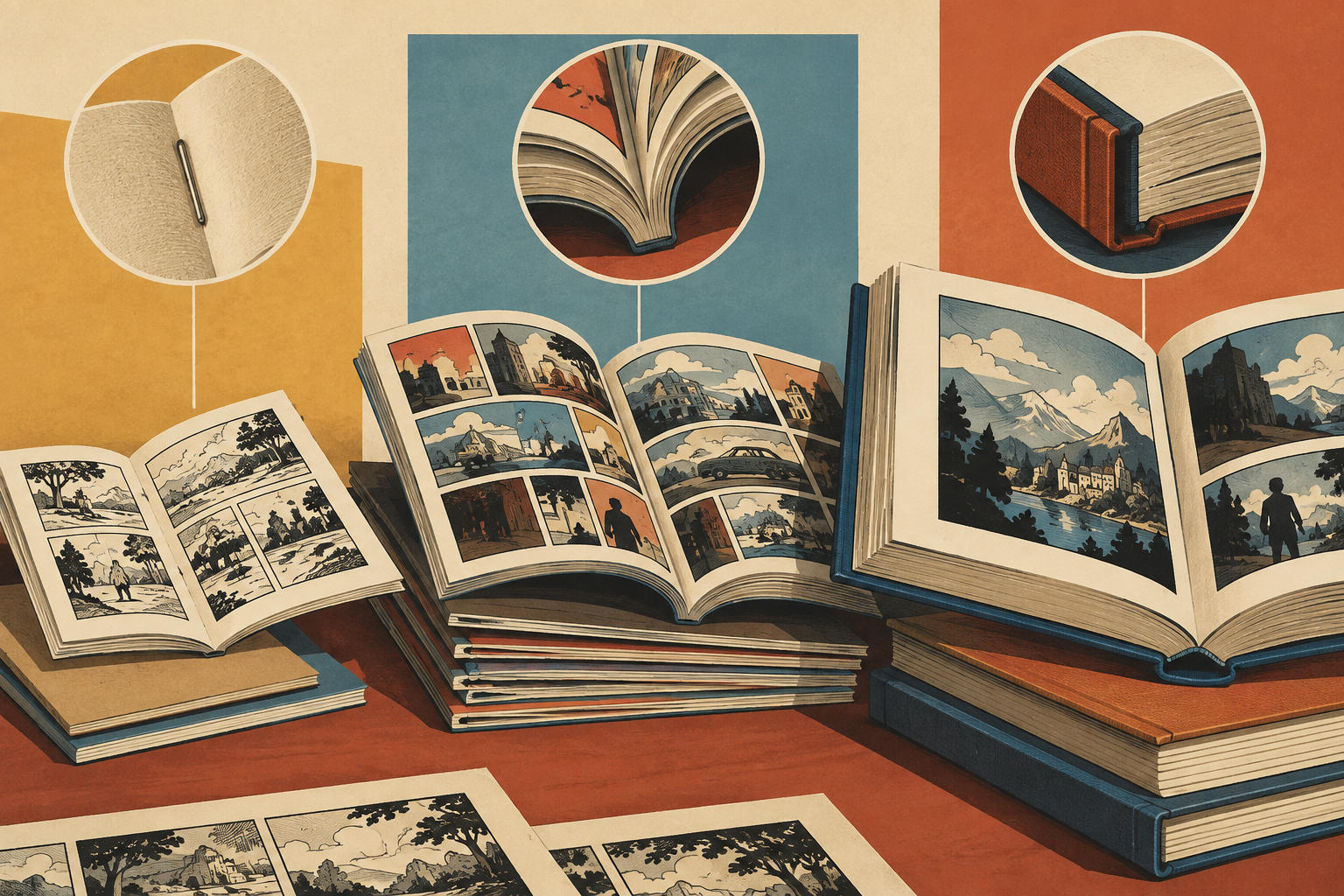
The entry on comic magazines describes an object printed less luxuriously than an album: soft cover, lower-quality paper and, usually, staples. It also notes that many publications restricted the number of interior inks to reduce costs. This description lets us see how production economics can be inscribed in a magazine’s physical form.
It does not justify concluding that all magazines were alike or that readers necessarily treated them as disposable. The supplied summary gives general characteristics but no detailed account of publishers, print runs, readerships or national variations. These features are best read as clues to a mode of production, not as a complete explanation of the magazine’s history.
Periodicity raises another question: what does it mean to read a story in instalments within a magazine rather than in a collected volume? The evidence provided cannot reconstruct particular publication schedules. It does, however, distinguish a magazine from an album, reminding us that a story’s editorial setting affects its presentation and preservation.
Mexico and the danger of a figure without context
Mexican comics offer an indication of the reach that periodical publication could attain. The supplied history summary associates the golden age of the 1940s and 1950s with extraordinary circulation for some magazines, estimating 350,000 copies a day for one publication, alongside two Sunday editions. It is a striking claim, but it must remain tied to the wording and scope of its source.
It is not a figure that describes every Mexican magazine, nor can it be compared straightforwardly with publications from other countries or periods. The supplied excerpt also does not identify every criterion behind the estimate. The editorial lesson is simple: a circulation figure can suggest scale and interest, but it cannot replace research into titles, readers, distribution and archives.
The academic material from the CCH Academic Portal at UNAM focuses on Mexican comics from 1940 to 1970 and recalls that comics communicated stories and ideas to broad sectors of society. The summary also mentions popular names such as “monitos” and references series published at the beginning of the twentieth century. This framework takes us beyond the isolated object: comics also belong to social practices and local vocabularies.
From booklet to contemporary categories
Discussing magazines, fanzines, mini-comics, albums and graphic novels together does not mean that they appeared at the same time or served identical purposes. Varillas’s study, published in CuCo, explicitly raises a question of format. Its title helps define the issue, although the bibliographic record supplied here is not enough to summarise all its arguments.
Rather than treating categories as a ladder of prestige—from cheap to valuable or from brief to literary—it is more careful to ask what can be compared. Size, binding, frequency, the grouping of stories and conditions of preservation all matter. The magazine entry describes some of these dimensions; others require examining individual publications and cannot be settled from the supplied excerpts.
Vocabulary also changes over time and across contexts. A publishing label may describe a physical form, a publication strategy or a later way of classifying works. The sources here do not document a complete history of these terms. They are therefore best used as analytical tools, not turned into rigid boundaries.
Comics as source and memory
The academic works included point to another dimension: comics can be studied in relation to history and memory, not only publishing. Ivan Jablonka’s article proposes a French perspective on history and comics. Viviane Alary’s work presents comics as a dialogic space between memory and history. Their titles and records support the relevance of these questions, but do not justify assigning conclusions to the articles that are not reproduced in the supplied evidence.
The study of comic exhibitions raises the problem of how a cultural form enters an art museum and risks being treated through formulas already applied to other practices. As it appears in the summary, this observation connects the printed format to its later life: preserving and exhibiting a publication are acts of selection and framing.
A magazine can therefore be read both as a carrier of stories and as a material document. Its paper, inks and binding speak to publishing conditions; its stories can prompt questions about memory and representation. Neither role makes it self-sufficient evidence: provenance, context and the limits of each surviving copy still matter.
What this group of sources can establish
The available evidence supports a limited thesis. Publishing formats matter when describing and studying comics; magazines can have material features associated with lower-cost production; and Mexican comics history includes examples of mass circulation, although the cited figure requires caution. Academic works also address the relationships between comics, history, memory and museums.
The evidence cannot establish a complete global chronology, measure the impact of every format or provide a quantitative comparison between countries. Nor does it document how each readership encountered a particular publication. Respecting these limits does not diminish the subject; it prevents a reference entry, an article abstract and detailed historical research from being treated as equivalent.
Looking at comics through their physical supports brings something often overlooked back into view: reading also means encountering an object produced and preserved under particular conditions. A magazine is not merely a container for a story. It is one of the forms through which that story circulated, was organised and can reach an archive, with gaps.
- Decade
- 1950s
- Region
- Latin America
- Level
- Enthusiast
- Entities
- Museum
Sources and references
- Historieta en México - Wikipedia, la enciclopedia librees.wikipedia.org · 2026-09-29
- Las exposiciones de cómics. Historia y contexto globalwww.researchgate.net · 2026-09-29
- Revista de historietas - Wikipedia, la enciclopedia librees.wikipedia.org · 2026-09-29
- El cómic de 1940-1970 - Portal Académico CCHportalacademico.cch.unam.mx · 2026-09-29
- El cómic, una cuestión de formatos (2): revistas de cómics, fanzines, mini-cómics, álbumes y novelas gráficasdoi.org · 2026-09-29
- Historia y Cómics: una perspectiva francesadoi.org · 2026-09-29
- Memoria-historia: el cómic como espacio dialógicoopenalex.org · 2026-09-29