Video game history seems to demand a first page: a machine, a game, a date. Yet the Universitat Politècnica de Catalunya source identifies an early commercial milestone in 1971, when Nolan Bushnell began marketing Computer Space, described as a version of Spacewar!. The wording already calls for care: it identifies a milestone and commercialization, not necessarily the absolute birth of video games. The answer changes with the question being asked.
A beginning depends on the question
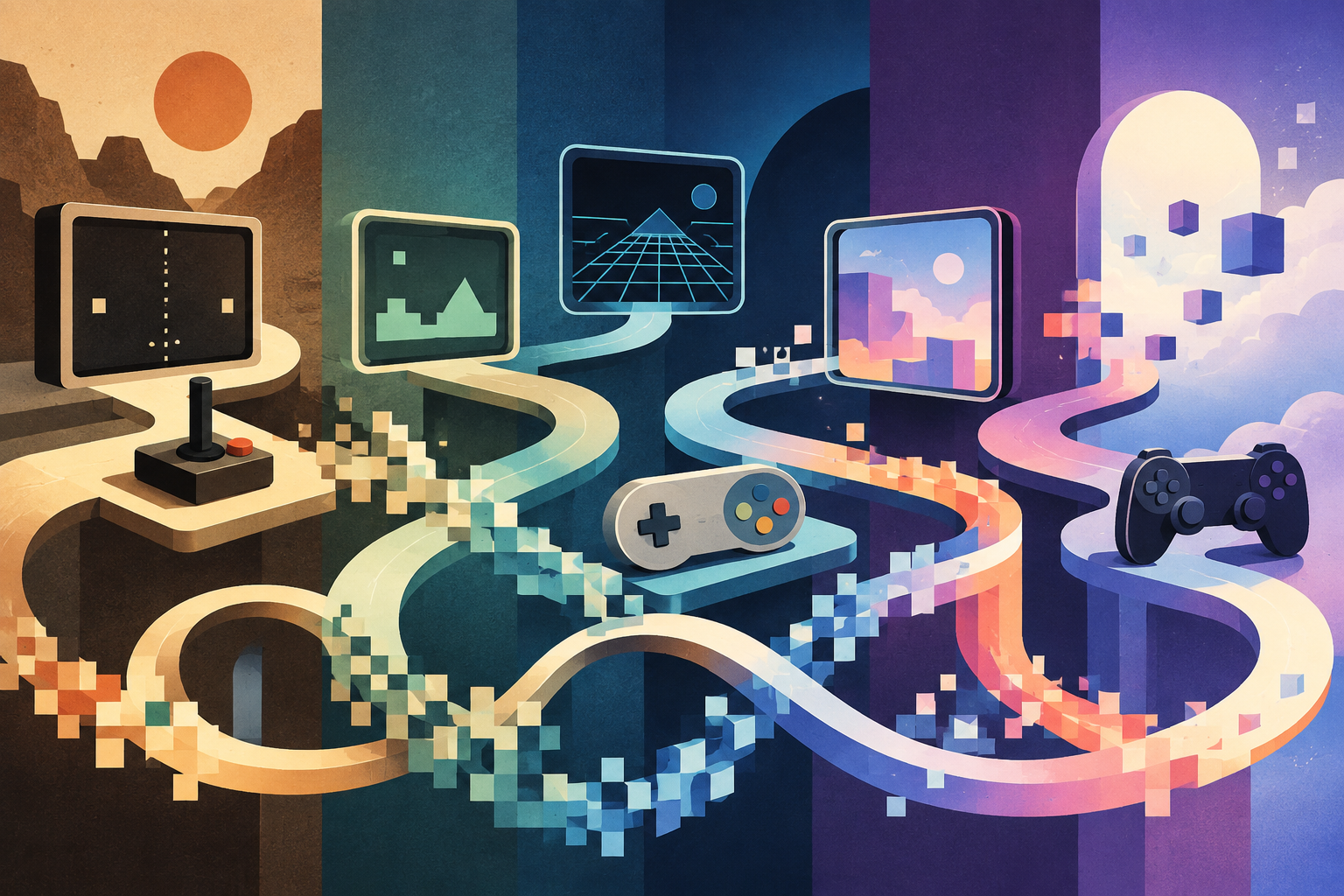
One history may focus on early experiments, another on games reaching the public, and another on the formation of an industry. These are not interchangeable criteria. The UPC page places Computer Space in a sequence of commercialization; Telefónica’s account, meanwhile, arranges familiar milestones from the 1970s and later. Both offer orientation, but their summaries alone cannot make one date the definitive answer to every question about origins.
This distinction does not diminish milestones. It makes them more precise. Instead of asking “What was the first video game?”, we can ask what counts as a game, what counts as commercialization, and what kind of circulation we are trying to document. Those questions define the scope of a narrative and help prevent a visible stage from being mistaken for the whole historical process.
From chronology to relationships
Chronologies provide an accessible structure: they order events and help readers notice changes over time. But a list of dates can make history look like an inevitable march toward later technologies. The academic article on video games and museums in the supplied sources describes games as a cultural industry and addresses museums’ renewal; the OpenAlex record for a study on historical video games and memory points to another perspective. Games can be interpreted and remembered, not merely listed as products and events.
The cautious approach is to use chronology as a map, not a complete explanation. A milestone may mark a meaningful change without explaining how it happened, who made it possible, or how it was received. The supplied material does not provide enough evidence to reconstruct those processes in detail, so it would be misleading to fill the gaps with an overly confident story.
Genres describe ways of playing
The supplied entry on video game genres explains that classification is generally based on gameplay rather than visual or narrative differences. It also notes that classification can be subjective and that a game may belong to several genres. The adventure-game entry emphasizes investigation, exploration, puzzle-solving, and interaction with characters, and says the genre was popular in the late 1980s and early 1990s.
These definitions support a different kind of history from a sequence of dates. They let us ask what activities a game proposes and how its conventions are organized. They also reveal a limitation: labels are not natural boundaries and cannot fully explain an individual player’s experience. A genre is a reading tool, not a complete description of a work.
Museums change the story too
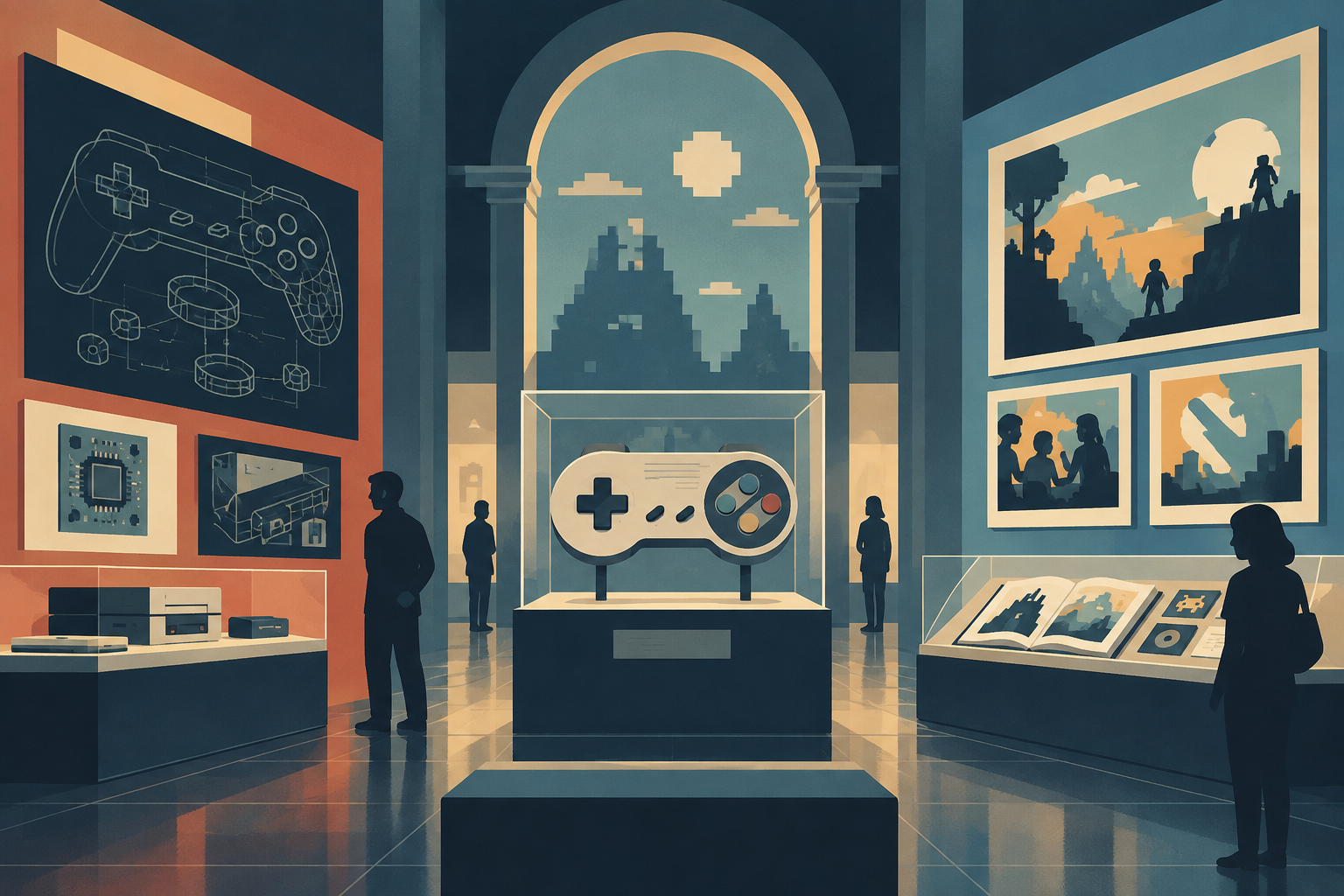
When video games enter a discussion of museums, the questions change. It is no longer enough to list releases: presentation, preserved context, and cultural meaning matter too. The University of Málaga journal article in the evidence addresses the relationship between museums and video games. The supplied evidence supports only that broad description; it does not justify attributing specific conclusions to the article that are absent from its available summary.
That caution matters because preservation and explanation are not the same thing. An object may show a technology or a way of playing, but interpretation requires context. Likewise, a written history can preserve names and dates without explaining which questions it has left out. Archives, chronologies, and exhibitions organize memory in different ways, each with its own possibilities and limits.
A history with several entry points
The sources gathered here point to a varied field: a commercialization milestone in 1971, a popular chronology, studies of video games and memory, and descriptions of genres. They do not provide a complete history or establish a single inaugural date. They do support a more useful conclusion: video game history becomes more rigorous when it makes clear what it is trying to recount.
A beginning might be a date in a chronology, a question about commercial circulation, a game category, or a problem of cultural memory. Choosing one of those entry points is not a flaw; hiding the choice can be. Rather than searching for a date that ends the discussion, it is better to say what each milestone brings into focus—and what remains outside the frame.
- Decade
- 2000s
- Region
- Global
- Level
- Introduction
- Entities
- Computer Space, Museum
Sources and references
- Historia de los videojuegoswww.fib.upc.edu · 2026-09-30
- El videojuego histórico como forma de memoriaopenalex.org · 2026-09-30
- Vista de Museos y videojuegos. La renovación de los ...revistas.uma.es · 2026-09-30
- Historia de los videojuegos - Telefónicawww.telefonica.com · 2026-09-30
- Videojuego de aventuraes.wikipedia.org · 2026-09-30
- Género de videojuegoses.wikipedia.org · 2026-09-30