An image does not arrive alone
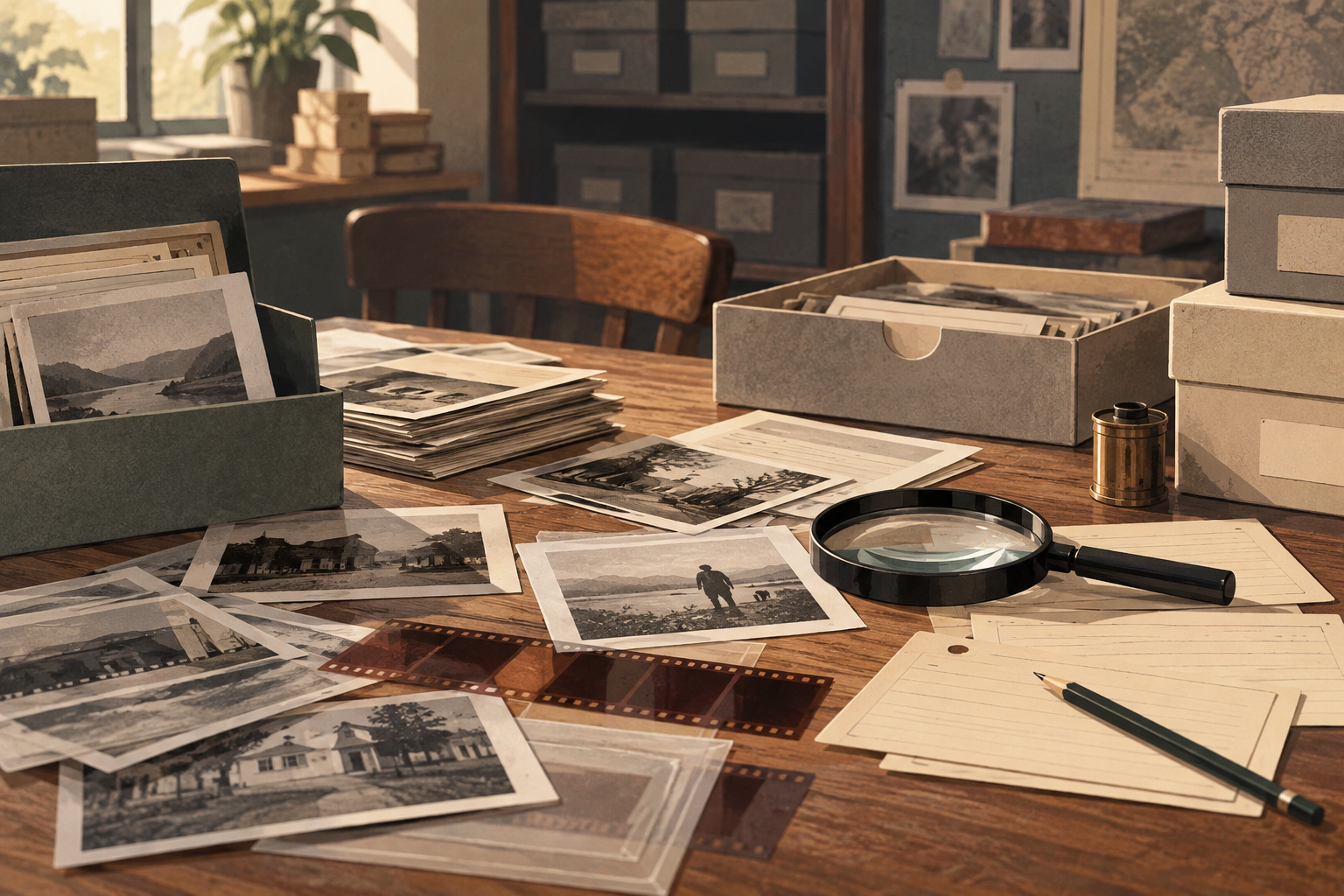
Looking at a photograph is only the first step. To understand what it can document, its provenance, the collection in which it is preserved and the information that places it in context also matter. The materials gathered here offer different ways into that question: a conference on nineteenth-century photography, an institutional collection of images connected with the activities of the Bank of Spain, and resources devoted to press archives and photographers in Logroño. They do not amount to a complete history of Spanish photography. They do, however, support a useful approach: an image gains documentary value when it can be related to a context rather than treated as self-sufficient proof.
From the nineteenth century to the documentary question
The Biblioteca Regional de Madrid lists a professional event titled “La fotografía del siglo XIX” (“Nineteenth-Century Photography”). The title confirms that photography from this period is the subject of specialist attention, but the available information does not support attributing specific arguments to the event or detailing the techniques and authors discussed. That distinction matters: the record confirms that an event on the subject took place, not what was said there.
The same caution is useful when looking at old images. A photograph may suggest a scene, but without information about who made it, when and where it was made, and for what purpose, part of its meaning remains open. Reading it as a document requires distinguishing what is visible from what other sources allow us to claim.
Institutions and social life
The Museo del Prado lists a lecture by Beatriz Sánchez Torija, from its Department of Conservation of Drawings, Prints and Photographs, titled “Las transformaciones de la sociedad española a través de la fotografía” (“Transformations in Spanish Society Through Photography”). Its record says that it was delivered on 4 June 2024. The title proposes a relationship between photography and social change; on its own, it is not enough to summarize the lecture’s examples or conclusions.
The Banco de España Photographic Archive is another institutional case. Its presentation describes photographs of Bank events and links them to the institution’s participation in political and economic life. That connection between images and institutional activity makes it relevant to ask what was photographed and which aspects of that activity are represented. It does not, however, justify assuming that the collection covers all events, people or viewpoints equally.
The archive as a collection
A single photograph and a series do not offer the same kind of reading. Within a collection, relationships between images and their arrangement can prompt questions that one item alone would not raise. The university document titled “Archivos fotográficos de prensa” (“Press Photographic Archives”) explicitly identifies the recovery, preservation and dissemination of Catalonia’s graphic history among its stated aims and activities. It is a reminder that preserving images and making them accessible are part of producing knowledge about them.
A Logroño source announces an exhibition on “Vida y Sociedad en los archivos de los fotógrafos de Logroño (1865-1975)” (“Life and Society in the Archives of Logroño Photographers”). Its title connects a defined period and city with photographers’ archives. The supplied information does not identify the photographers, the images on display or the selection’s scope. What can safely be said is that the exhibition presents these archives as a way to approach local life and society; more detailed interpretation would require consulting the exhibition or its catalogue.
A genealogy is not a simple line
The Reina Sofía shared a video about “Genealogías documentales. Fotografía 1848…” (“Documentary Genealogies. Photography 1848…”). The available excerpt is not enough to reconstruct the exhibition’s contents or explain what “genealogies” means in this context. Even so, the term suggests a cautious idea: the documentary history of photography can be considered through relationships between images, practices and contexts, not only as a succession of inventions.
This relational approach does not replace research into each object. It helps frame questions: which institution or photographer preserved the image? What series accompanies it? What description identifies it? What lies outside the frame? Answers should come from verifiable documentation, not from the impression produced by the image alone.
What these sources allow us to say
The resources document different events and projects: a conference on nineteenth-century photography, a lecture on social change, an institutional archive, work related to press archives, an announced local exhibition and an exhibition video. They are not a shared inventory and, in the supplied excerpts, do not provide enough information to compare their collections or reconstruct their full histories.
That limit does not diminish their value; it defines how they can be used. Read carefully, they help us understand photography both as an image and as an object preserved through institutional and archival practices. The key question is no longer only “What do we see?” It also becomes “What do we know about this image, through which record, and with what limits?” That distinction turns looking into documentary reading.
- Decade
- Before 1950
- Region
- Spain
- Level
- Introduction
- Entities
- No linked entities
Sources and references
- La fotografía del siglo XIX Jornada profesional en la BRMwww.youtube.com · 2026-09-29
- Las transformaciones de la sociedad española a través ...www.museodelprado.es · 2026-09-29
- La exposición "Genealogías documentales. Fotografía 1848 ...www.facebook.com · 2026-09-29
- El valor de una exposición: “Archivo fotográfico del Banco ...www.bde.es · 2026-09-29
- Ayuntamiento de Logroñowww.facebook.com · 2026-09-29
- ARCHIVOS FOTOGRÁFICOS DE PRENSArevistas.ucm.es · 2026-09-29