A photograph seems to present a scene all at once: something stood before a camera and was recorded. But when an image becomes part of an archive, the scene is no longer the only thing that matters. Its provenance, the collection that preserves it, the information accompanying it and the decisions that make it findable all count as well. The photographic holdings of the Museo Arqueológico Nacional and the Spanish Institute of Cultural Heritage’s Fototeca offer two institutional examples of large collections with long chronologies. Studies of photography and archives, in turn, invite us to consider that preserving an image does not, by itself, settle how it should be interpreted.
The image and its context
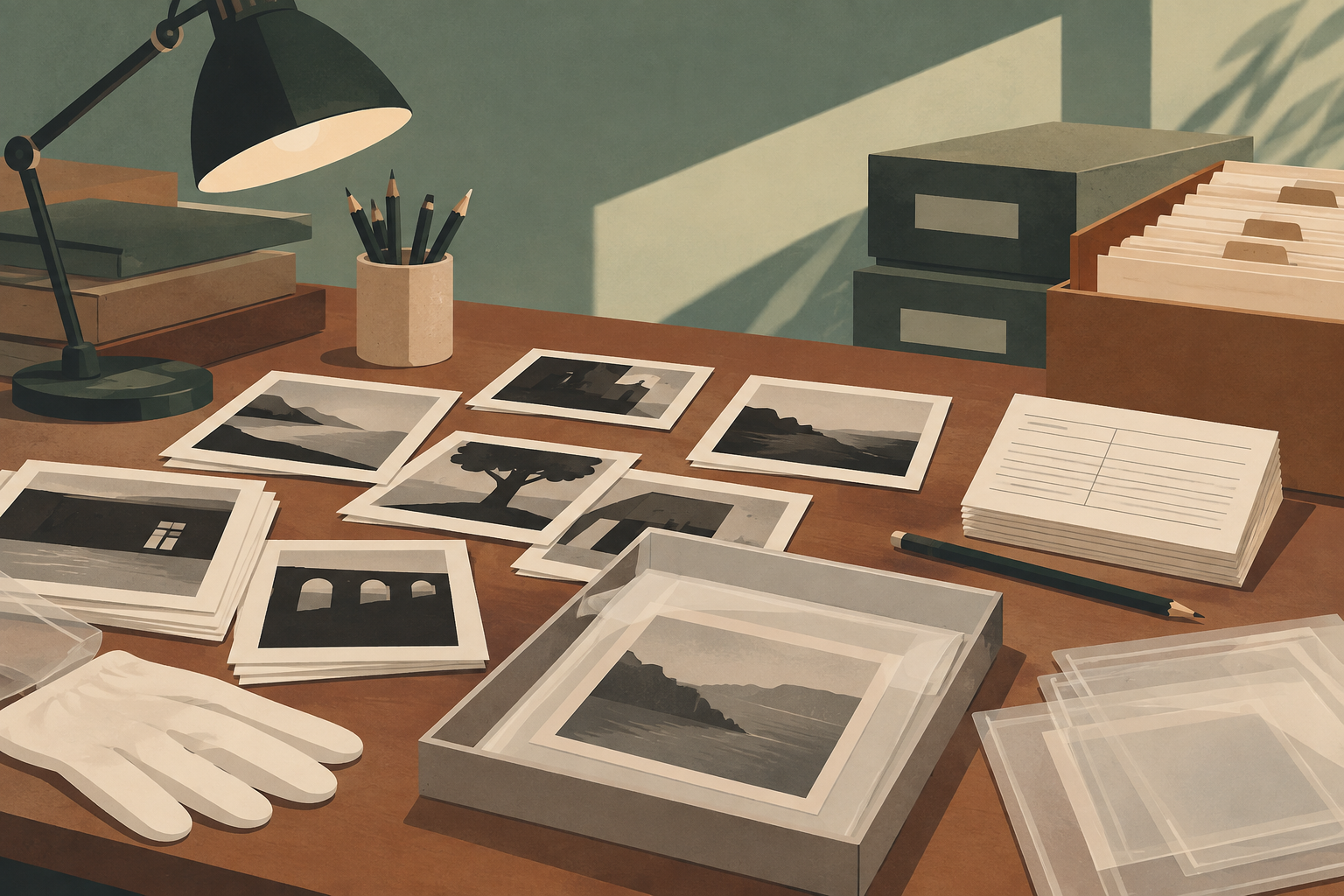
The photographic archive of the Museo Arqueológico Nacional includes material produced by the museum from its founding in 1867 to the present, as well as donations and purchases, according to the available description. This matters because it discourages us from imagining the archive as a set of images with a single origin. Here, different routes into the collection are described, along with a relationship to the museum’s work. The institution itself emphasizes the documentary value of holdings with varied subjects, chronologies and types.
The IPCE Fototeca preserves nearly half a million images, dating from 1844 to today. That figure and time span indicate the collection’s breadth, but do not, on their own, tell us how each group was formed or what information exists about each image. For readers, the distinction is essential: a general description helps explain an institution, but cannot replace consulting the record for a particular photograph.
There is no single kind of archive
The Museo de Zaragoza describes its archive as a collection built over the institution’s history and made up of images with varied origins, subjects and techniques. This characterization echoes the diversity noted by the MAN and the IPCE, but does not justify treating the three collections as equivalent. Their histories, organizational methods and associated documents may differ; the information provided does not allow us to compare them in detail.
These examples do show that “photographic archive” names a composite reality. It can include photographs made by an institution as well as material received through donation or purchase; it can bring together different subjects and techniques. Such features make the question “What does this picture show?” insufficient when we want to understand its documentary place. We should also ask who preserved it, how it entered the collection and what description the institution provides. If those details are absent from the material consulted, they should not be replaced with conjecture.
Preservation is not the same as explanation
The existence of institutional collections and academic work on photography and archives allows us to distinguish two related but different tasks: maintaining images and making their context intelligible. The title of Isabel Argerich’s article, Photography and Archive, signals a framework for considering that relationship. Other works in the evidence concern historic photography collections related to Aragonese art and a documentary analysis of underground photography through the fanzine Rockocó and the Miguel Trillo Archive at the Reina Sofía Museum.
The available titles and metadata identify those subjects, but do not justify attributing specific arguments to articles whose contents are not documented here. They do show that research can approach archived photography through different collections and questions: historic holdings, publications and archives associated with a cultural practice. The editorial lesson is simple: do not present a general interpretation as the conclusion of a study whose contents have not been consulted.
Treat absences with care
A catalogue record may be brief, a date may refer to a collection rather than an individual print, and a collection may be described at an institutional level. The available evidence does not provide individual image records, complete access policies or detailed accounts of conservation processes. We therefore cannot infer the physical condition of a photograph, the precise conditions for consulting it or the history of a particular item.
That caution does not make archives useless. It helps separate what is known from what requires a more specific enquiry. An institutional overview can provide context and indicate the scale of a collection; an individual record, when available, may supply more precise information about an image. These are different levels of information and should not be confused. Guided tours and public-facing resources can introduce visitors to an institution, but cannot, by themselves, replace documentation for each object.
The archive changes the question
Looking at a photograph in an archive is not only a matter of searching for a recognizable scene. It also means attending to the conditions that make it possible to find and describe the image, and acknowledging the limits of the information available. The holdings of the MAN, the IPCE and the Museo de Zaragoza allow us to speak cautiously about diverse collections and a documentary dimension that the institutions consider significant. The cited academic works place the relationship between image, archive and analysis in different settings, although the evidence provided does not allow us to summarize their findings.
The archive is not a neutral frame added after the photograph: it is part of the context through which an image can be consulted and read. But neither does it authorize us to fill silences with an imagined story. Responsible reading combines attention to the image, consultation of its documentation and clarity about what we still do not know. Preservation does not close the meaning of a photograph; it makes it possible to ask new questions with better evidence.
- Decade
- Contemporary
- Region
- Spain
- Level
- Enthusiast
- Entities
- Museum, Museo Arqueológico Nacional
Sources and references
- Fotografía y archivodoi.org · 2026-09-30
- Fondos de fotografía antigua sobre el arte aragonés en la Biblioteca Nacional y unas notas sobre el Museo del Prado y el Archivo Histórico Nacionaldoi.org · 2026-09-30
- Una mirada documental de la fotografía underground a través del fanzine Rockocó. Análisis del Archivo Miguel Trillo en el Museo Nacional Centro de Arte Reina Sofía (MNCARS)doi.org · 2026-09-30
- Fototeca - Instituto del Patrimonio Cultural de Españaipce.cultura.gob.es · 2026-09-30
- La conservación de la fotografía en el Museo de Zaragozawww.museodezaragoza.es · 2026-09-30
- Archivo fotográfico - | Ministerio de Culturawww.man.es · 2026-09-30