A home-movie reel and a VHS tape may preserve the same family holiday, but their images are recorded on very different materials. Motion-picture film combines a plastic base with an emulsion that contains the image; magnetic video depends on tape and compatible playback equipment. Understanding that distinction helps prevent tests that could damage an original and guides more appropriate preservation choices.
If you suspect a film may be nitrate, or find material that is mouldy, stuck, brittle or warped, do not play or clean it. External observations can help prepare for a consultation, but they are not a substitute for an audiovisual conservator’s assessment.
Identify formats without forcing them
Start with existing labels, containers and documentation. Record the indicated format, content, known dates and who made the recording. A photograph of the container and its inscriptions may be useful; do not peel off labels or open cartridges to look for more information.
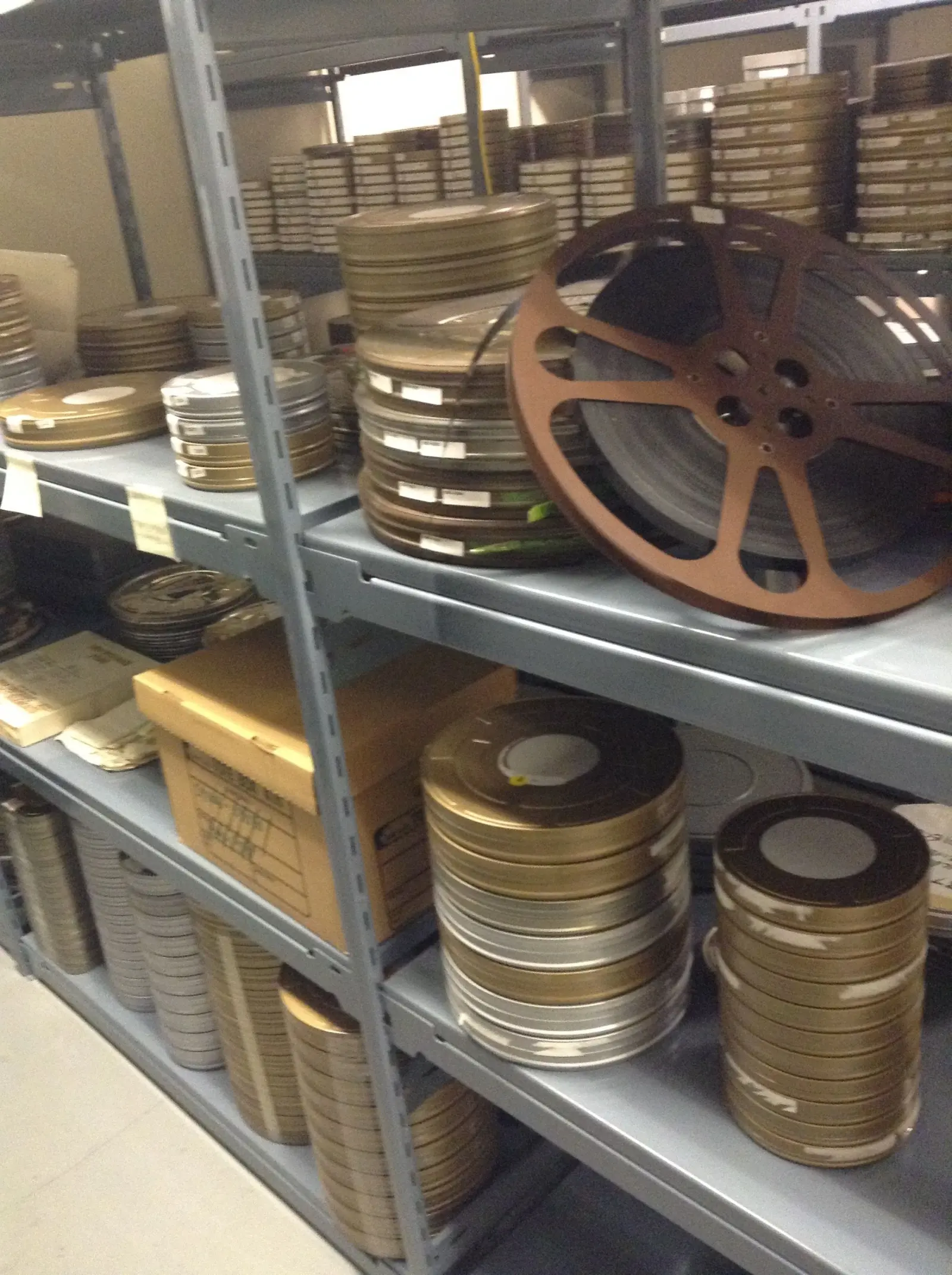
Motion-picture film is usually a flat roll or reel and may show frames and perforations. Video images require a playback device. VHS, Betamax, Video8 and MiniDV, among other formats, are not interchangeable: each depends on its own system and equipment. A label or the outside appearance may offer clues, but neither confirms the material or its condition on its own.
Motion-picture film has three main base types: nitrate, acetate and polyester. Acetate was widely used for safety film, including much home-movie stock; polyester is more resistant to certain forms of decay. Nitrate film is flammable and was not used for ordinary home movies, but an inherited collection may include professional material from another source. The date of the event recorded does not necessarily tell you when the print was made.
Nitrate: a safety issue
Cellulose nitrate is highly flammable and can become more hazardous as it deteriorates. Its decomposition can release acidic gases that also damage containers and other materials. Identification should not rely on a home test or a photograph. If there is reason to suspect nitrate, do not project the film, bring it close to your face to smell it, or test it with fire or solvents. Do not put it in household rubbish, mail it, or improvise a solution in a domestic refrigerator or freezer.
Contact a film archive or audiovisual conservator before opening, moving or transporting the material. If you see smoke, heating or an immediate danger, move away and contact emergency services. Nitrate requires specialist storage and custody; it does not belong in the same cupboard as ordinary family films.
Acetate and vinegar syndrome
Vinegar syndrome is a form of deterioration of the acetate base. The process releases acetic acid and can accelerate in warm, humid conditions. An incidental vinegar smell is a reason to seek advice—not a reason to open cans deliberately to check.
As deterioration progresses, film may shrink, lose flexibility, curl and warp. A brittle or shrunken reel can break in a projector or scanner. Professional cold storage with controlled humidity can slow the process, but it cannot reverse the damage or restore the base.
A-D strips are used to assess acidity, including before an odour becomes apparent. Their use and interpretation require the appropriate procedure. Do not try to neutralise the acid with household products or treat the film yourself; ask for guidance on handling and separating affected material.
The image can fade while the film remains intact
Dyes in colour film change chemically over time. Some fade faster than others, so an image may take on a magenta or purplish cast even while the base retains its shape. The course of deterioration depends on the film type and its storage history; there is no universal expiry date.
Black-and-white film can also change, including through the metallic sheen known as silvering. The emulsion may be scratched, flake off or be affected by mould. A more stable polyester base does not make an image indestructible.
Digitisation records the information still present in the original. Colour correction may improve an access copy, but it cannot guarantee the recovery of information already lost. Keep the original capture and note any adjustments, so it can be distinguished from a restored or interpretive version.
Videotape: different damage, and disappearing players
Magnetic tape can suffer binder deterioration, loss of magnetic coating or a distorted tape pack. Layers may stick together, and mould or damage to the cassette shell can also occur. Sticky-shed syndrome is a specific problem involving binder breakdown, also called binder hydrolysis. Not every case of shedding, sticky tape or jamming has that cause: similar-looking problems may require different treatments.
Some heat-based techniques are used in professional settings as a temporary preparation for recovering a particular recording. They are not a general repair and do not justify baking tapes at home. Do not use hair dryers, alcohol or household cleaners, and do not open the cassette to separate layers or clean the tape. The Library of Congress notes that magnetic-tape cleaning is delicate work for specialists.
The playback machine matters too. Players age, parts become hard to find, and formats fall out of use. MiniDV records a digital signal, but it still depends on a physical medium and equipment that can read it. “Digital” does not mean immune to deterioration.
Do not use an irreplaceable recording to test a questionable player. If an attempted playback produces unusual noise, jamming, residue or uneven movement, stop using the equipment. Picture or sound problems may come from the tape, the player or the transfer; they do not identify the cause by themselves.
What to note without handling the material
Limit observations to what is already visible on the outside of a container or, if the casing is intact and safe, through its window. Do not unwind film or tape to look for signs, and do not open suspect containers.
| Known or externally visible sign | What to do |
|---|---|
| A label mentions nitrate, or the provenance of an old 35 mm film is uncertain | Consult a film archive before opening, playing or moving it. |
| An incidental vinegar smell, warping or brittle fragments | Do not play it; request a professional assessment. |
| Fluff, dust or marks that may be mould | Avoid contact; do not brush or vacuum it, and ask how to isolate the material. |
| A broken shell, uneven winding or layers that appear stuck | Do not open, rewind or attempt a repair. |
| Altered colours in a print already being viewed | Record what you observe and consider transfer without projecting it again for comparison. |
The absence of visible signs does not prove that a medium is in good condition. An inventory with photographs, labels, observed symptoms and any known history of dampness can help a specialist plan an assessment without asking the owner to conduct further tests.
A stable environment for identified materials
For identified home movies and tapes with no warning signs, aim for a clean, cool and stable space. Avoid direct light, radiators, hot attics, garages, damp basements and areas at risk of leaks. Keep the collection off the floor, where it may be exposed to water, insects or rodents.
Archival recommendations vary according to the medium and preservation goal. Film and magnetic tape should not be treated as if they were the same material: cold-storage guidance for certain films does not automatically apply to video or to a household freezer. A cold-storage programme requires suitable conditions and packaging; changing temperatures without advice can also create condensation problems.
Store healthy film cans horizontally and videotapes upright in their cases, without stacking them on top of one another. Keep labels and provenance information. For identified film, use compatible enclosures and avoid rusty or broken containers. Do not seal reels in airtight bags at room temperature as a universal solution. Decisions about isolating mouldy material or placing nitrate in custody should be made with professional advice.
Less handling, fewer risks
Work on a clean, uncluttered surface and keep food and drink away. Hold videocassettes by their shells, not by the tape or internal reels. Do not rewind tapes periodically to “stop them sticking” or make repeated playbacks just to check them.
If an identified, stable film needs handling, avoid touching the emulsion and seek instructions appropriate to that material. Do not try to repair perforations, lubricate or clean deteriorating film, or use ordinary adhesive tape on a splice. A projector that powers on is not necessarily safe to run film through.
Digitise with care
Home digitisation can be an access option for sound material and verified equipment. It is not a prudent choice when the medium is unknown, damage is apparent, the playback machine is unreliable, or a recording is unique and there is no margin for loss.
Filming a projection with a phone can make a viewing copy, but it is not equivalent to a preservation scan. For video, a capture device alone does not guarantee a transfer that adequately preserves picture, sound and continuity. Quality depends on the original, the player and the entire transfer chain.
When contacting a laboratory, describe the format, quantity, known condition and significance of the recording. Ask whether the medium will be assessed before playback, how problems will be documented and which files will be delivered. Distinguish a preservation master, intended to retain as much information as possible, from an access copy, designed for convenient viewing and sharing. No transfer can guarantee the recovery of images or sounds that have already disappeared.
Preserve the digital files too
Digitisation does not finish the work. Keep multiple copies on different devices or in different locations, and use clear names and documentation to link each file to its reel or cassette. The US National Archives recommends three copies on different media and advises against relying on the cloud alone. Check periodically that the files open; checksums can help detect changes to the data.
Keep original materials, labels and documentation after transfer when their custody is safe and practical. If nitrate or another hazard is involved, agree with a specialist on who can take responsibility for the material. A copy makes the images easier to watch; preserving the originals and documenting the process keeps more options open for future study and recovery.
- Decade
- Contemporary
- Region
- Global
- Level
- Introduction
- Entities
- VHS, Sounds
Sources and references 13
- NFPF — Nitrate Degradationwww.filmpreservation.org · 2026-11-13
- NFPF — Vinegar Syndromewww.filmpreservation.org · 2026-11-13
- NFPF — Color Dye Fadingwww.filmpreservation.org · 2026-11-13
- NFPF — Good Storage Practiceswww.filmpreservation.org · 2026-11-13
- National Archives — Important Characteristics of Motion Picture Film Formatswww.archives.gov · 2026-11-13
- National Archives — Determining the Condition of Motion Picture Filmwww.archives.gov · 2026-11-13
- National Archives — Storing Motion Picture Filmwww.archives.gov · 2026-11-13
- Library of Congress — Care, Handling, and Storage of Audio Visual Materialswww.loc.gov · 2026-11-13
- National Archives — Storage of Video Materialswww.archives.gov · 2026-11-13
- National Archives — Playback and Digitization of Video Materialswww.archives.gov · 2026-11-13
- National Archives — Playback and Digitization of Motion Picture Filmwww.archives.gov · 2026-11-13
- National Archives — Ensuring Future Usability of Digital Videowww.archives.gov · 2026-11-13
- National Archives — Condition Assessment of Magnetic Media: Videowww.archives.gov · 2026-11-13