The image is not enough
An archival photograph can seem self-contained: it offers a scene, an object or a face at a single moment. But that appearance does not, by itself, explain how the image was made, what support carries it or why it was produced. A careful reading separates what is visible from what the documentation allows us to claim. This is not a minor qualification: it is the difference between describing an image and turning it, without evidence, into a complete story.
Visual documentation of collections has a specific purpose: recording objects to support their identification, as Ibermuseos’s protocol explains. That purpose gives the photograph a particular use. It is not necessarily an image made to narrate a scene or express an artistic intention; it may primarily serve as a record. Recognising this function helps us ask better questions about framing and missing information.
Support and process: questions before answers
Asking about a photograph’s support does not license guesswork. A print, a negative and a digital image raise different preservation and access questions, but the appearance of a reproduction alone cannot establish the original process. If a record does not identify the material or process, that absence should remain a limit rather than be filled with a plausible attribution.
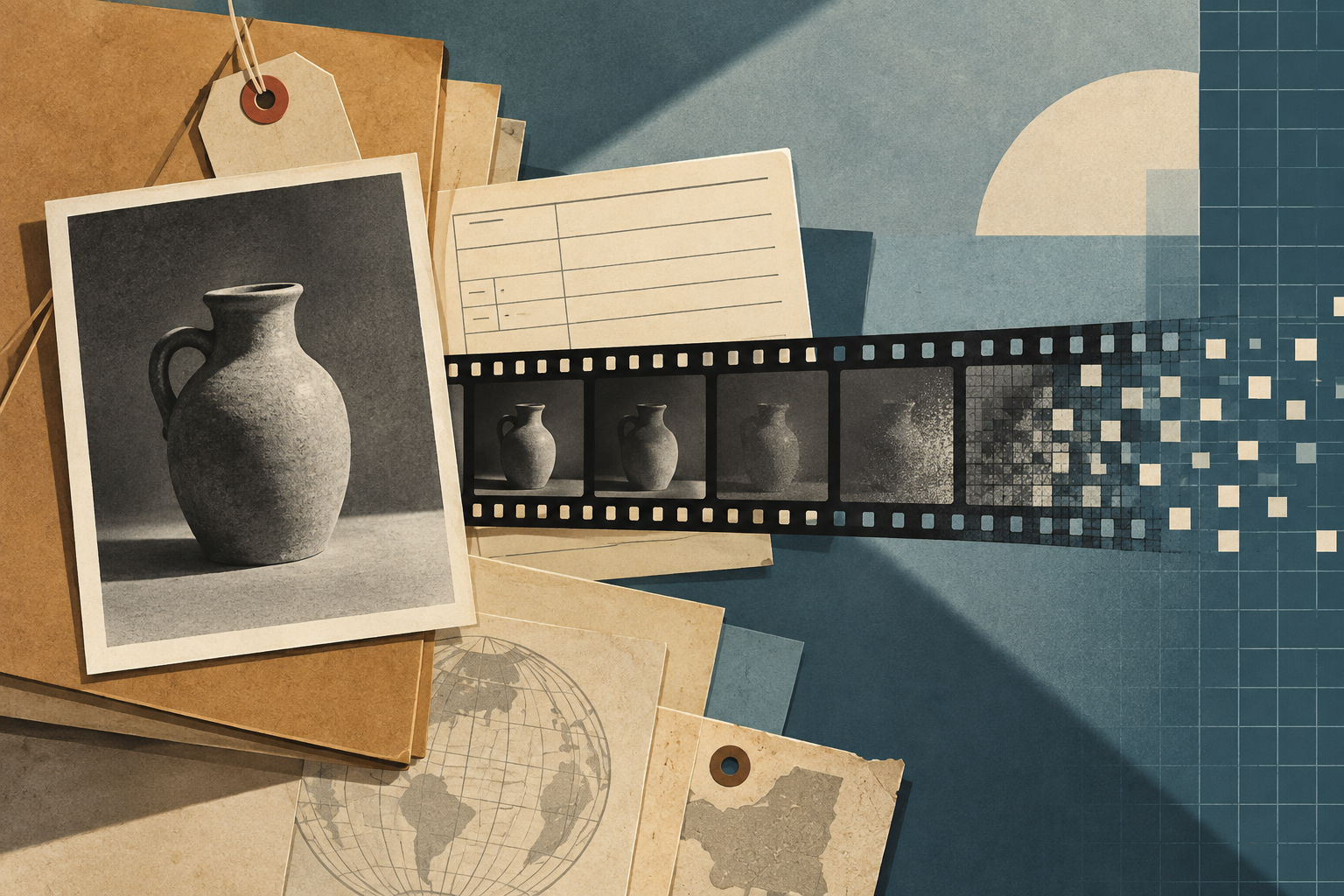
The Banco de España Photographic Archive exhibition, described as a journey “from albumen to pixel”, makes the range of supports and periods within one archive visible. The available information describes a photographic collection of 25,000 images and an exhibition that could be visited until 20 July 2024. This allows us to discuss diversity as a frame for interpretation, but not to assign a particular process to each photograph without consulting its individual records.
Identification is not the whole story
A documentary photograph may help identify an object, but identification does not necessarily establish who made the image, when, under what circumstances or for what purpose. The study of press photographic archives emphasises the value of recording information about the producer and the dates when photographs were generated. The methodological point is that preserving such data alongside the image can expand research possibilities. It does not mean every collection has those details, nor that an archival date is automatically the date of exposure.
The image and its description complement one another, but they are not interchangeable. A caption may add information that cannot be seen; it may also be incomplete, later in date or in need of review. Editorial work should distinguish what the photograph shows, what its record states and what the analysis proposes as interpretation. When these layers are presented together without marking their differences, the reading can seem more certain than it is.
Materiality is part of the archive too
Treating a collection only as a group of visible scenes leaves out the material conditions of its images. A text on the materiality of photographic archives, discussing holdings at the Biblioteca Pública Piloto, invites attention to the relationship between image, support and archive. The supplied evidence does not justify attributing more detailed arguments to that text; it does support materiality as a relevant line of inquiry.
Access also changes when an image is reproduced or digitised. An accessible copy can make study easier, but it should not be confused with the original object or treated as a complete account of its history. A grid on a screen can help compare and locate images; it does not automatically reveal how they were stored, handled or described before that consultation. Those questions require specific records.
Photography and video do not work in the same way
A photograph fixes a moment; video organises a temporal sequence. An academic article on time and rhythm as distinguishing features of photography and video offers a starting point for avoiding the assumption that the media are equivalent. The distinction matters when describing audiovisual documents: a still image does not preserve the development of an action, while video includes duration and rhythm. Yet this general difference should not become a claim about a particular photograph without knowing its context.
Production and use also guide interpretation. An image made to record an object, a press photograph and an image intended for another use may look similar while answering different questions. The supplied evidence does not identify individual cases that would allow us to reconstruct those situations. Here, comparison is therefore a research method, not a history of particular uses.
What can be claimed
The available examples point to three complementary practices: making photographs to identify objects, preserving collections that span different supports and processes, and recording production information when it is known. They also show a limit: general references cannot replace an individual photograph’s record or, by themselves, prove who made it, when it was made or what process was used.
Reading an archival photograph means attending both to the image and to the conditions that allow it to be located, described and compared. When support and process are documented, they can explain specific possibilities of production and preservation. When they are not, the question remains open. Such restraint does not impoverish interpretation; it prevents the archive from seeming to say more than it actually preserves.
- Decade
- Contemporary
- Region
- Spain
- Level
- Enthusiast
- Entities
- No linked entities
Sources and references
- El factor temporal y el ritmo como distintivo entre fotografía y vídeodoi.org · 2026-10-07
- protocolo-documentacion-visual.pdfwww.ibermuseos.org · 2026-10-07
- El valor de una exposición: “Archivo fotográfico del Banco ...www.bde.es · 2026-10-07
- ARCHIVOS FOTOGRÁFICOS DE PRENSArevistas.ucm.es · 2026-10-07
- Más allá de la imagen: las materialidades de los archivos ...lavidadelosarchivos.substack.com · 2026-10-07