A past that can also be discovered
Japanese Heisei retro brings together people who recognize objects from childhood and those encountering them for the first time. That coexistence invites us to look beyond nostalgia. Alongside asking what people remember, we can consider how they access this material culture today through reissues, digital channels and new fan practices.
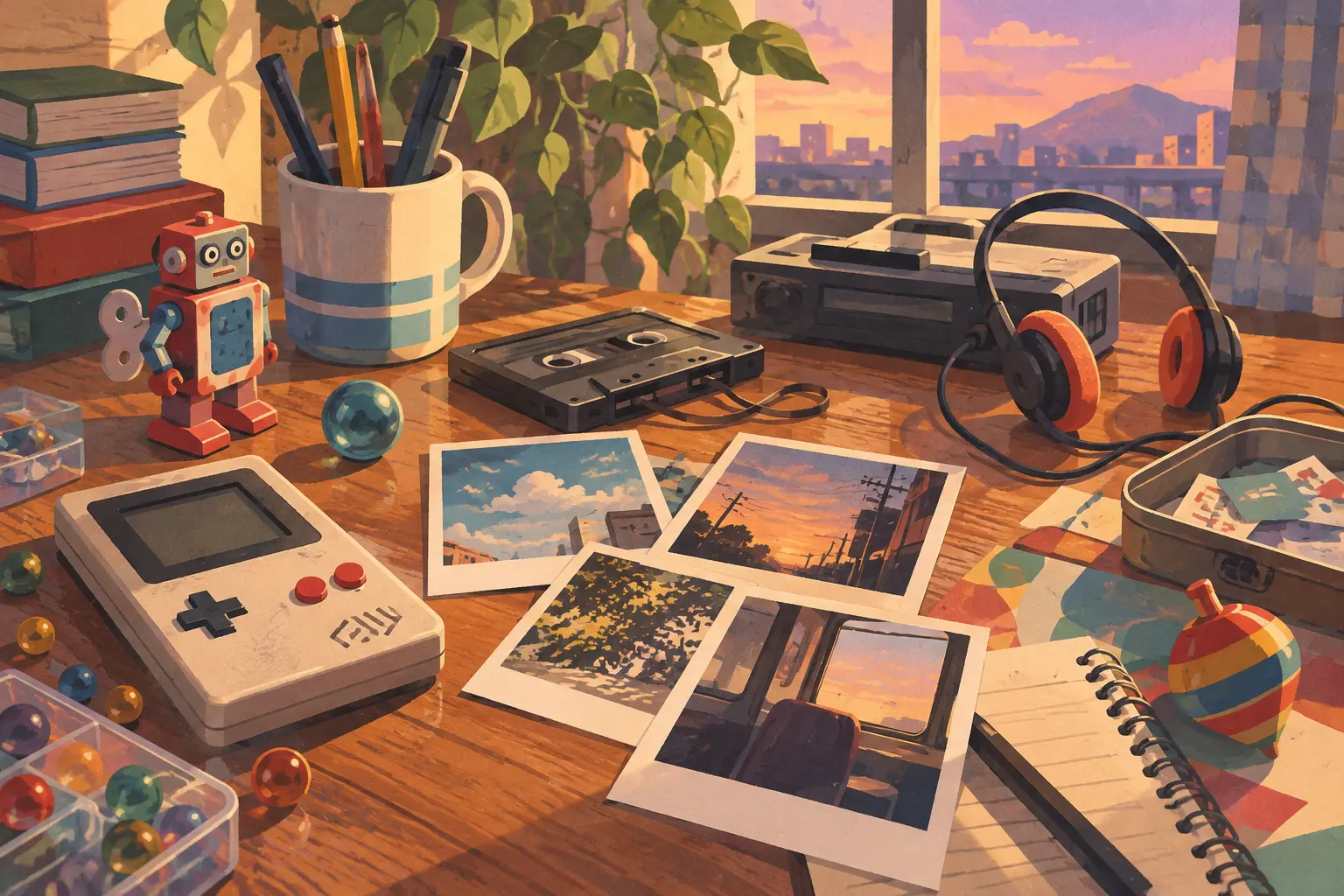
The Heisei era ran from 1989 to 2019, and its reference points vary with age and experience. For some, they are purikura booths and handheld consoles from the 1990s; for others, stickers, virtual-pet toys or mobile-phone decoration from the 2000s. Y2K overlaps with part of this repertoire but does not encompass it: the term describes an aesthetic associated with around the year 2000, not the full diversity of the period. Likewise, Heisei girls’ culture—often linked to stationery, toys and stickers—does not represent a universal experience. Memories depend on age, place and personal circumstances.
The object, and the gestures that went with it
The original Tamagotchi went on sale on 23 November 1996. Its compact shell, small screen and three buttons shaped a care-based game: feeding the character, cleaning its space and watching it grow. Carrying it on a strap allowed it to accompany other everyday activities. Continuity with later versions lies not only in the name or egg shape, but also in how each product organizes care, interaction and play time.
Tamamori stickers reveal another dimension of use. The line first went on sale in 2011 and was reissued in January 2026 alongside collectible albums. Because they can be repositioned, users can layer accessories over characters and create different looks. Their appeal lies in a sequence of actions: choosing, combining, changing and showing. Restoring that open-ended, hands-on possibility is not the same as printing an old illustration on a new object that offers no way to interact with it.
Purikura, a name derived from Print Club, appeared in 1995 as an experience tied to a particular place: choose a frame, take a photo and receive an adhesive print. Cutting up and sharing the images with friends was part of using the machine, as was spending time together at the venue. Current machines offer capture and retouching features, as well as ways to obtain digital files. A photo taken in a booth today therefore does not simply reproduce the 1995 experience: both the technology and the circulation of the image have changed.
Older works, new ways in
Older works and songs do not necessarily reach audiences in release order. Someone might discover an anime through a recent production or a song through an official channel, then seek out earlier versions. In a franchise such as Sailor Moon, manga designs, the classic television series and later productions are related references, but they are not identical. Naming the period and medium of a design helps clarify which version a new product is revisiting.
Music presents a similar dating question. TRF’s “BOY MEETS GIRL” is identified as a 1994 song. A recording available today, however, may correspond to the audio from a greatest-hits album released in 2007, while the digital video has its own publication date. The original release year, album edition and video publication date are separate facts. Anyone wishing to listen to or collect a work should check the edition and track listing rather than assume that a familiar title identifies a particular recording.
Video games also require a distinction between owning the historical object and accessing the game. The Game Boy appeared in 1989. Anyone looking for a period console and cartridge must consider hardware condition and compatibility; playing through a current service depends on its terms and supported devices. Both routes offer access to the titles, but their material forms and uses differ. A reissue can preserve a recognizable silhouette without necessarily reproducing the original’s handling, specifications or context of use.
Reissuing means choosing what to preserve
Retro initiatives can bring back an original product, adapt historical imagery for objects with new uses, offer an in-store or exhibition experience, or republish music and video. Each format preserves different things. A toy reissue may emphasize form and play; a collaboration, imagery and its place in everyday life; an exhibition, history and context; a digital release, access to the work. Treating these formats as interchangeable obscures both design choices and audience expectations.
The initiatives announced for Tamagotchi’s thirtieth anniversary illustrate this variety: a permanent Harajuku store and a touring commemorative exhibition from 2026 were announced. Alongside new toys and reissues, these formats offer different ways to approach the franchise. They do not, by themselves, establish commercial results or guarantee that the experience of the past can be reproduced exactly.
The return of Heisei objects does not depend on nostalgia alone. A sticker can be new to someone who never owned one; a song can be discovered decades after its release; a particular object can become a point of conversation across generations. Current practices of decorating, photographing, collecting and sharing have affinities with some forms of participation from that period, but resemblance does not prove direct continuity or a relationship of origin.
A useful comparison asks what form has been preserved, what materials or functions have changed, what actions the product enables, and the context in which it circulates now. This makes it possible to assess a contemporary reinterpretation without mistaking it for the original. The past is not an experience one must have lived to enjoy; describing its context precisely helps show what is being recovered and what is being transformed.
- Decade
- Contemporary
- Region
- Japan
- Level
- Enthusiast
- Entities
- Game Boy, Anime, Tamagotchi
Sources and references
- Modelo multidimensional de los factores que afectan la interacción entre marketing y ventas en el lanzamiento de nuevos productos en Latino Américadoi.org · 2026-11-05
- Por qué el estilo retro Heisei renació como actividad fan en ...oshifuturelab.com · 2026-11-05
- Nintendoes.wikipedia.org · 2026-11-05
- Ponges.wikipedia.org · 2026-11-05
- 32Xes.wikipedia.org · 2026-11-05