The past as material, not a template
When Lady Gaga released The Fame in 2008, the proposition extended beyond sound: music, image and performance formed a connected project. The album drew on recognisable elements of 1970s glam rock and 1980s electronic pop, but it did not aim to recreate either period. Instead, it rearranged those idioms as danceable pop for a media environment in which videos, television and the internet widened the circulation of songs and images.
The distinction between quotation and imitation helps explain the record. Glam supplied theatricality and the idea that artistic identity could be built as a stage persona. Gaga connected that sensibility with David Bowie and Queen. Electronic pop contributed synthesizers, dance pulses and direct song structures. On tracks such as “Just Dance” and “Poker Face,” these elements became immediate hooks while also supporting a carefully staged persona.
Gaga described the album as a celebration of pop culture and the possibility of feeling famous. Fame is not presented only as the privilege of a remote celebrity; it is also a feeling anyone can project and share. That invitation broadens the title’s meaning. The audience is not simply asked to look at a star, but imaginatively to enter the world the record presents.
A work meant to be seen as well as heard
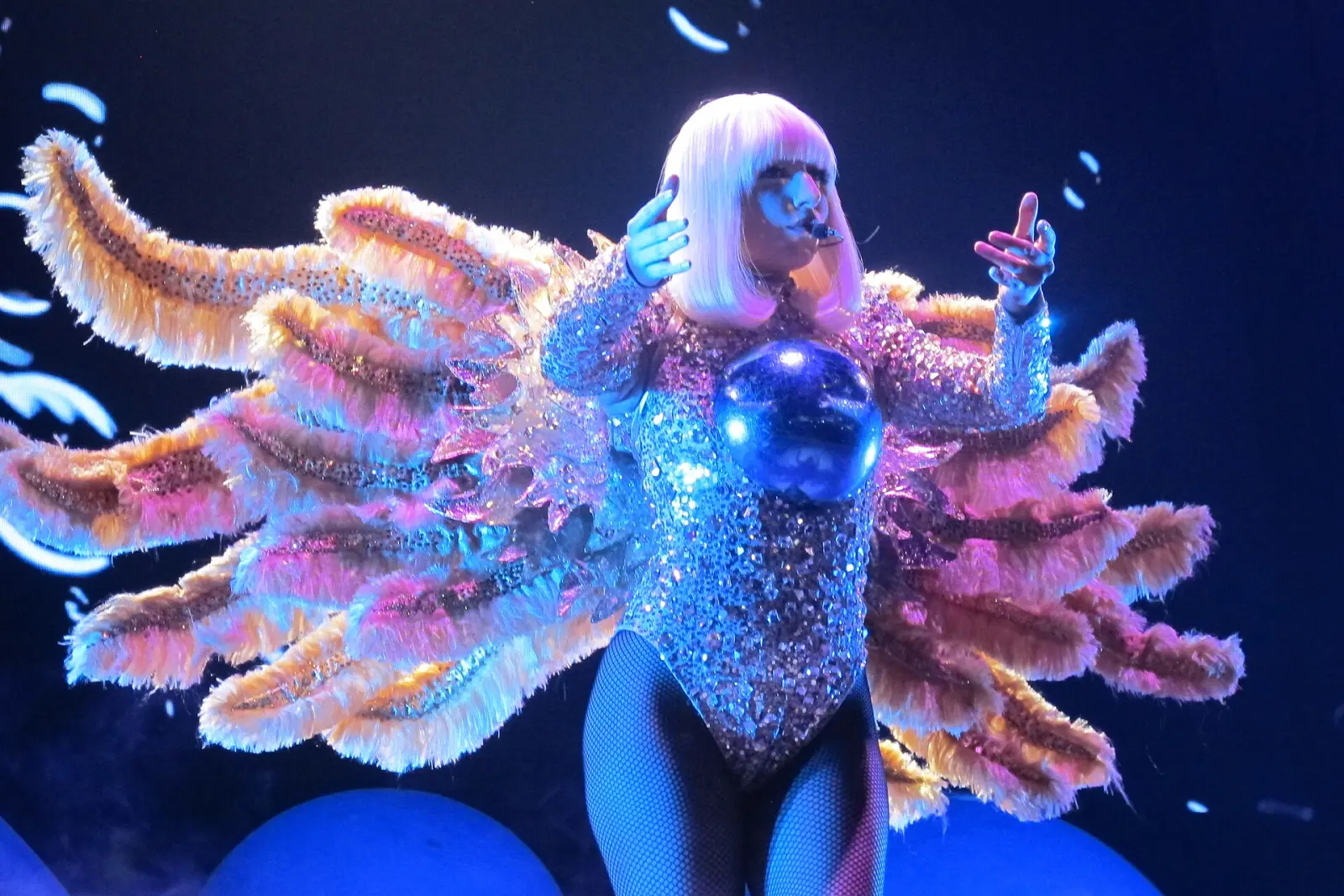
In statements about the project, Gaga emphasised that pop music should be experienced alongside an artist’s image and performances. Haus of Gaga, her creative team, helped shape that visual dimension. Theatricality was therefore not an embellishment added after the songs were recorded: it was part of how the album communicated.
This approach updated glam’s emphasis on spectacle for a different media culture. Music videos, television appearances and online circulation could extend an artist’s presence beyond the stage or the record itself. Image helped make the songs recognisable while presenting an identity that was changeable and deliberately constructed. Rather than separating music from promotion, The Fame made them work as related parts of one pop proposition.
The songs also complicate that glossy surface. “The Fame” and “Paparazzi” address the desire for recognition and the public gaze; “Poker Face” plays with the distance between what is shown and what is withheld. Fame emerges as an appealing construction, but one shaped by performance, image management and ambiguity. That tension connects glam staging to an increasingly mediated celebrity culture.
From New York clubs to international circulation
The album’s development began before its release. Gaga wrote and performed songs in New York bars and clubs, and used Myspace to promote her work. The Fame took approximately two years to develop and involved producers including RedOne, Rob Fusari and Martin Kierszenbaum. Gaga later moved to Los Angeles to complete the record and develop her creative team.
That passage—from club culture and online self-promotion to a label-backed release—helps place the project’s combination of artistic self-fashioning and mass-market ambition. An online presence could help build an audience before the songs circulated more widely. Singles, videos and television performances then reinforced an identity that could travel across markets.
The album first appeared in Canada in August 2008, then reached other territories over the following months, with release dates and editions varying by country. “Just Dance” and “Poker Face” became international hits, and the album reached number one in Canada and several European countries. Technology did not replace the record’s musical references; it changed the reach and speed with which its sounds and images could circulate.
Between continuity and formula
The Fame retained glam’s emphasis on visual transformation, theatricality and the possibility of turning identity into spectacle. From electronic pop it drew synthesizers and a dance pulse. Its most significant move was to integrate those idioms into a work where songwriting, persona and media circulation reinforced one another. The past was not a historical reconstruction, but a repertoire available for making something that sounded contemporary.
The initial response reflected a debate that often accompanies stylistic revival. Several reviews praised the production’s energy and the effectiveness of its hooks; others felt that the record favoured spectacle over musical innovation. The difference allows two readings: reusing familiar codes can be understood as creative continuity, but it can also be heard as a commercial formula. Part of the album’s interest lies in leaving that tension unresolved.
In retrospect, “Just Dance” and The Fame have been placed in accounts of dance and electronic music’s expansion within late-2000s pop. The album’s retro significance is not simply that it points to earlier influences. It lies in bringing them together with online self-presentation, music video and international circulation: inherited codes reorganised for another media culture, made to sound like the present again.
- Decade
- Contemporary
- Region
- Global
- Level
- Introduction
- Entities
- Televisión, The Fame, Internet, Sounds, Revisiones, Lady Gaga
Sources and references
- RESEÑA CRÍTICA DEL EMPRESARIO EN EL PENSAMIENTO ECONÓMICO NEOCLÁSICO, KEYNESIANO Y CONTEMPORÁNEOdoi.org · 2026-11-06
- 2000-2009 | Cronología de la historia de la modatranslate.google.com · 2026-11-06
- Versión (música)es.wikipedia.org · 2026-11-06
- The Famees.wikipedia.org · 2026-11-06
- Girl groupes.wikipedia.org · 2026-11-06